Ritual, Community, and Tradition: The Nine Emperor Gods Festival at Labuan Feng Huang Shan Ba Xian Miao 纳闽凤凰山八仙庙九皇大帝
Text and photographs by Soh Chuah Meng Esmond 蘇泉銘 著
Table of Contents
- Ritual, Community, and Tradition: The Nine Emperor Gods Festival at Labuan Feng Huang Shan Ba Xian Miao 纳闽凤凰山八仙庙九皇大帝
- 1. History of the Persatuan Pengurusan Tokong Feng Huang Shan Ba Xian Miao Jiu Huang Da Di
- 2. Preparations Before the Festival
- 3. Rewarding the Spirit Soldiers Ritual 犒军 (Observed on the first, third, sixth, ninth, and final days of the Festival)
- 4. Consecration of the Nine Emperors Ship 九皇船
- 5. Receiving the Nine Emperor Gods
- 6. Ninefold Offering Ritual 九献礼 (Observed on the first, third, sixth, ninth, and final days of the festival)
- 7. Nine Lamps and Bamboo 高灯竹
- 8. Inviting the Deities to Respond to Devotees’ Questions, 21 October 2025 (First day of the ninth lunar month)
- 9. Preparation for the Crossing of the Pass and Commemoration of the Dipper Star Lords, 22 October 2025 (Second day of the ninth lunar month)
- 10. Collective Offering at the Gate of the Netherworld for Deceased Senior Vegetarian Members and Selection of Censer Masters for the Coming Year, 23 October 2025 (Third day of the ninth lunar month)
- 11. Crossing the Pass of Peace and Longevity, 24 October 2025 (Fourth day of the ninth lunar month)
- 12. Procession to the Labuan City Centre, 25 October 2025 (Fifth day of the ninth lunar month)
- 13. Charity Bazaar and Go Green Clothing Design Competition, 26 October 2025 (Sixth day of the ninth lunar month)
- 14. The Nine Emperor Gods Descend for Blessings, 27 October 2025 (Seventh day of the ninth lunar month)
- 15. Descent of the Nine Emperor Gods for Public Blessings, 28 October 2025 (Eighth day of the ninth lunar month)
- 16. Honouring Dou Mu Yuan Jun
- 17. Concluding Rites and Sending Off of the Nine Emperor Gods 29 October 2025 (Ninth day of the ninth lunar month)
- 18. Formal Conclusion of the Nine Emperor Gods Festival, 30 October 2025 (Tenth day of the ninth lunar month)
- 19. Epilogue: Ritual, Community, and Tradition
- Acknowledgments
1. History of the Persatuan Pengurusan Tokong Feng Huang Shan Ba Xian Miao Jiu Huang Da Di
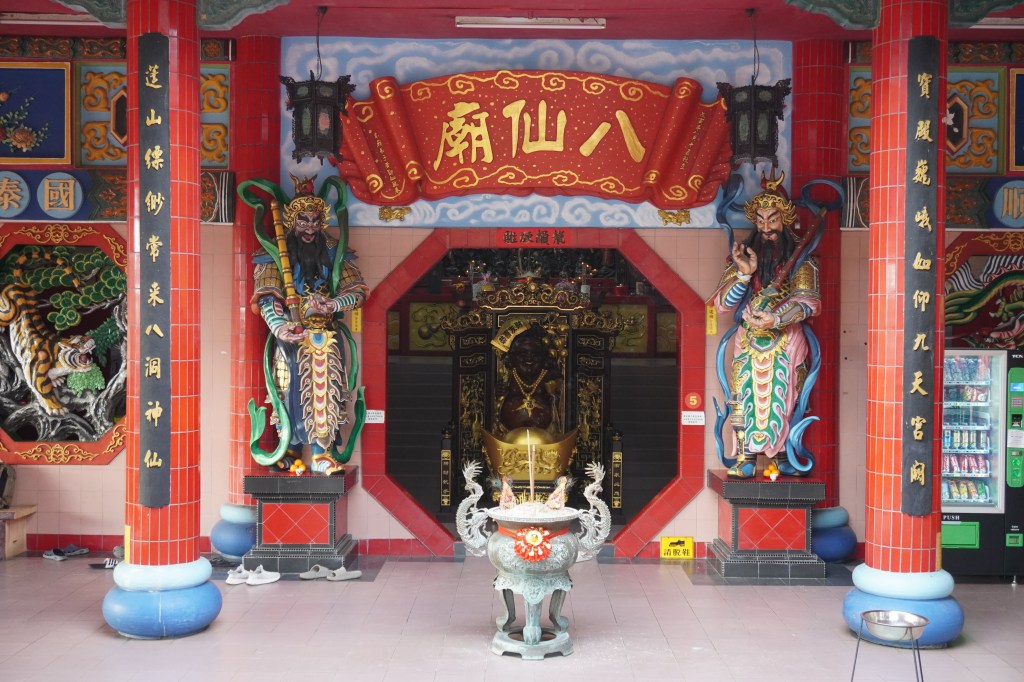
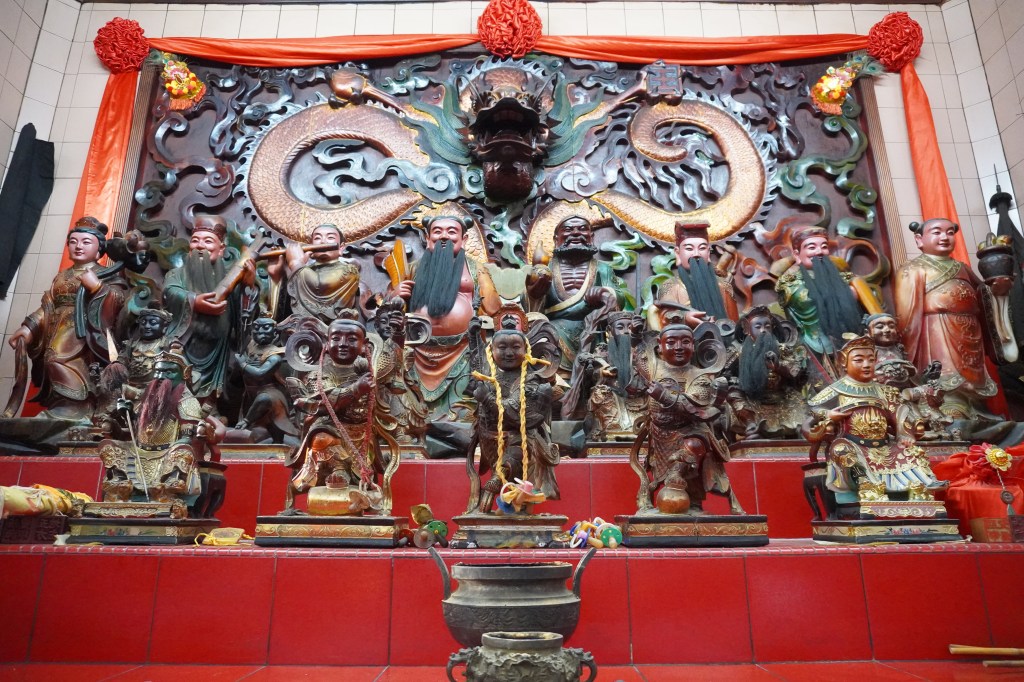
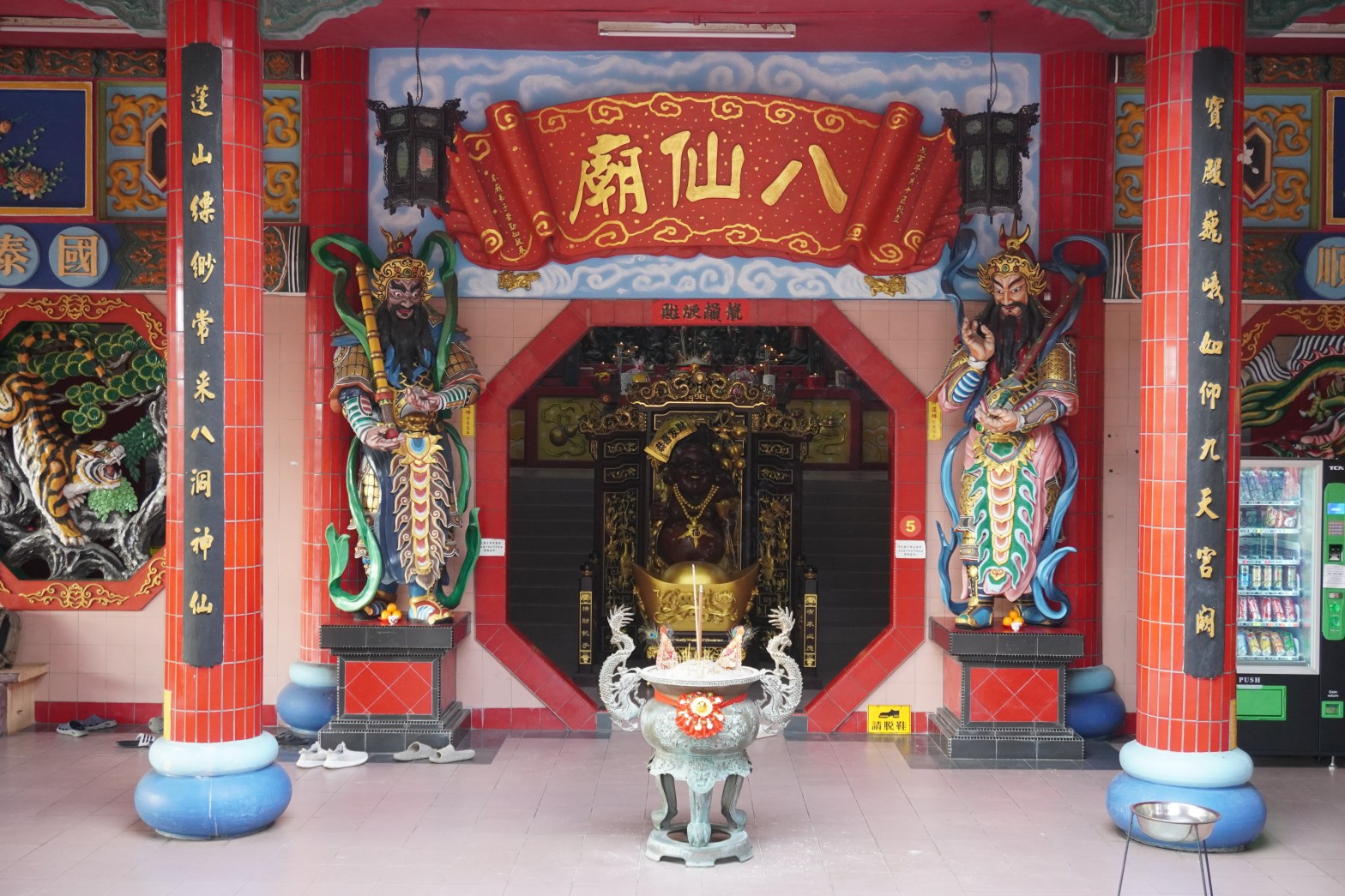
The history of the Labuan Feng Huang Shan Ba Xian Miao begins with Liu Naijing 刘乃敬, a spirit medium who initially conducted ritual work 救世 from his private residence. He belonged to the Lu Shan tradition 蘆山 and maintained long-standing links with Lo San Miaw (Da Ba Wang Gong) Temple in Kuching 古晋蘆山庙大霸王公 and the Fong Hwang San Ur Par Wang Kong Temple in Sibu 砂拉越诗巫凤凰山二霸王公庙, from which the title Feng Huang Shan 凤凰山 was derived. These connections were sustained through regular travel between the respective temples, a pattern of inter-temple circulation that continues to the present day. The principal deity who descended upon Liu Naijing was Immortal Master Iron Crutch Li 铁拐李仙师, who offered guidance and practical instruction through spirit-medium consultations 问事. As a result, the temple developed a primary devotion to the Eight Immortals 八仙, who remain venerated as its resident deities on the first floor of the temple.
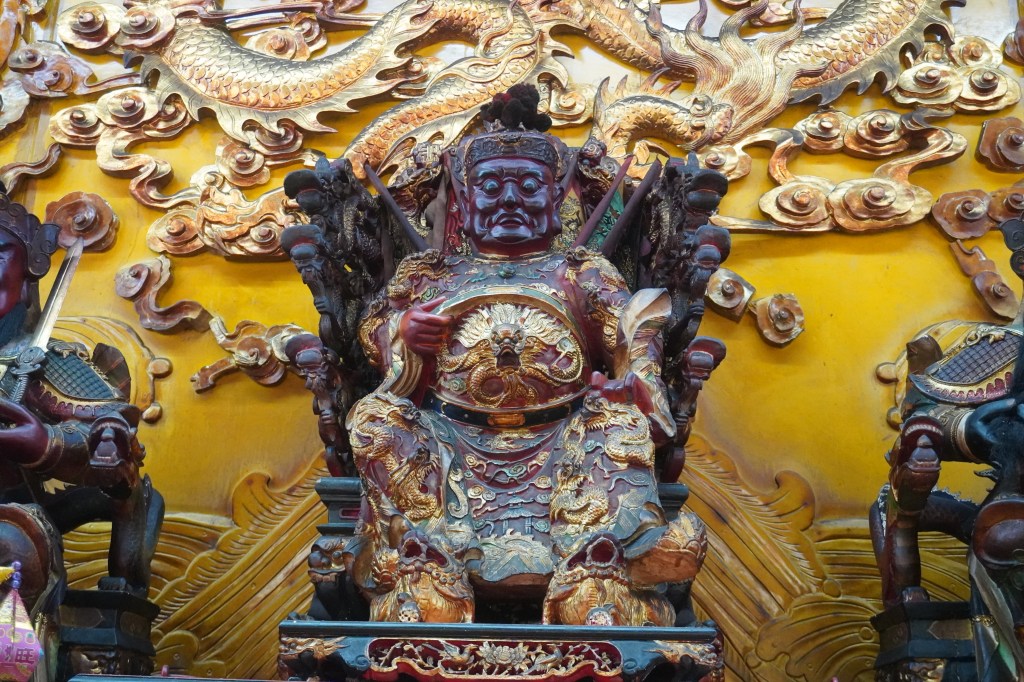
In the early stage of the temple, the Nine Emperor Gods were venerated in the form of a single image.
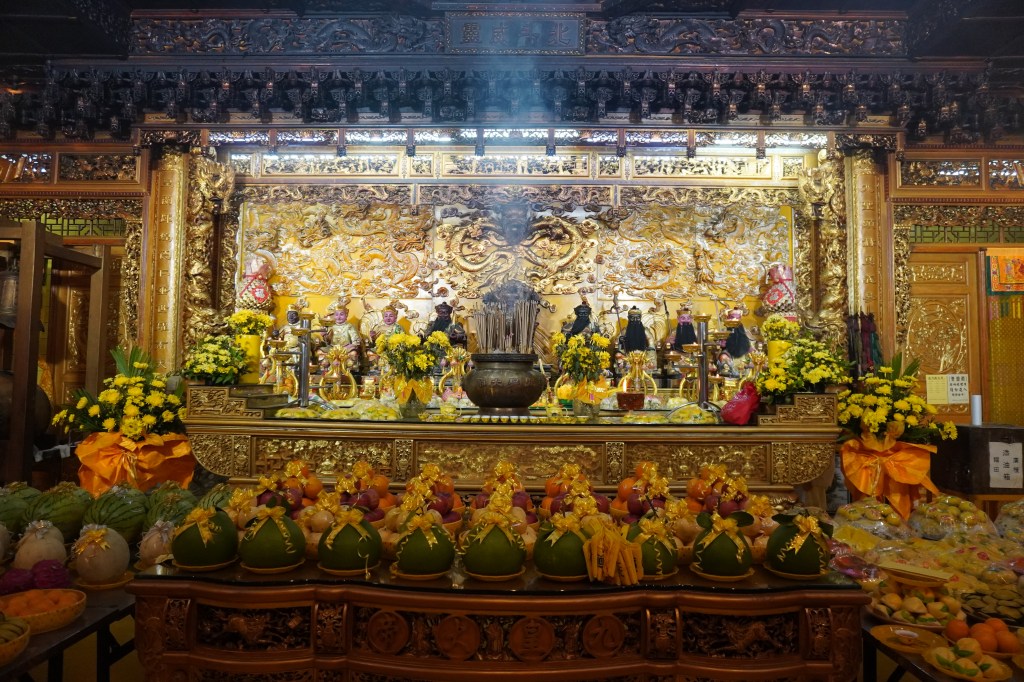
In its early years, observances of the Nine Emperor Gods Festival 九皇大帝千秋 were conducted within Liu Naijing’s residence, known as Ba Xian Ling Tang 八仙灵堂; it was only after relocation to the present site that it was renamed Ba Xian Miao 八仙庙. As the number of devotees increased, the temple relocated to its present site, with construction completed in 1998. At this stage, the building was a single-storey structure, and the Nine Emperor Gods were represented by a single image. Subsequent expansions reflected the temple’s growing ritual scale, including the installation of three images associated with the First and Second of the Nine Emperor Gods. In 2009, with the completion of the Nine Emperor Gods Palace 九皇殿 on the third-storey extension, all nine images of the Nine Emperor Gods 九皇大帝金身 were formally installed. In the temple, the Nine Emperor Gods Palace 九皇殿 refers to the main public altar on the upper storey, whereas the Sacred Virtue Palace 圣德殿 designates the restricted inner ritual space within the temple.
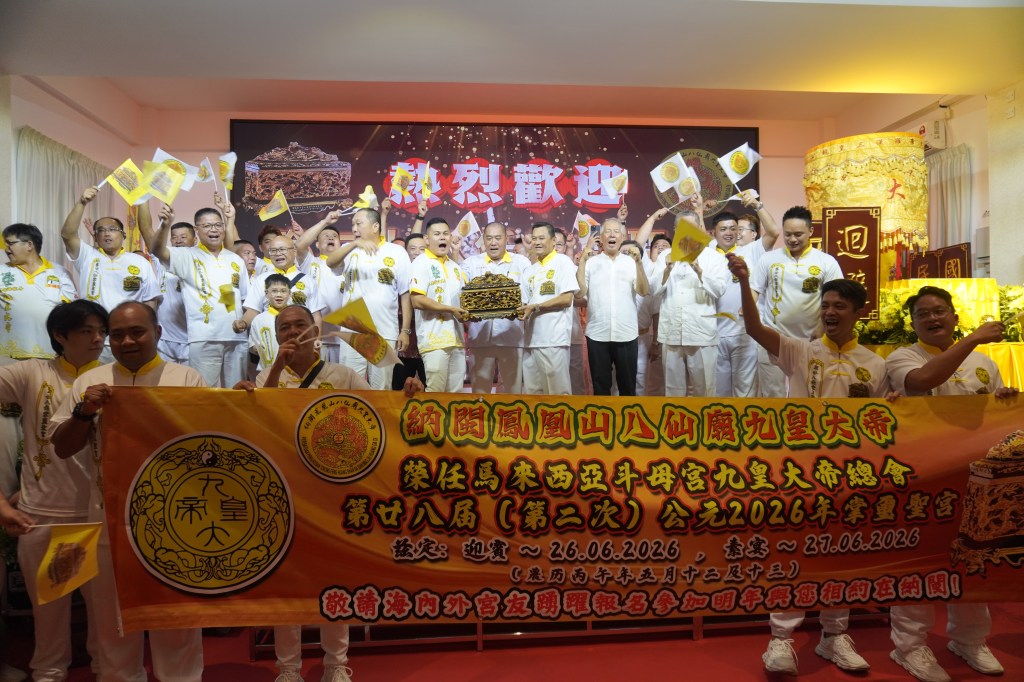
The formal transfer of the Nine Emperor Gods Federation’s ceremonial seal from Hai Long Temple in Miri to Labuan Feng Huang Shan Ba Xian Miao, marking the beginning of the temple’s role as Seal-Holding Sacred Palace.
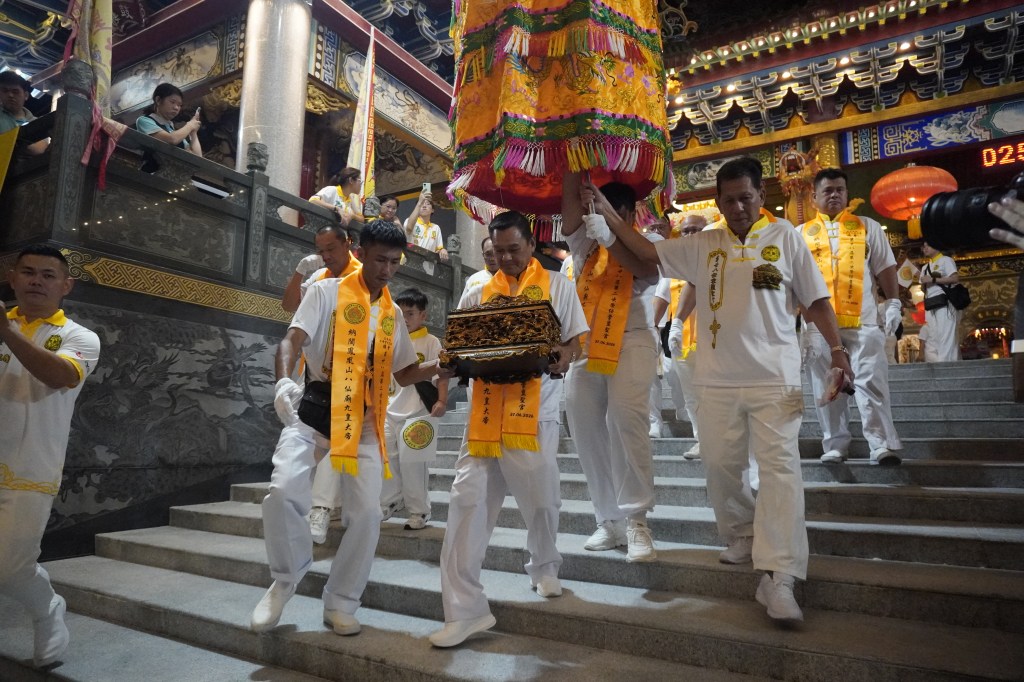
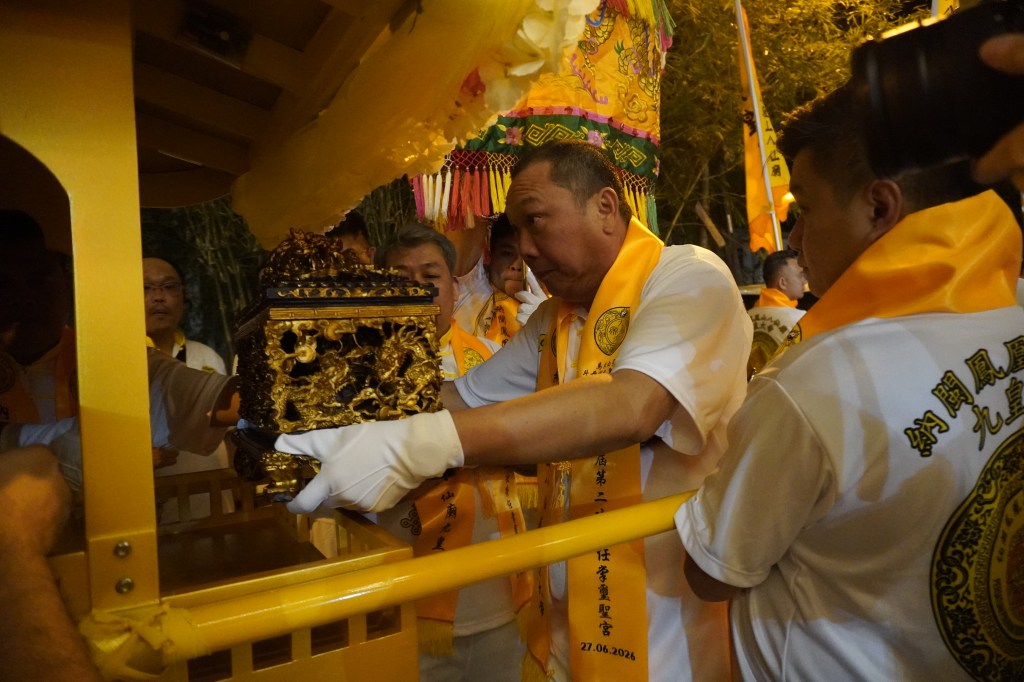
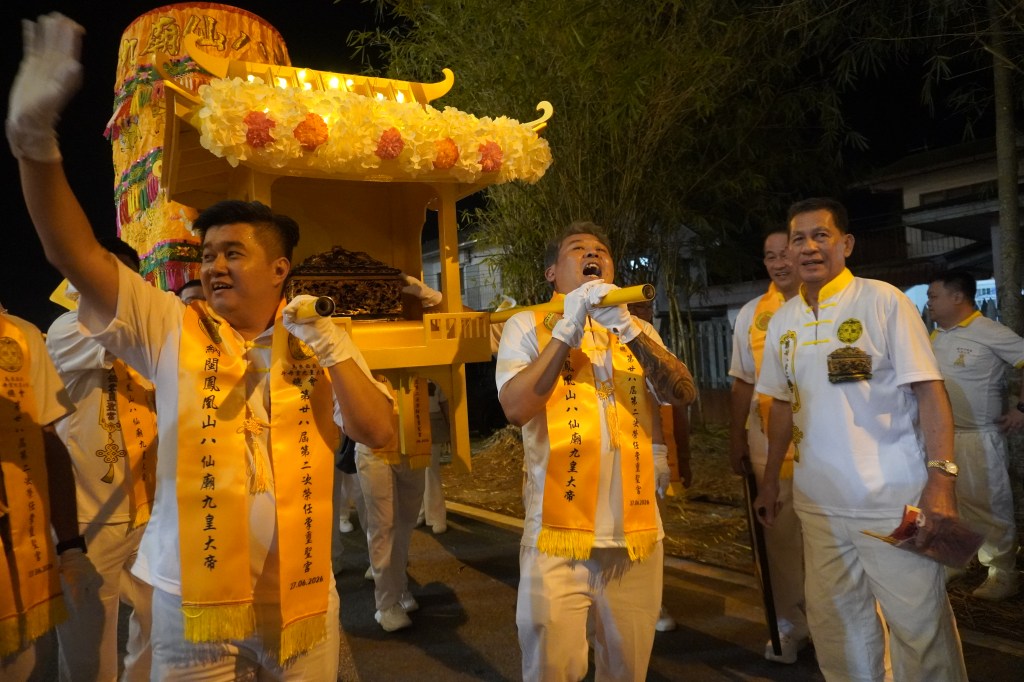
Temple leaders of Labuan Feng Huang Shan Ba Xian Miao escort the Nine Emperor Gods Federation’s ceremonial seal on a specially prepared sedan chair during the handover in Miri.
In June 2025, Labuan Feng Huang Shan Ba Xian Miao assumed the role of Seal-Holding Sacred Palace 掌玺圣宫 from Hai Long Temple in Miri. This marked the first occasion in the history of the Nine Emperor Gods Federation when the ceremonial seal was conveyed by sea by a ship chartered by the temple, adding a new maritime dimension to the federation’s established ritual history.
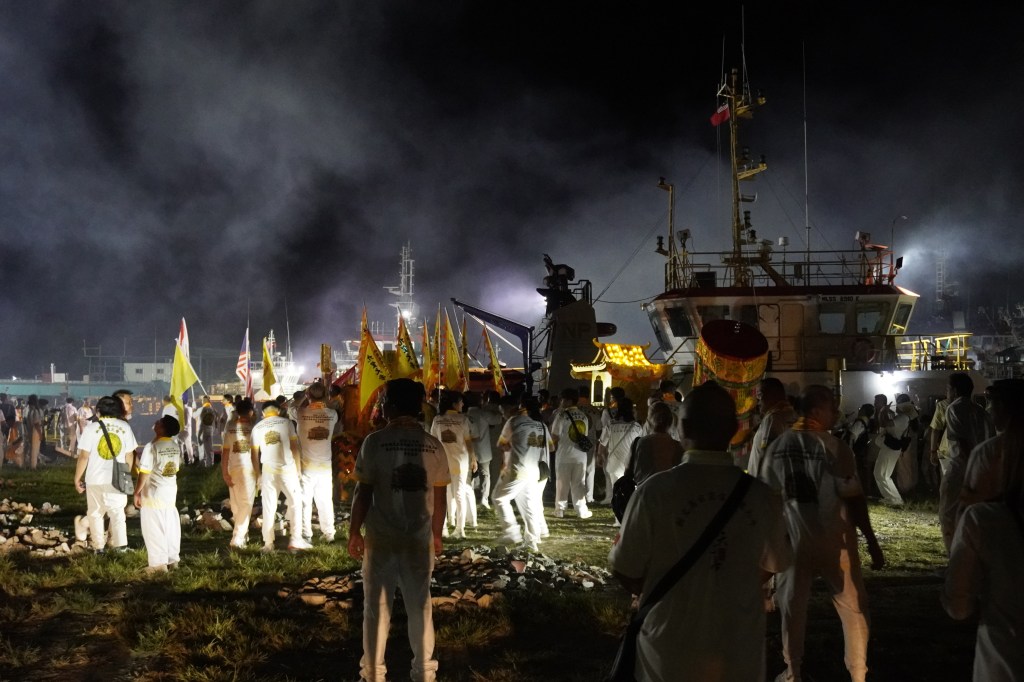
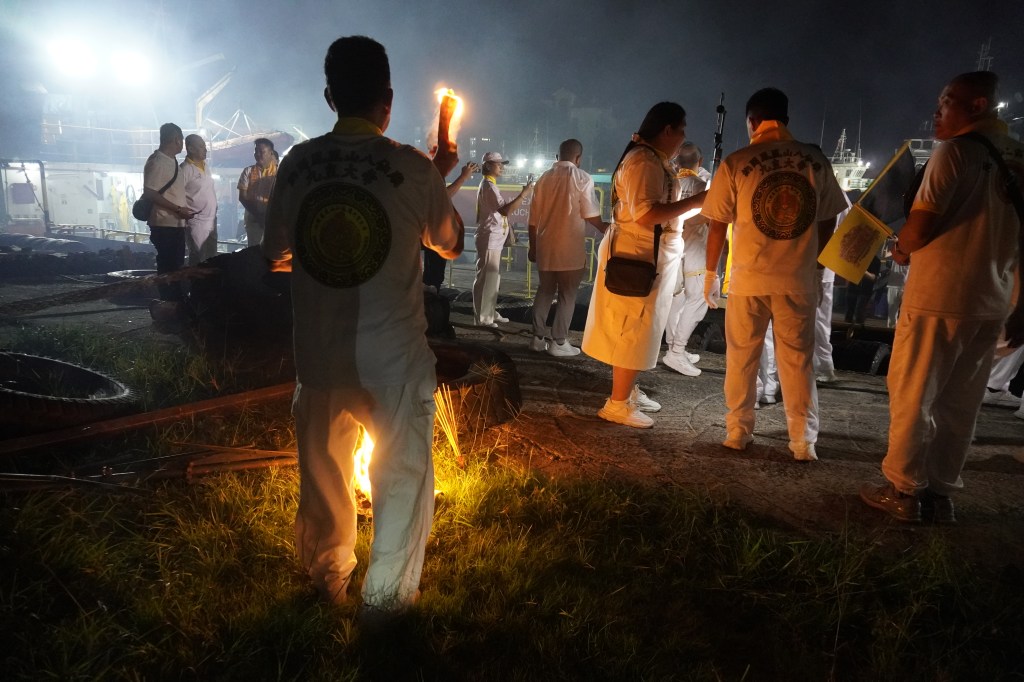
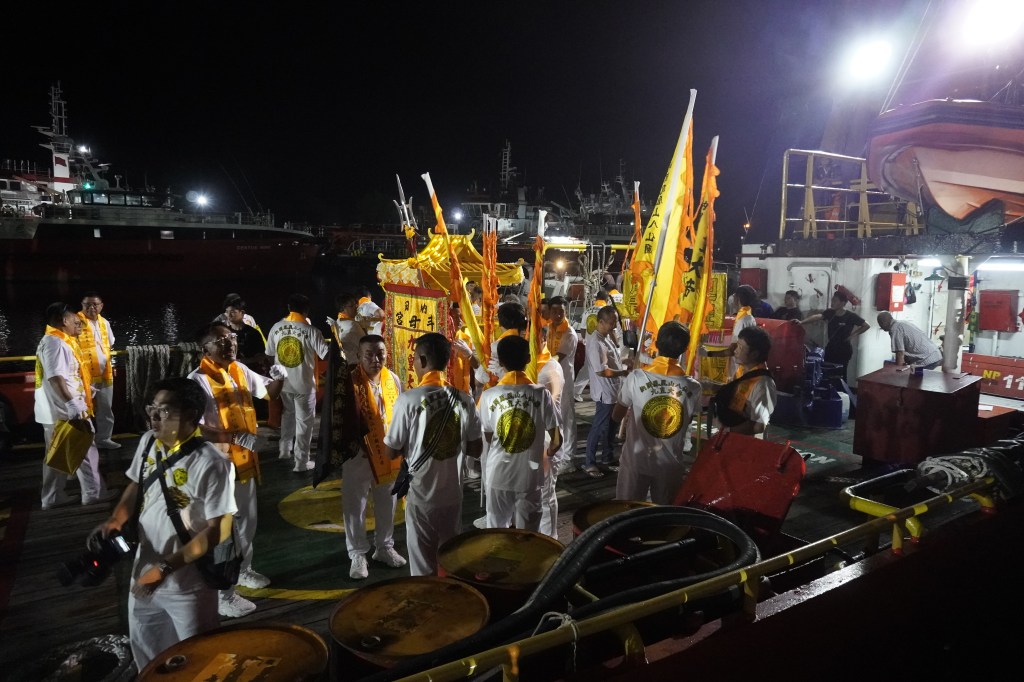
Temple leaders and volunteers assemble at the Miri jetty to escort the ceremonial seal by sea to Labuan Island.
2. Preparations Before the Festival
Three days before the formal opening of the Festival, the Labuan Feng Huang Shan Ba Xian Miao undertook an important preparatory step: the commencement of ritual vegetarian observance, known as Observing the Nine Emperor Vegetarian Discipline 持行九皇斋. This marked both the temple’s formal transition into a heightened ritual state and the anticipated arrival of the Nine Emperor Gods. From this point onwards, all participants—committee members, volunteers, and devotees—were expected to observe a strict vegetarian diet in advance of the festival itself. Throughout the duration of the festival, only vegetarian food is permitted within the temple grounds.
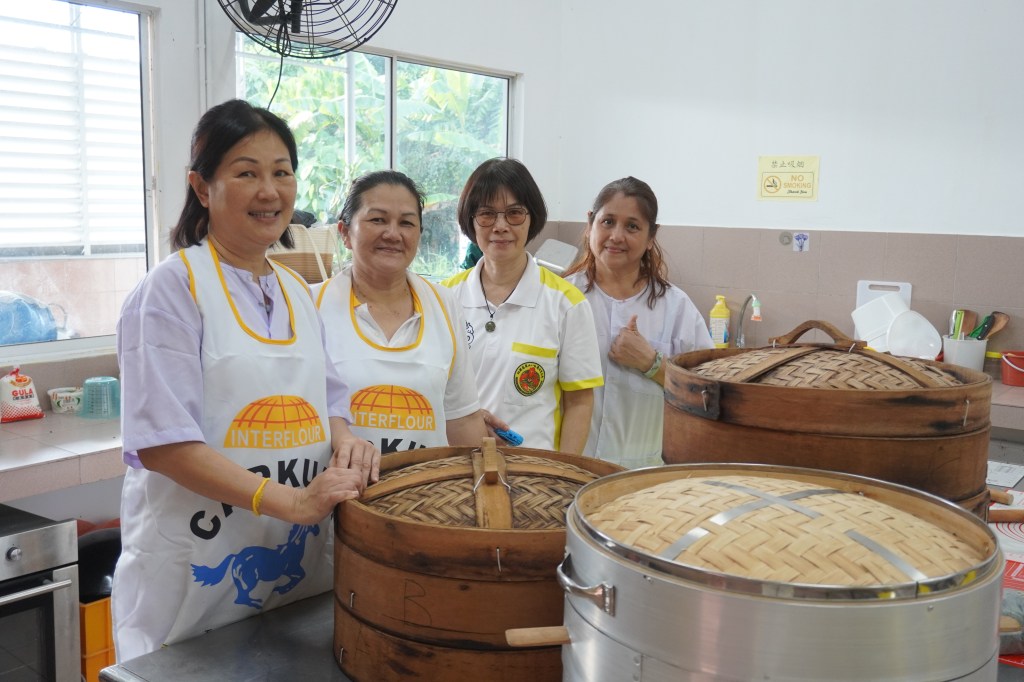
Volunteers prepare and serve strictly vegetarian meals for devotees throughout the Festival, covering all daily meals and late-night suppers.
This diet excluded not only meat and seafood, but also milk, garlic, onion, and eggs. To maintain ritual purity, the temple kitchens operated with a separate set of utensils and cookware reserved exclusively for vegetarian preparation. These measures ensured that the temple space, its food, and those who served within it were collectively aligned with the disciplined observance required for hosting the Nine Emperor Gods.
3. Rewarding the Spirit Soldiers Ritual 犒军 (Observed on the first, third, sixth, ninth, and final days of the Festival)
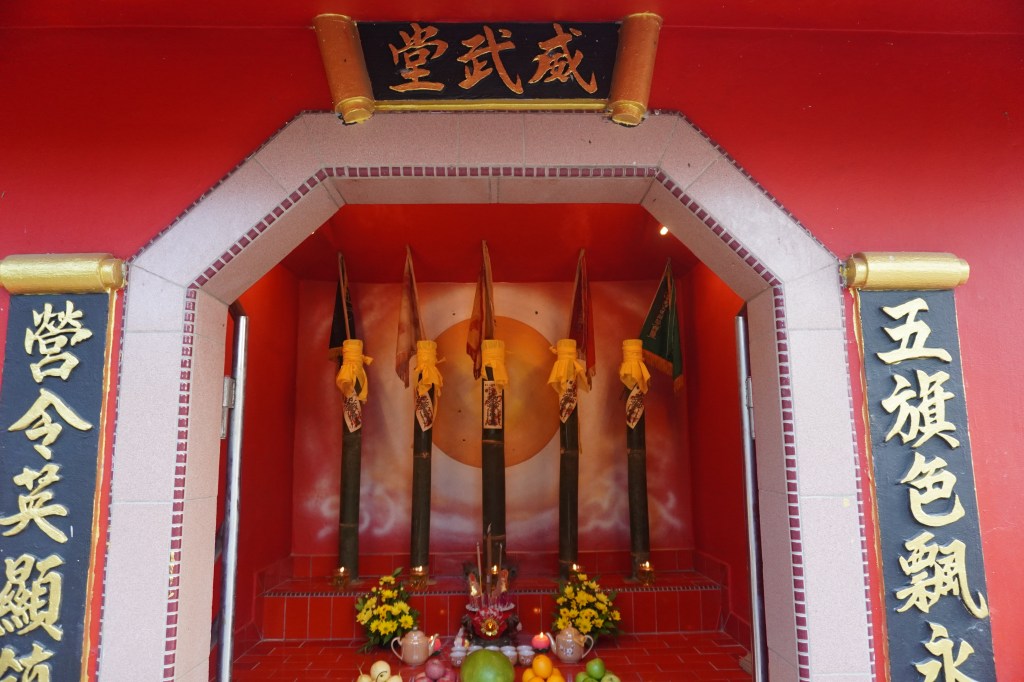
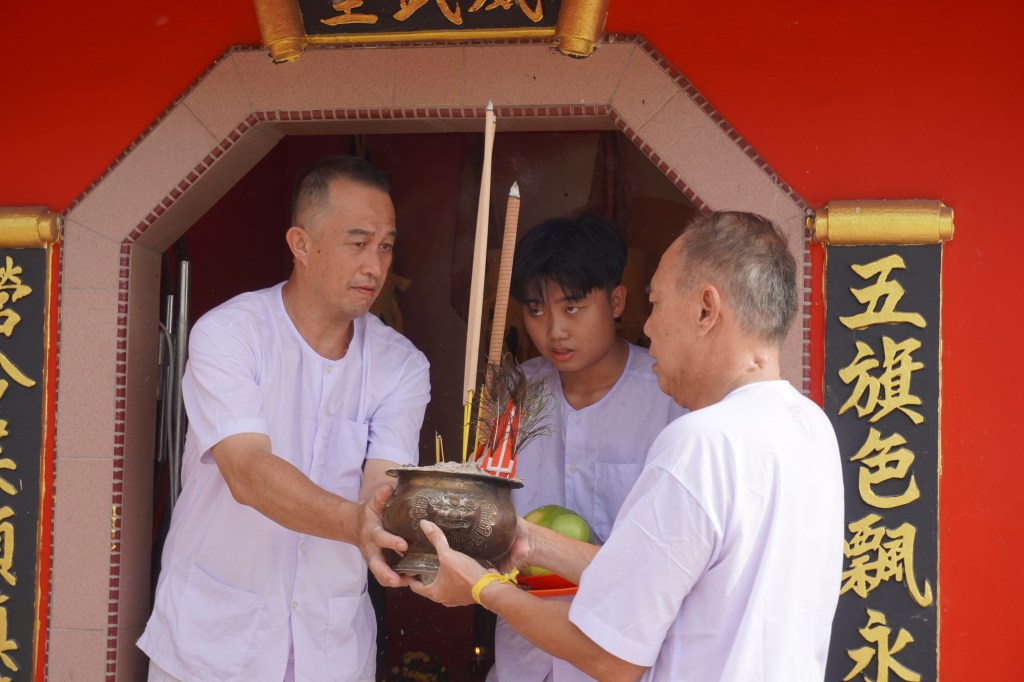
The Hall of Martial Commemoration, where the spirit soldiers’ incense censer is invited out to a temporary altar at the start of the ritual.
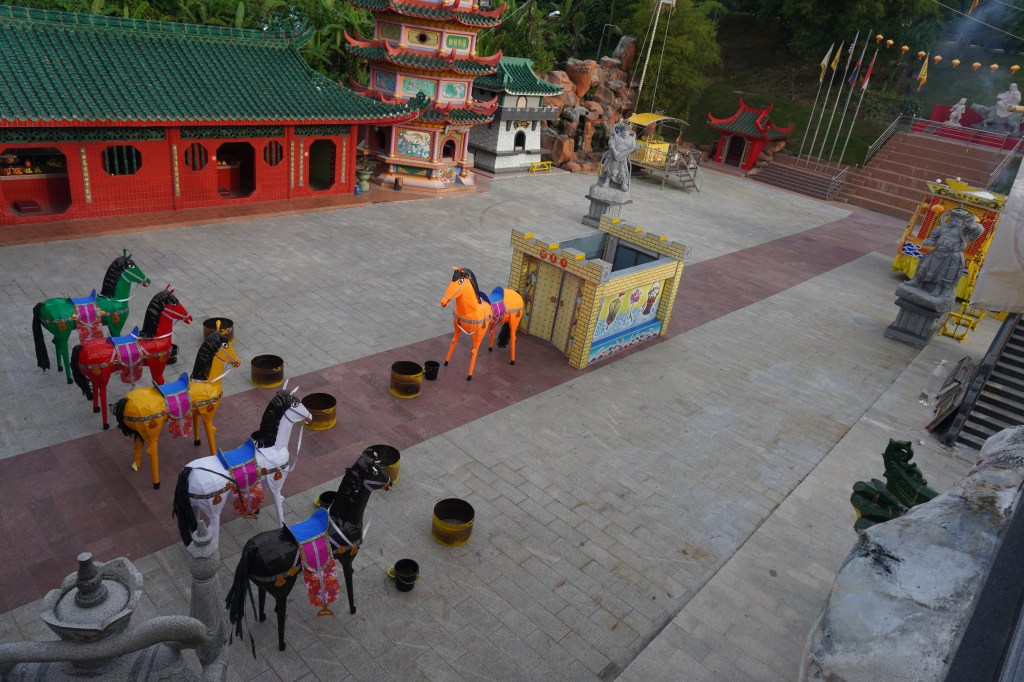
Five ritual horses represent the Five Directions, while a sixth orange horse marks the Nine Emperor Gods’ own spirit soldiers and is incinerated on the night of departure.
Before the festival begins in earnest, and before the Nine Emperor Gods are formally welcomed into the temple at night, Ba Xian Miao conducts the Rewarding the Spirit Soldiers ritual 犒军. This ritual marks the marshalling, provisioning, and stationing of protective spirit soldiers who are tasked with safeguarding the temple and its surroundings for the duration of the festival. These spirit soldiers are represented throughout the temple compound by five bamboo stakes, each bearing a command flag, corresponding to the Five Directions: East (green), West (white), Centre (yellow), South (red), and North (black). A sixth representation, associated specifically with the Nine Emperor Gods’ own spirit soldiers, is marked by an orange horse. The main ceremonies take place in the open space before the temple courtyard, organised around five ritual horses symbolising the Five Directions. From the perspective of visitors facing the temple, the space to the left of this axis is reserved for the Rewarding the Spirit Soldiers ritual, which is performed in recurring cycles across the festival days.
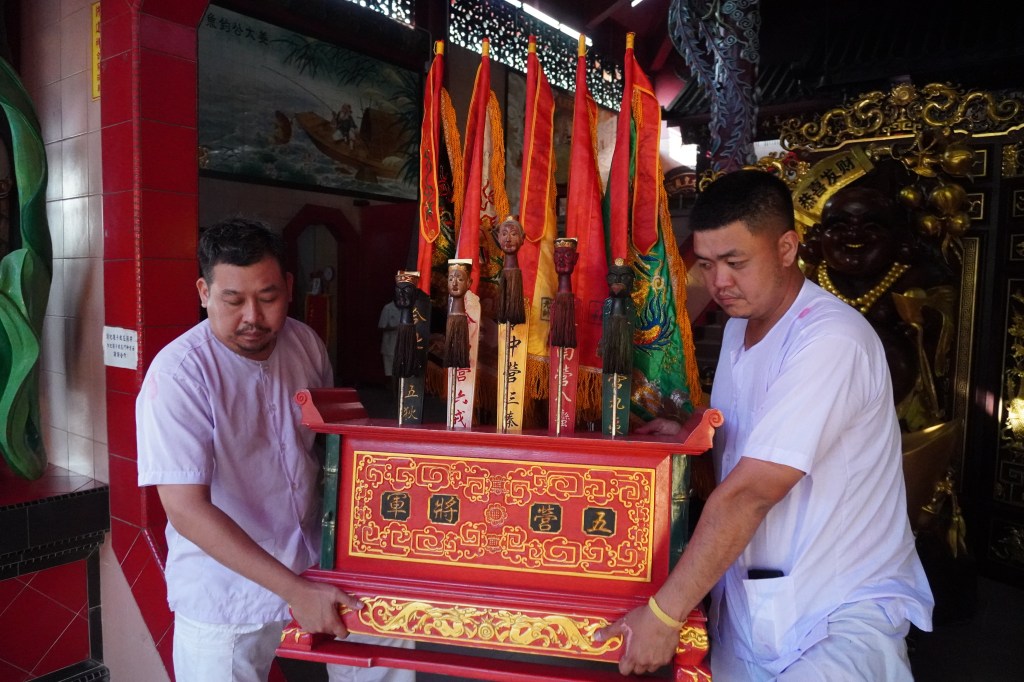
Volunteers and ritual specialists transfer the Five Camps Generals altar from the main altar to a temporary altar.
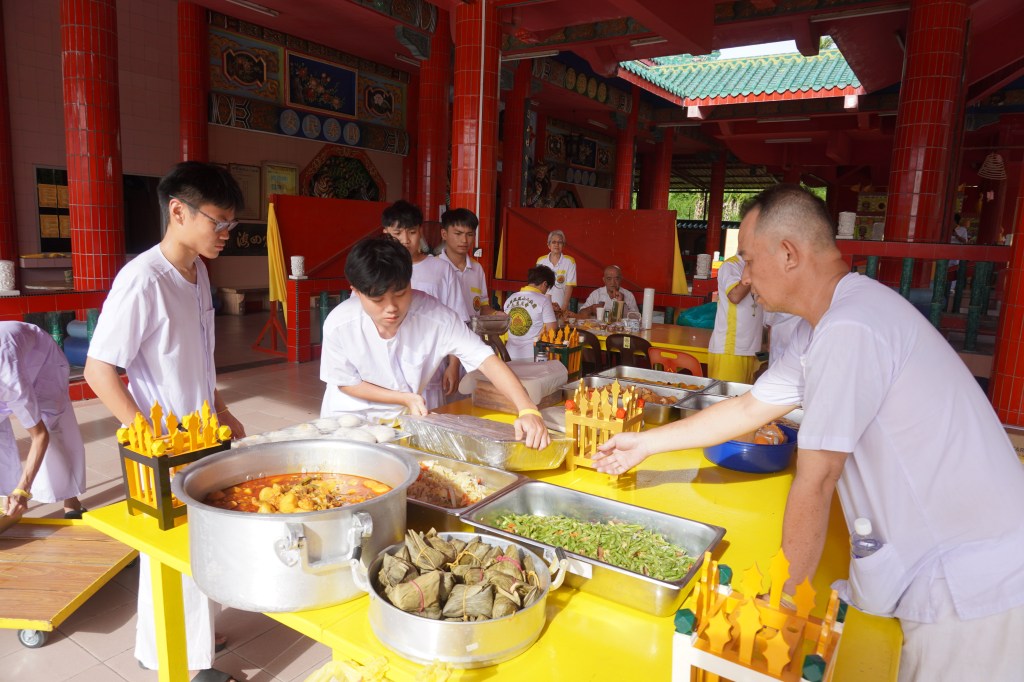
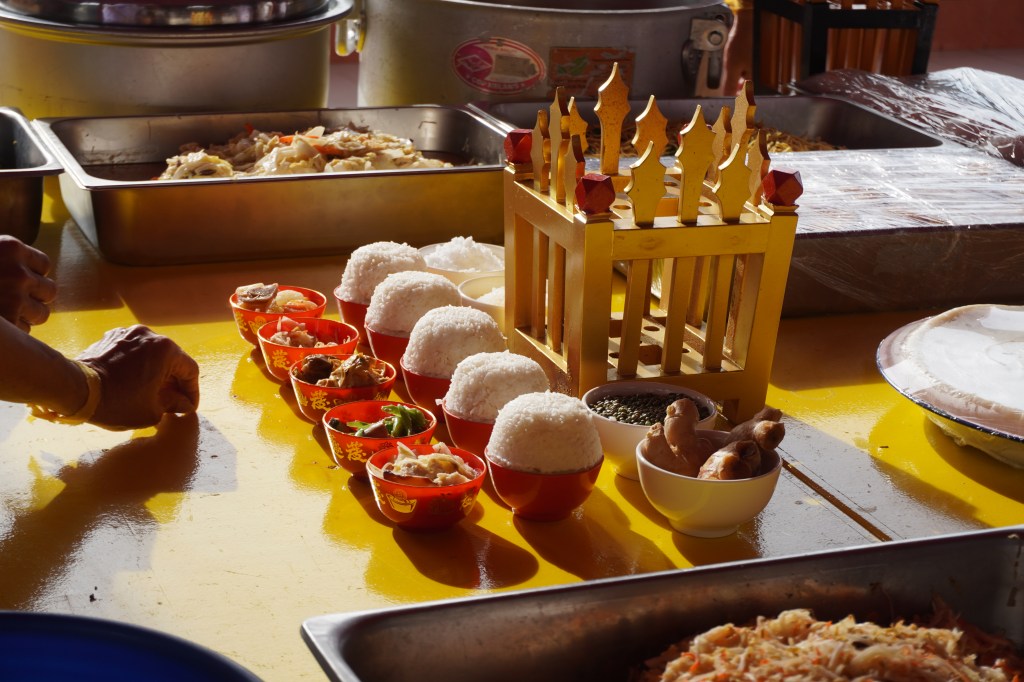
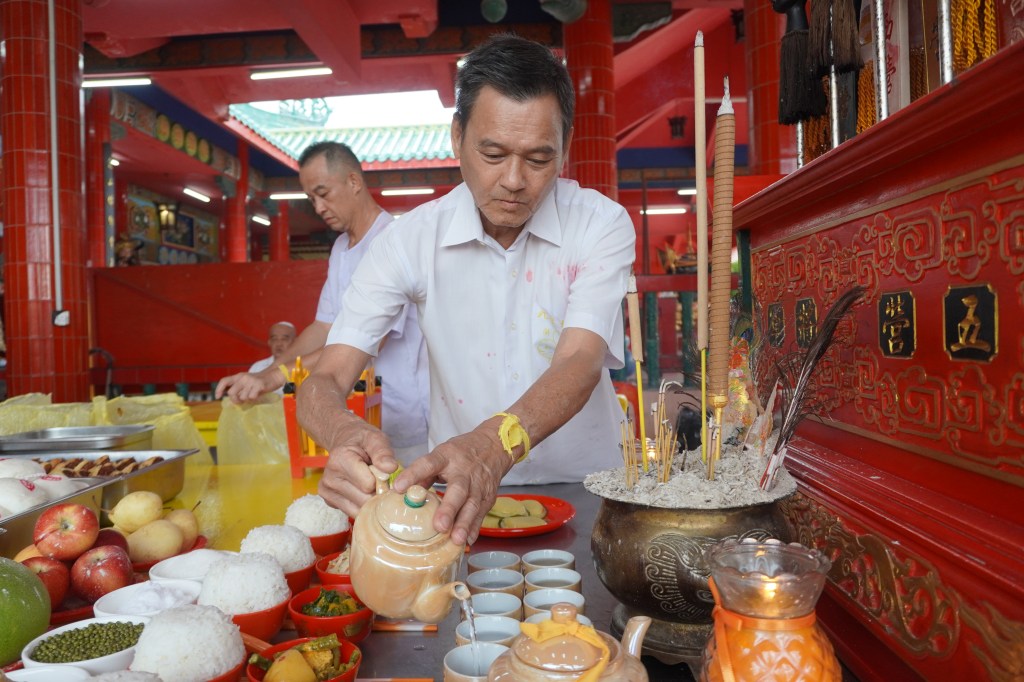
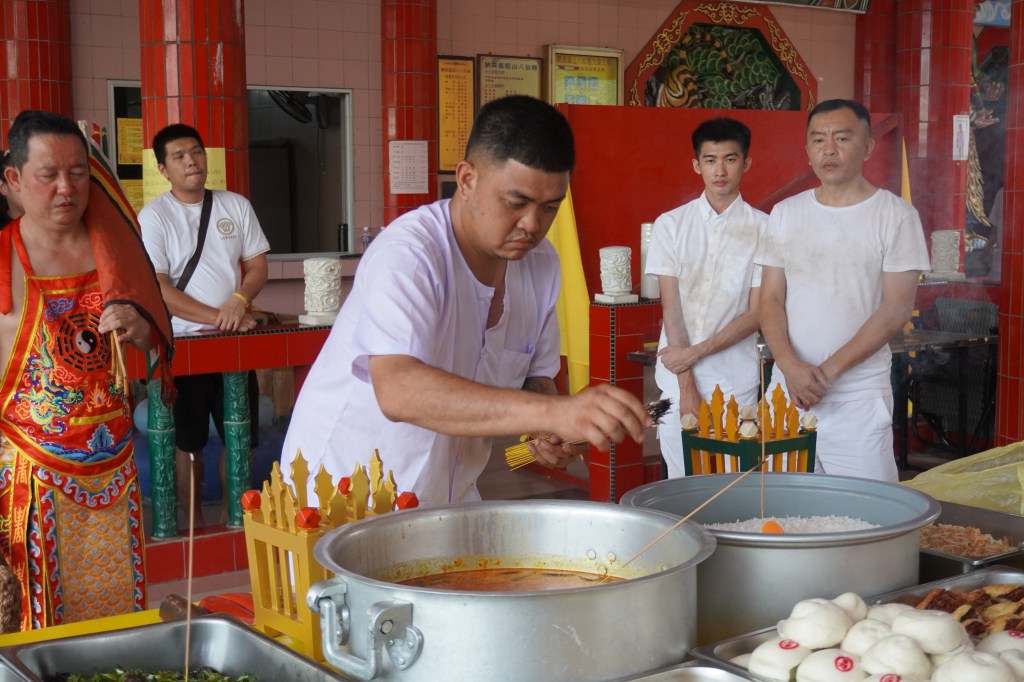
Temple volunteers prepare vegetarian food and tea offerings, planting incense in advance of the Rewarding the Spirit Soldiers ritual.
At the Feng Huang Shan Ba Xian Miao, the ritual begins at the main altar, where the spirit mediums invite a portable altar representing the Five Camps Generals 五营将军 to be moved to the front of the temple, forming a temporary ritual focus. In advance, temple volunteers prepare cooked vegetarian dishes to be offered to the spirit soldiers. An incense censer belonging to the spirit soldiers, ordinarily enshrined in the Hall of Martial Commemoration 威武堂 within the temple grounds, is formally received by a senior temple representative and arranged before the altar. Communication with each of the five camps is established through a sequence of actions: the spirit medium lashes a ritual whip 法索, a sonic gesture understood as a formal summons and a clearing of disruptive influences; incense paper is burnt; and the altar is stamped with a command plaque 令牌 to signal authority and invitation. Divination blocks are then cast to confirm the arrival of each camp. An affirmative response 圣杯 marks successful contact, after which a command flag is planted on the altar to indicate that the spirit soldiers have been duly stationed. If confirmation is not obtained, the sequence is repeated until communication is ritually established.
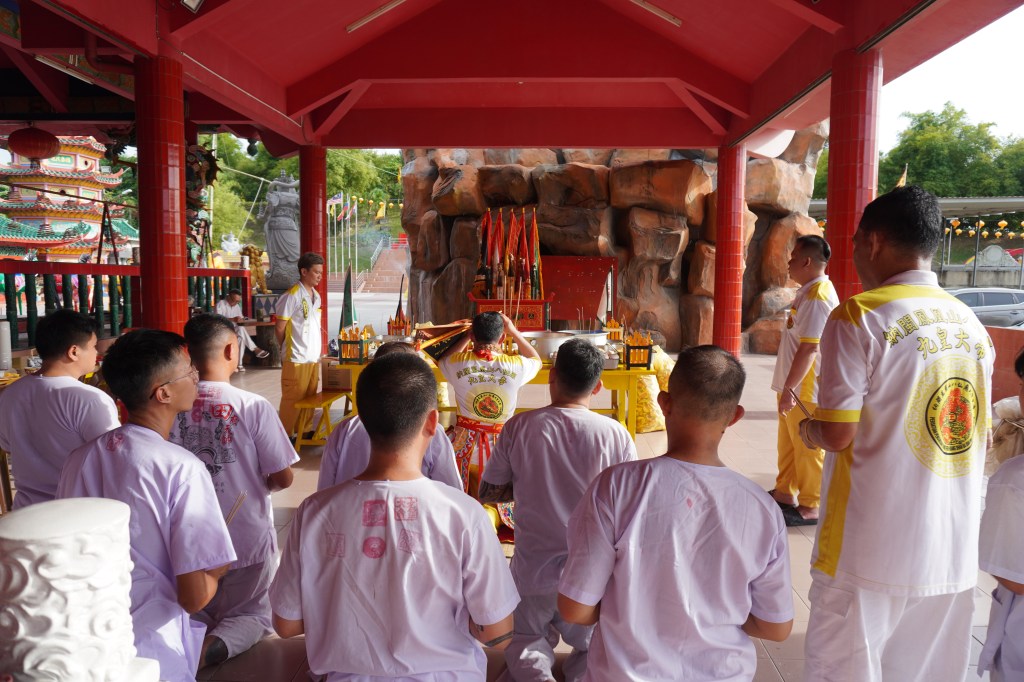
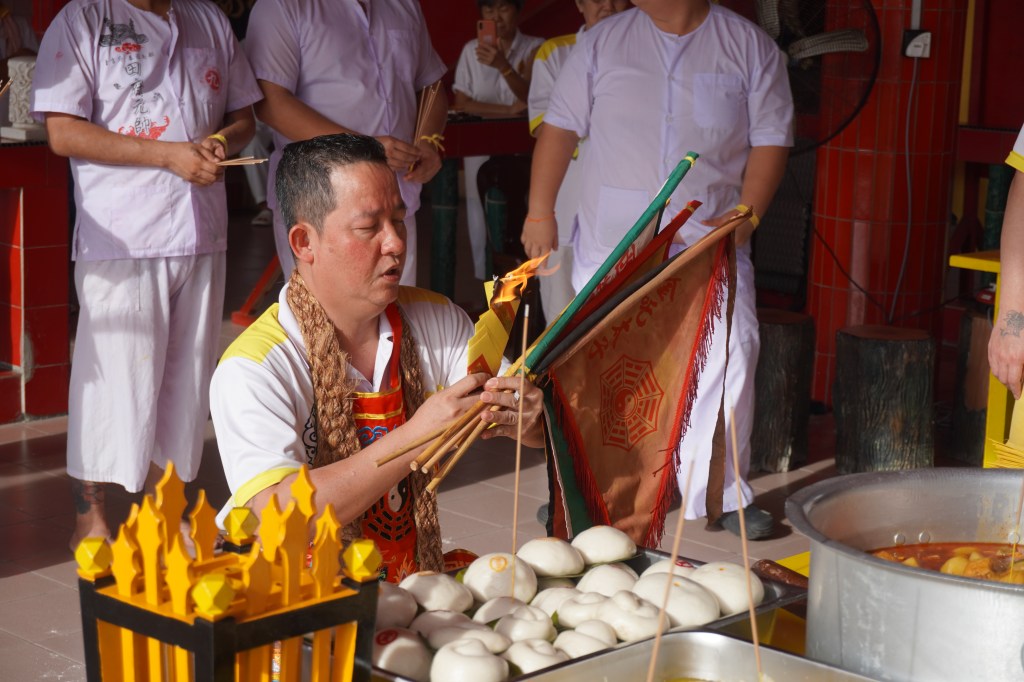
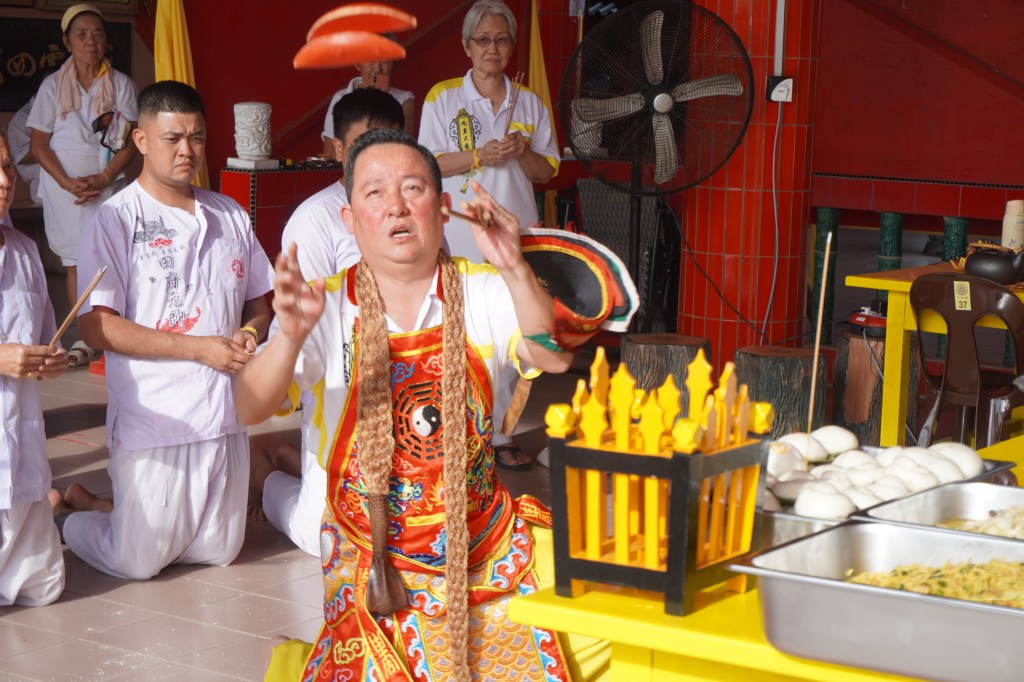
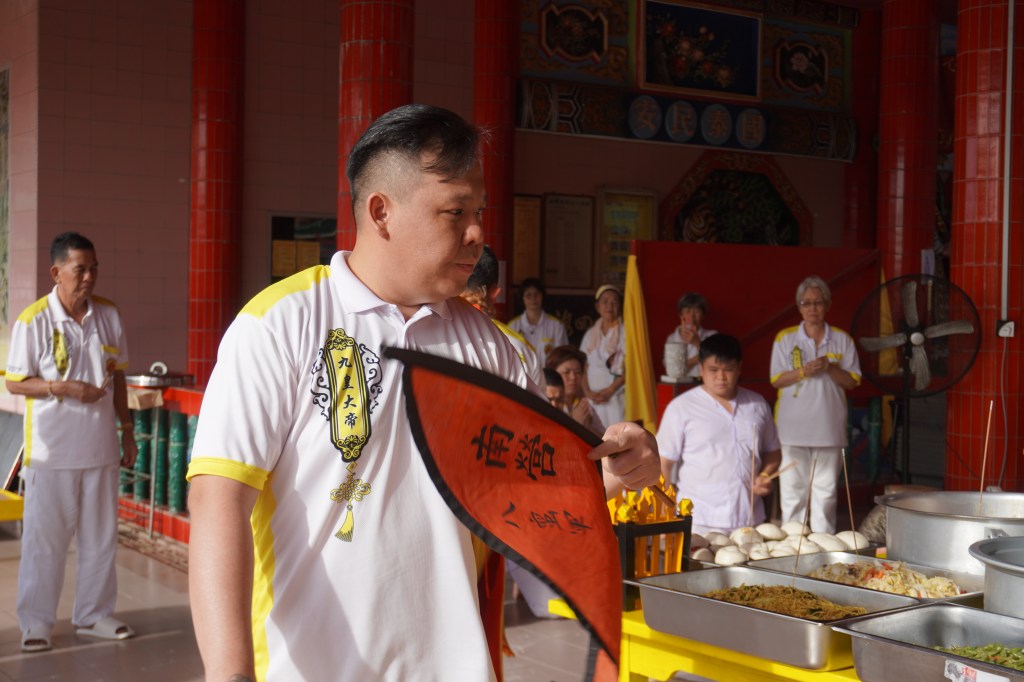
The spirit medium summons each directional camp, casting divination blocks to confirm their arrival before assistants plant the corresponding command flags.
Once all five camps have been summoned and provisioned, devotees and attendees present incense at the altar, and offerings of incense paper are burnt before each of the five ritual horses in the courtyard, which are simultaneously fed with grass and grain. This concludes the ritual sequence. The incense censer is then respectfully escorted back to its original location, the deities withdraw from the spirit mediums 退乩, and the portable altar representing the Five Camps is returned to the main altar until the next scheduled session. The offered food is subsequently shared among devotees and volunteers, in keeping with the strict vegetarian discipline of the festival. This shared vegetarian practice, known as the Nine Emperor zhai 九皇斋, is a defining cultural feature of the Nine Emperor Gods Festival in Southeast Asia, reinforcing communal discipline, ritual purity, and collective participation throughout the festival period.
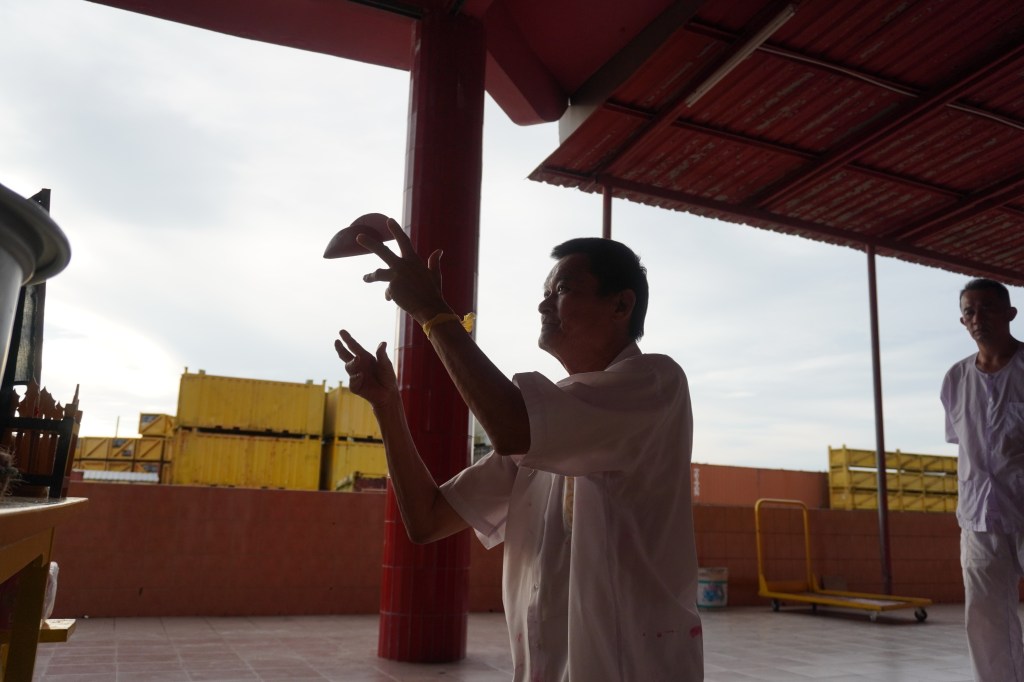
The temple chairman casts divination blocks to confirm that the spirit soldiers have completed their offerings.
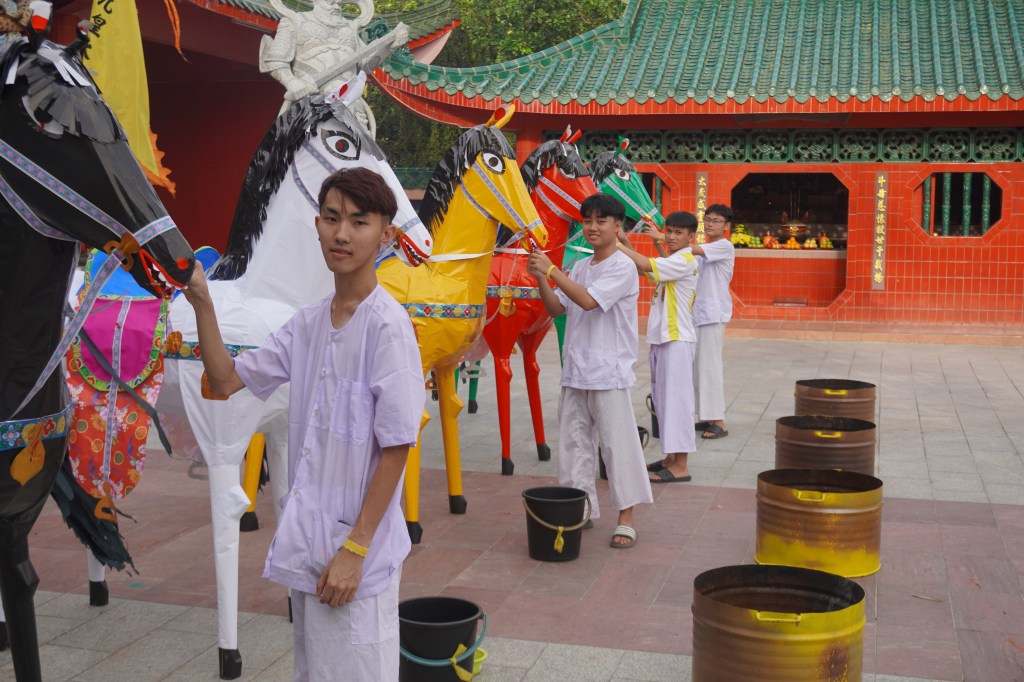
Grain and grass are offered to the ritual horses representing the stationed soldiers.
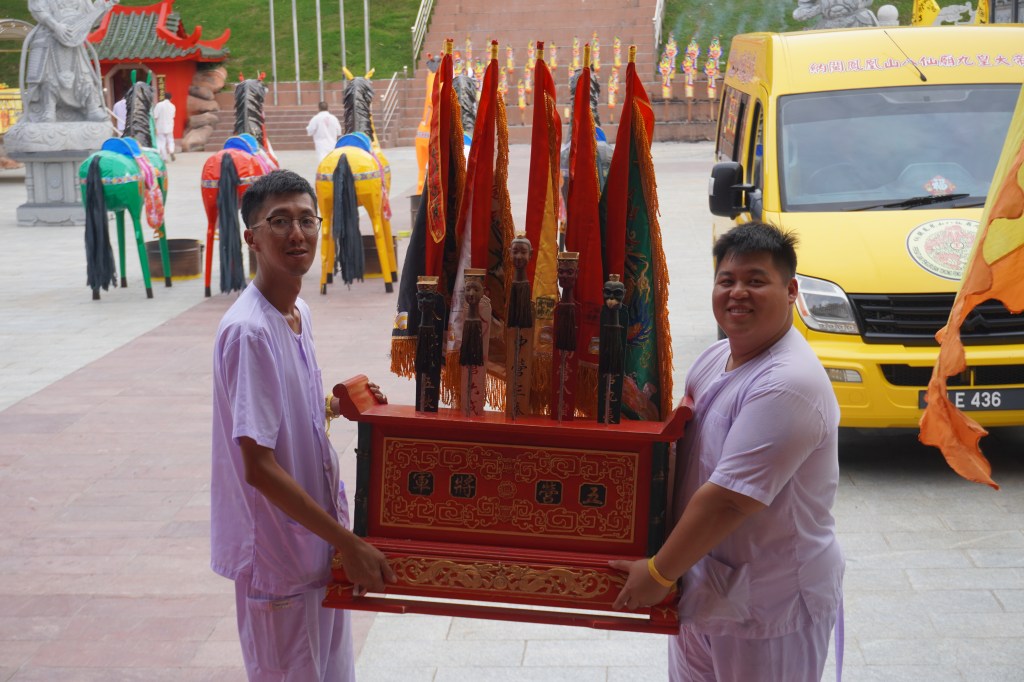
After the ritual sequence concludes, the Five Camps Generals altar is returned to the main altar.
4. Consecration of the Nine Emperors Ship 九皇船
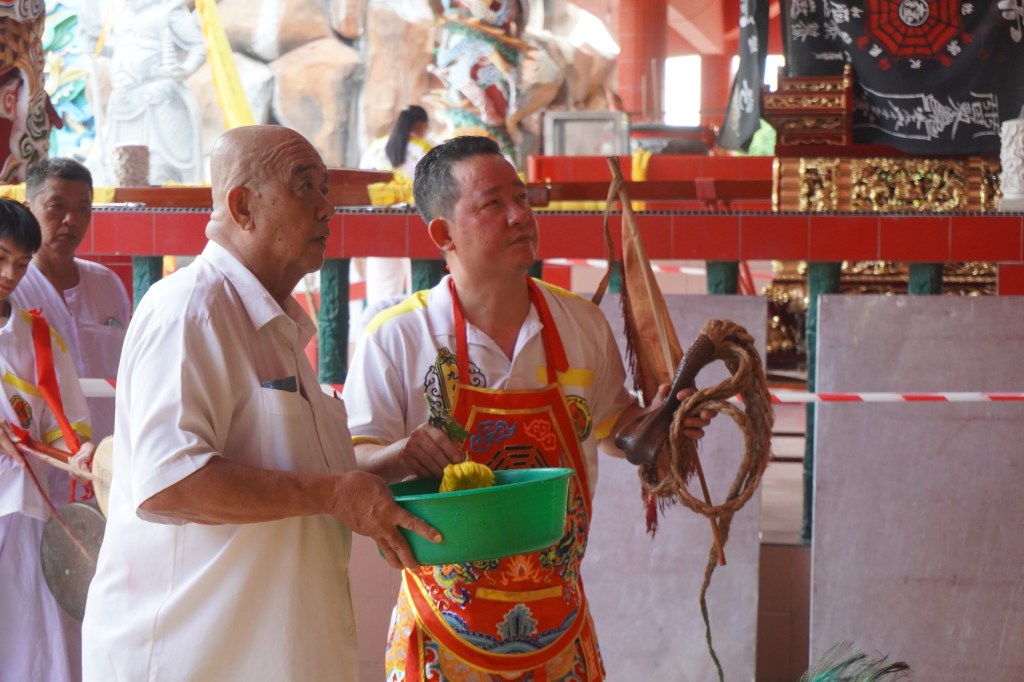
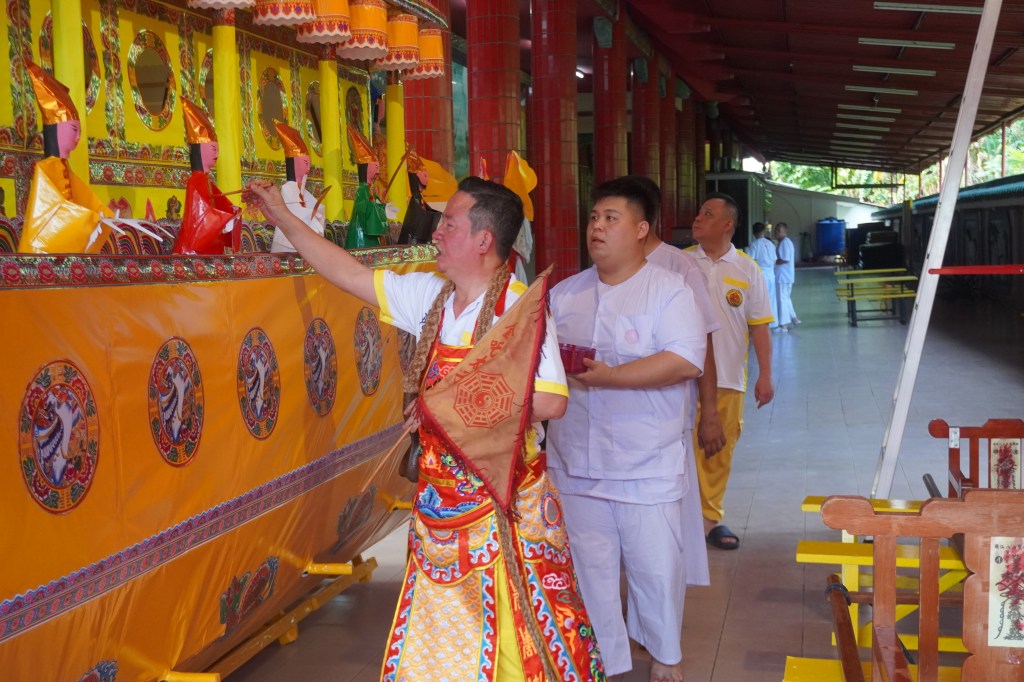
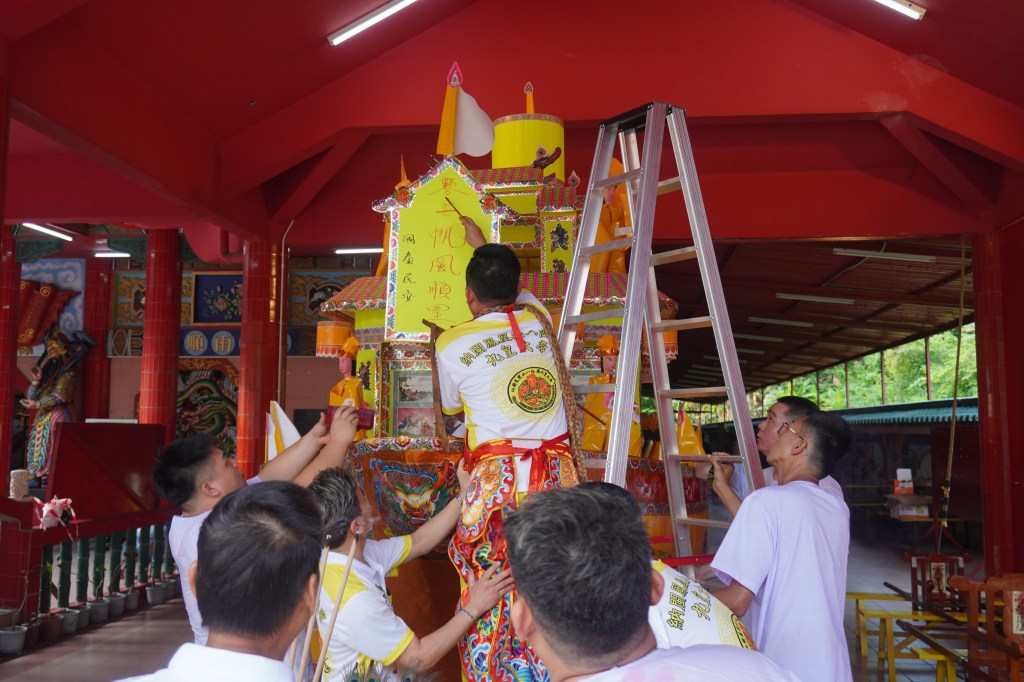
A spirit medium consecrates the Nine Emperor Ship by applying vermilion to key parts of the vessel and its ritual figures.
Before the Nine Emperor Gods are received, a spirit medium also consecrates a large ritual vessel known as the Nine Emperor Ship 九皇船. This boat is later conveyed to the riverside on the final day of the festival, where it serves as the vehicle for the deities’ departure and is ritually incinerated. During the festival, the boat is installed within the temple grounds, receives its own incense censer, and is treated as a significant ritual locus. Over the nine days, devotees may choose to have their names inscribed on incense paper and offerings symbolising daily necessities, such as rice and cooking oil, which are then placed within the boat. Throughout this period, volunteers continue to fold incense paper into lotus blossoms and carefully arrange them inside the vessel, gradually building up the offerings that will accompany the Nine Emperor Gods at the conclusion of the festival.
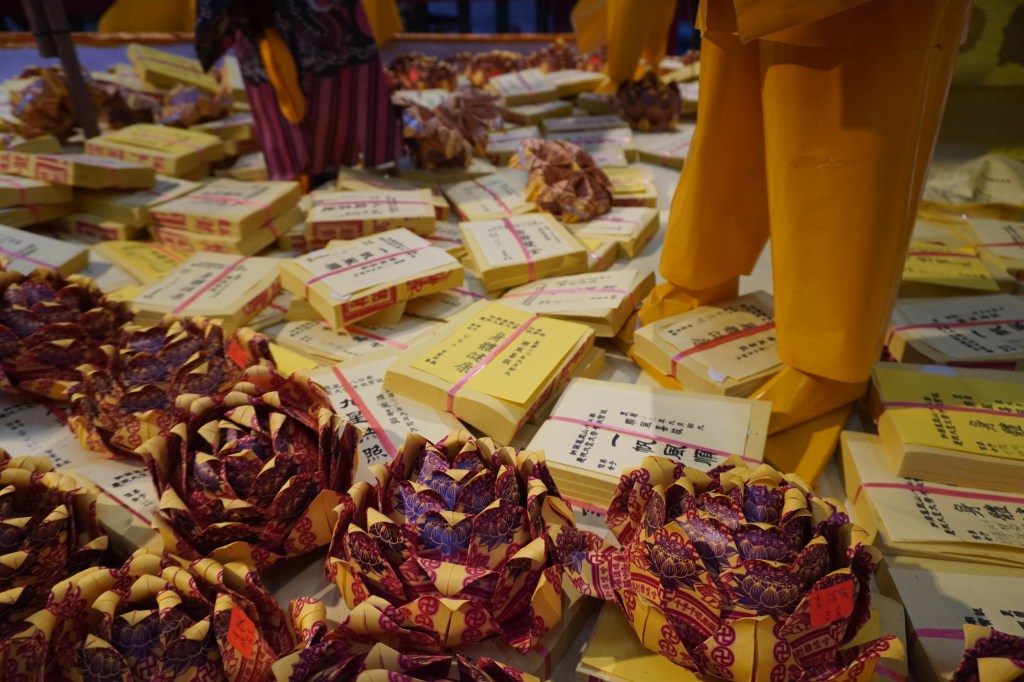
Incense paper offered by devotees and lotus blossoms folded from incense paper are placed inside the Nine Emperor Ship as ritual offerings.
5. Receiving the Nine Emperor Gods
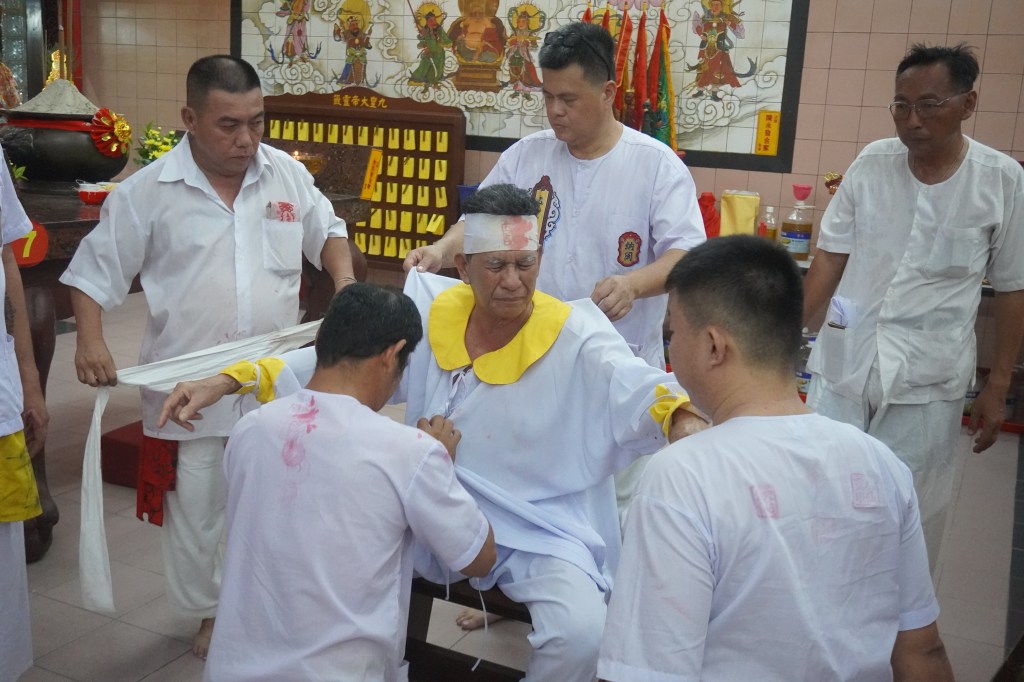
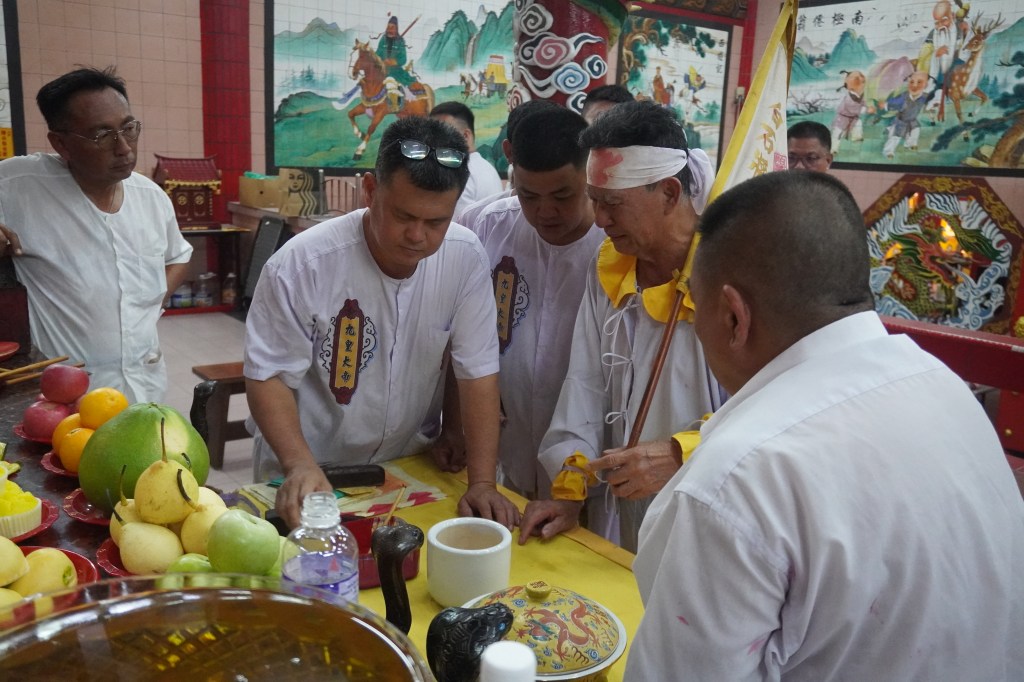
General White Stone descends upon the main altar to give instructions, consecrate paper talismans for pasting on the bamboo, and consecrate white headscarves for devotees.
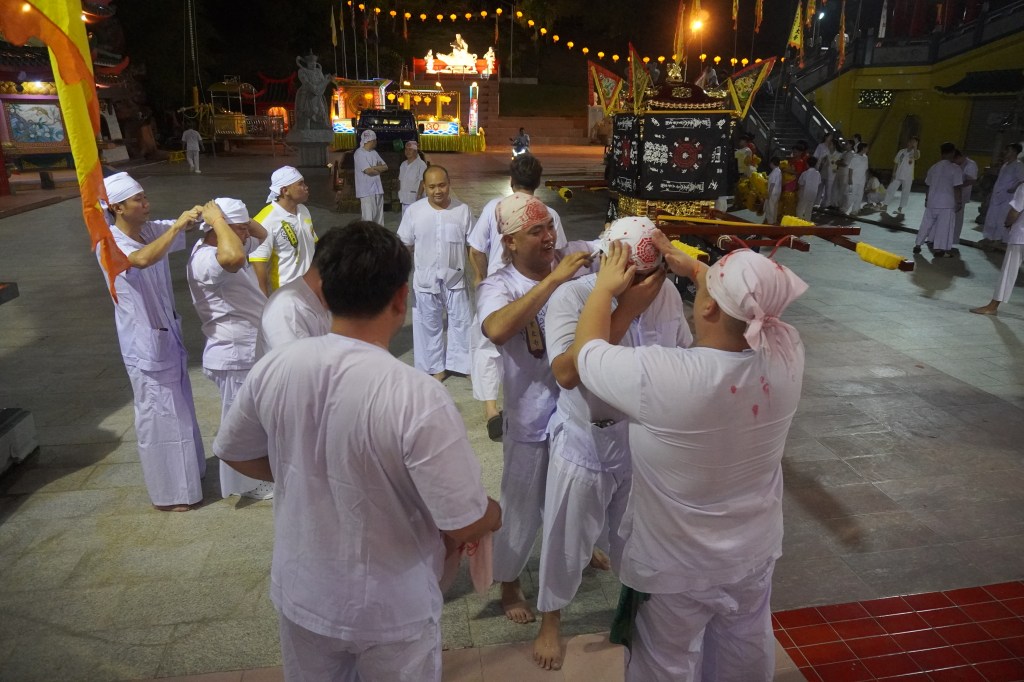
Devotees and volunteers don white headscarves, reflecting a shared ritual tradition of the Nine Emperor Gods Festival in Southeast Asia.
At sunset, the ritual reception of the Nine Emperor Gods formally marks the beginning of the Nine Emperor Gods Festival. From this moment onwards, the temple enters a heightened ritual state. All participants—committee members, volunteers, and devotees—are dressed uniformly in white, including a white headscarf, signalling their readiness to host the deities. Prior to the ceremony, General White Stone 白石将军 descends upon his spirit medium primarily to issue talismans, affix them to the bamboo that will later be raised into the sky, and provide instructions for the observance of the Nine Emperor Gods Festival. For devotees and volunteers wearing the white headscarf, the medium performs a consecration 加持, marking the cloth with vermillion and imprinting it with the temple seal and the Eight Trigrams 八卦, thereby ritually preparing participants for the occasion.
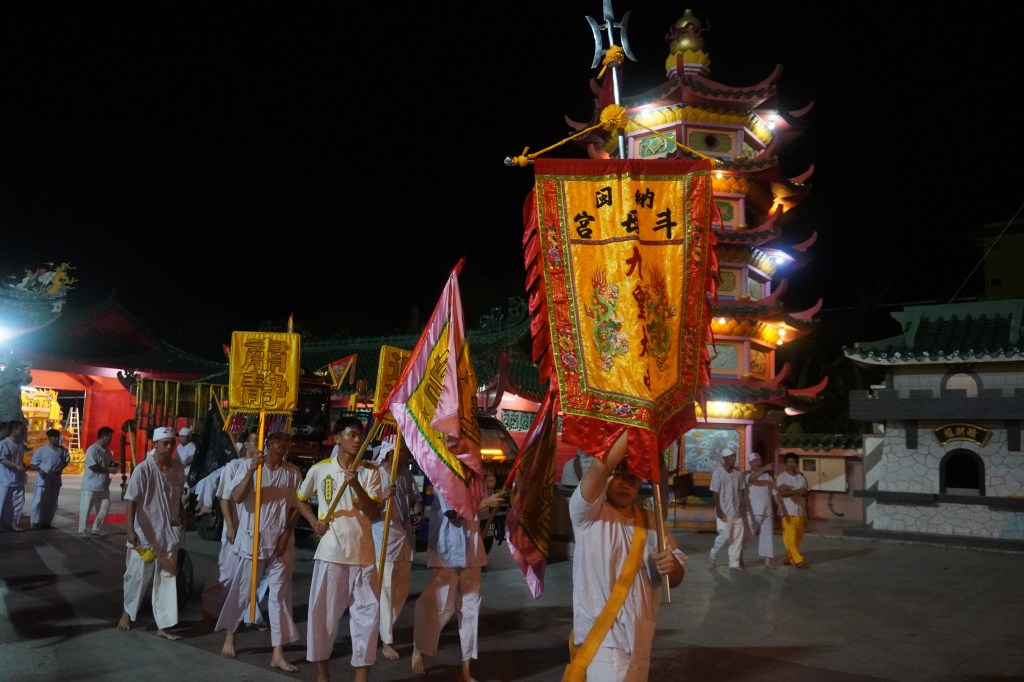
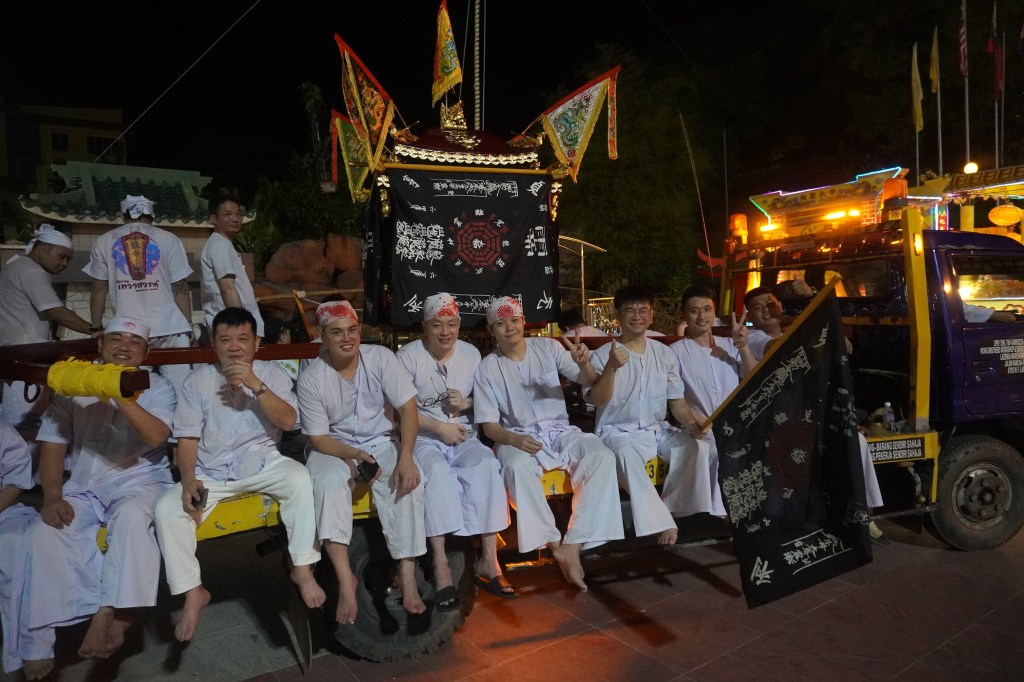
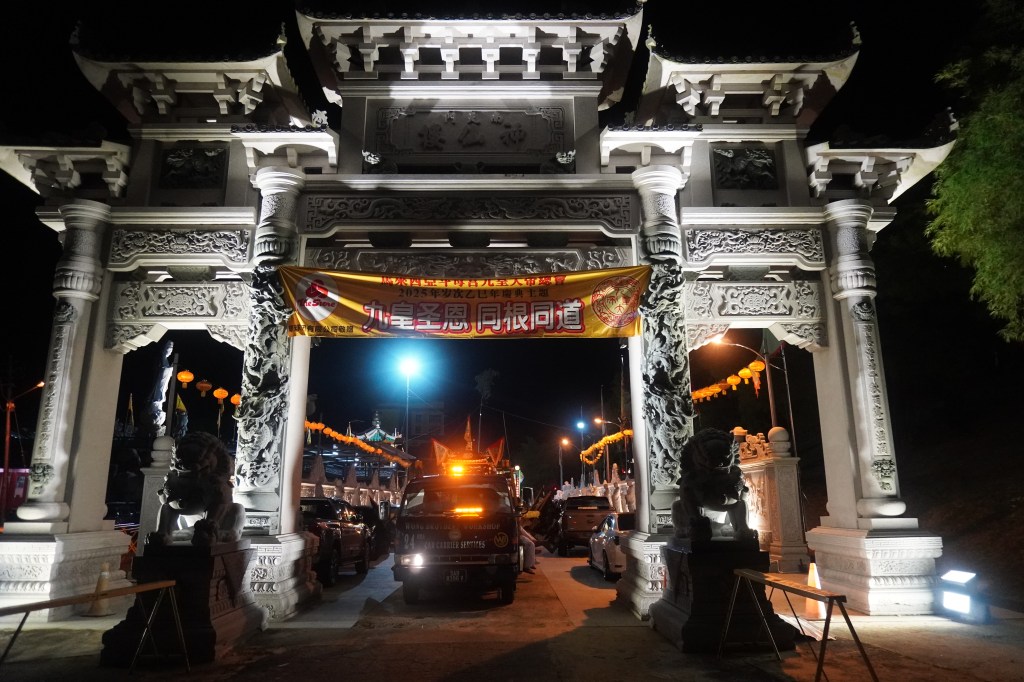
The Nine Emperor Gods’ palanquins lead a steady procession from the temple to the pier, accompanied by ritual objects, vehicles, and illuminated floats.
Once all are properly attired, the sacred objects of the Nine Emperor Gods are brought out from the Sacred Virtue Palace. These ritual objects are concealed beneath a precious canopy 宝盖 and black command flags 黑令旗, a practice that is maintained throughout the festival. Carried by the temple leadership, the objects are placed into prepared palanquins positioned outside the temple. The palanquins are then loaded onto vehicles, and a long, snaking procession forms, comprising banners, command flags, lion dance troupes, and illuminated floats. As the procession makes its way toward the pier to welcome the Nine Emperor Gods, spirit mediums and ritual specialists periodically lash the ritual whip 法索 at road junctions and breaks, a formal gesture intended to clear and prepare the path ahead.
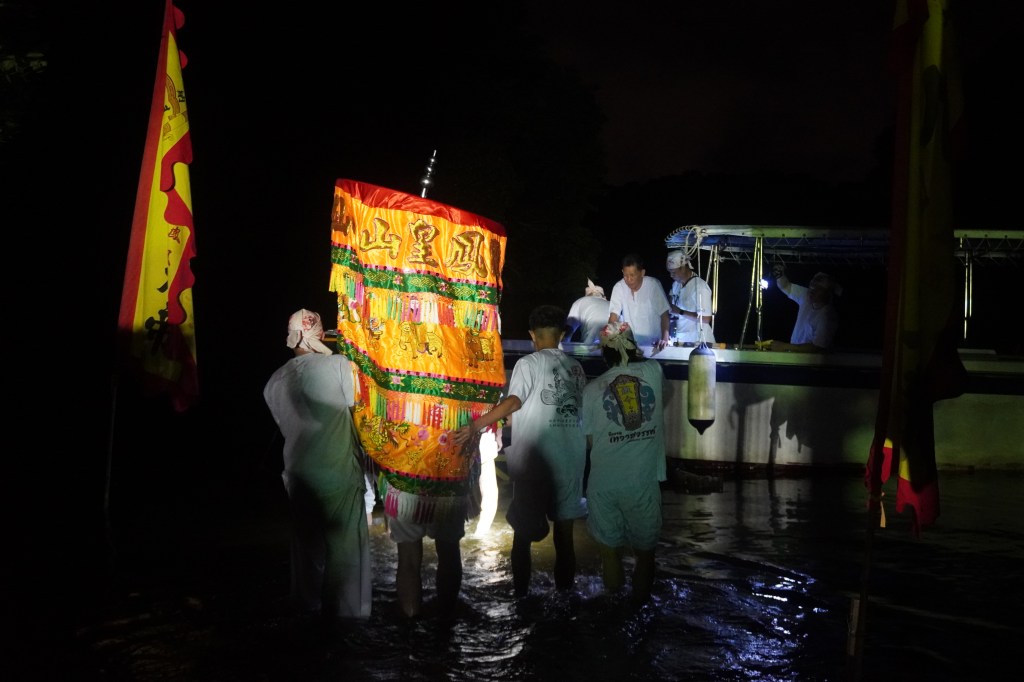
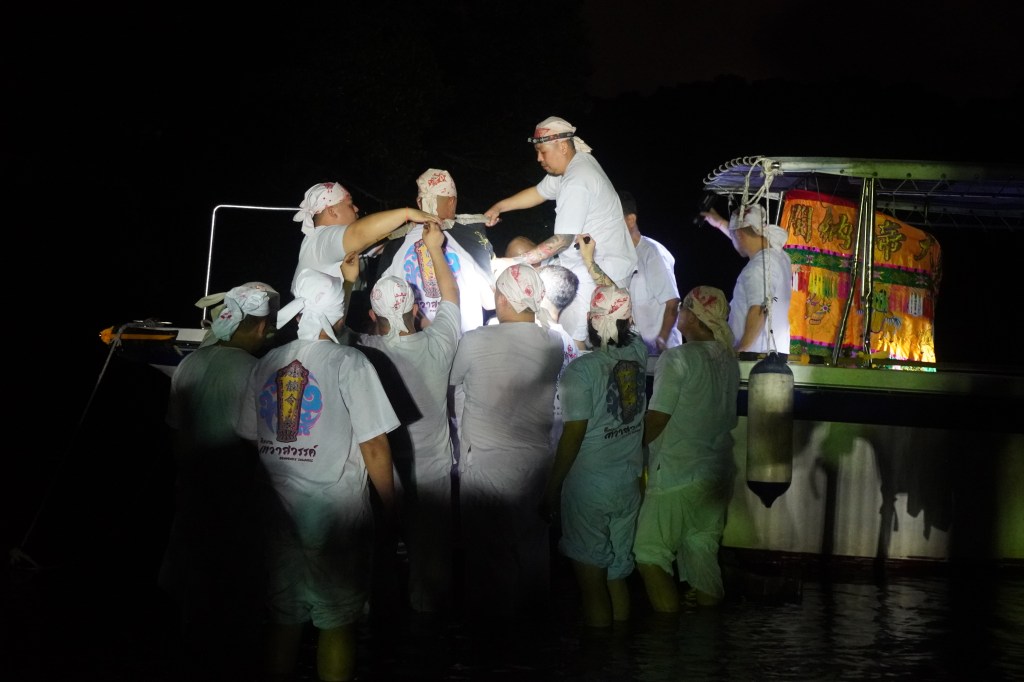
The temple’s senior ritual specialists and leadership board a vessel at the pier to receive the Nine Emperor Gods in open waters, concealed beneath a precious canopy and a black command flag.
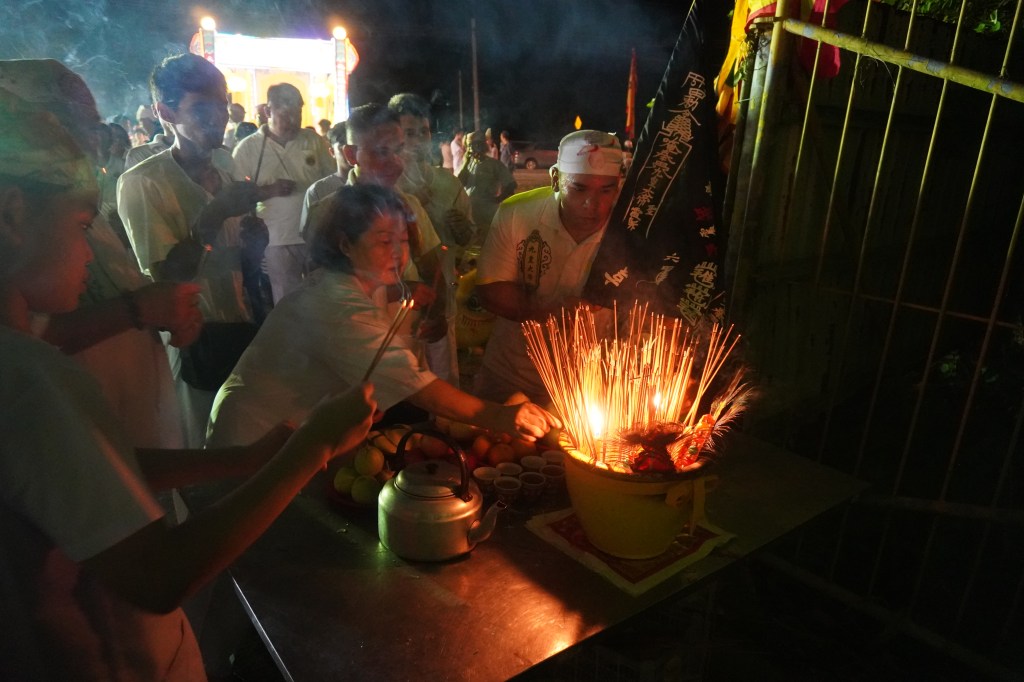
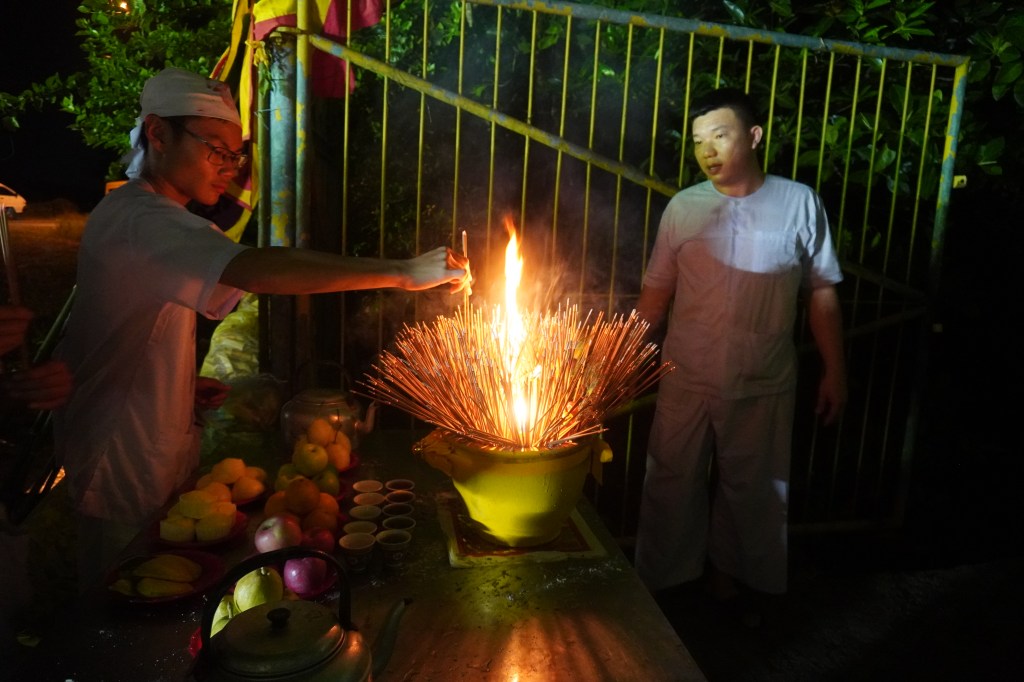
Devotees offer incense at a temporary altar beside the pier, where the incense flares into a sustained blaze 发炉 as they await the Nine Emperor Gods.
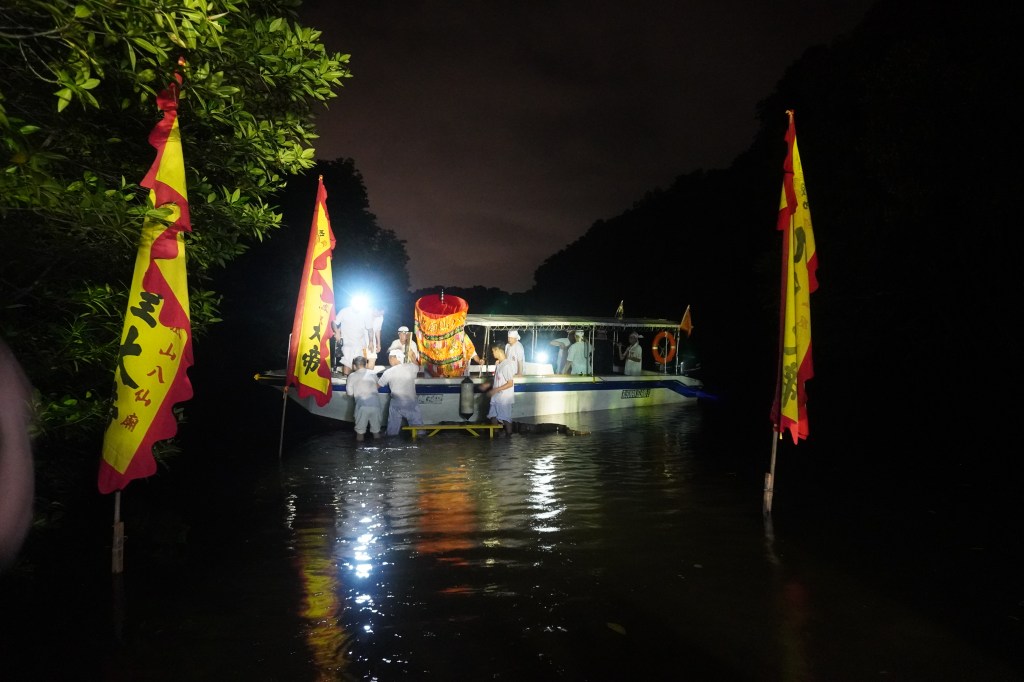
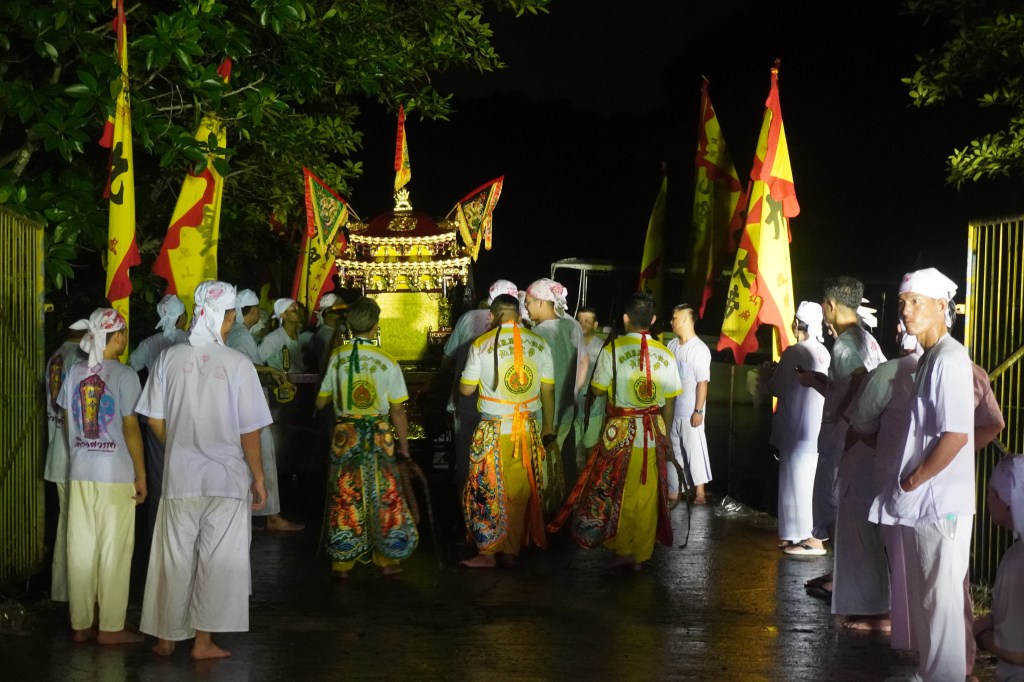
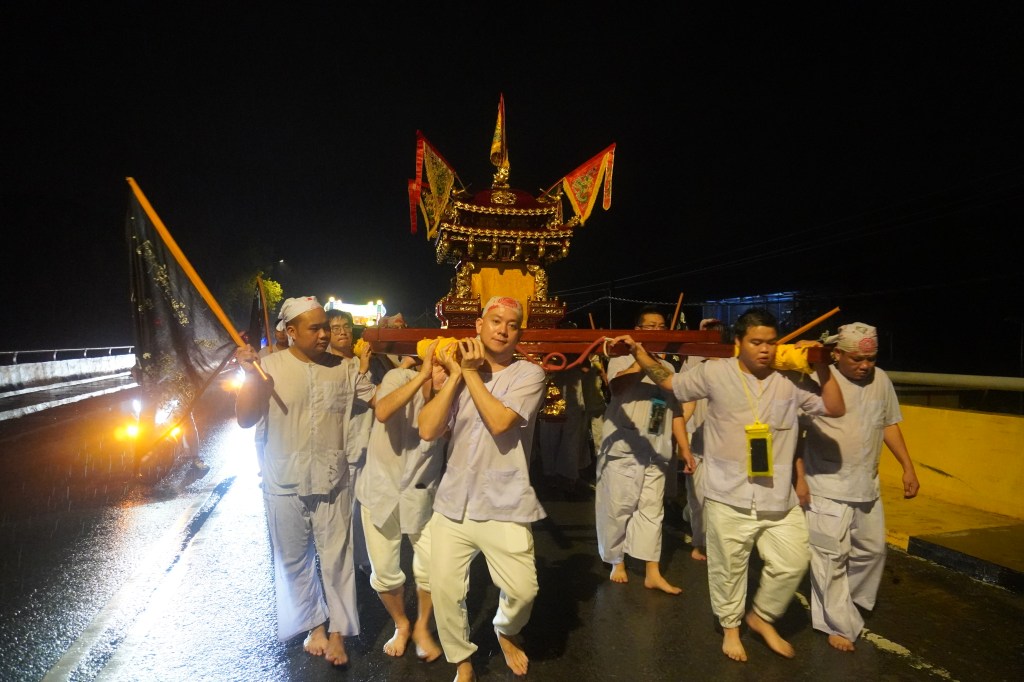
After the vessel returns to the pier, the Nine Emperor Gods are received into their palanquin under the escort of spirit mediums and carried in procession back to the temple.
At the pier, selected members of the temple leadership board a vessel and proceed into open waters to receive the Nine Emperor Gods, while devotees remain onshore, offering incense at a temporary altar as they wait. Upon the boat’s return, the deities are ceremonially transferred—once again concealed beneath black command flags—into the waiting palanquin. At this moment, the atmosphere intensifies: drums sound, lion dances begin, and the floats are fully illuminated. The return procession retraces its route back to the temple, where the Nine Emperor Gods are respectfully escorted inside and enshrined within the Sacred Virtue Palace for the duration of the festival. They will remain there, emerging only for the major procession on the fifth day and for the sending-off ceremony on the ninth day of the festival.
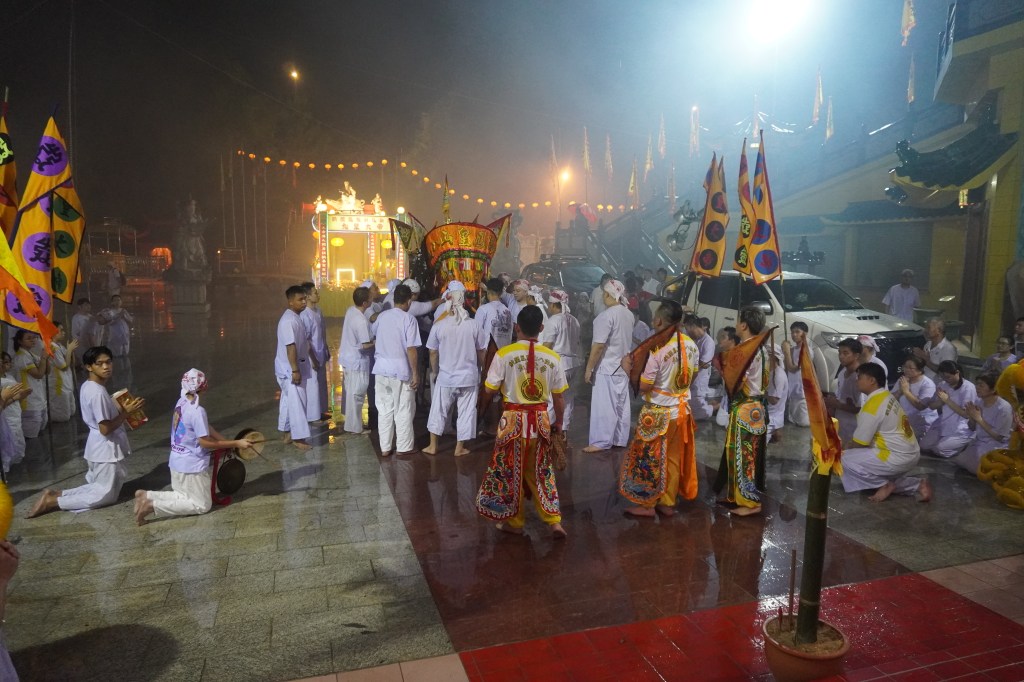
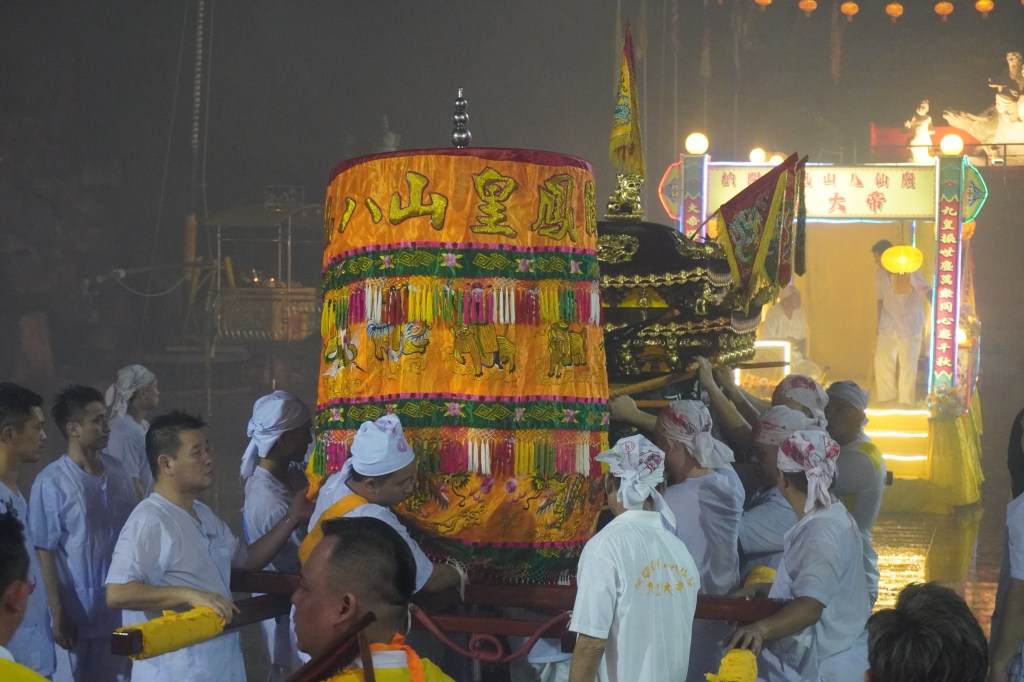
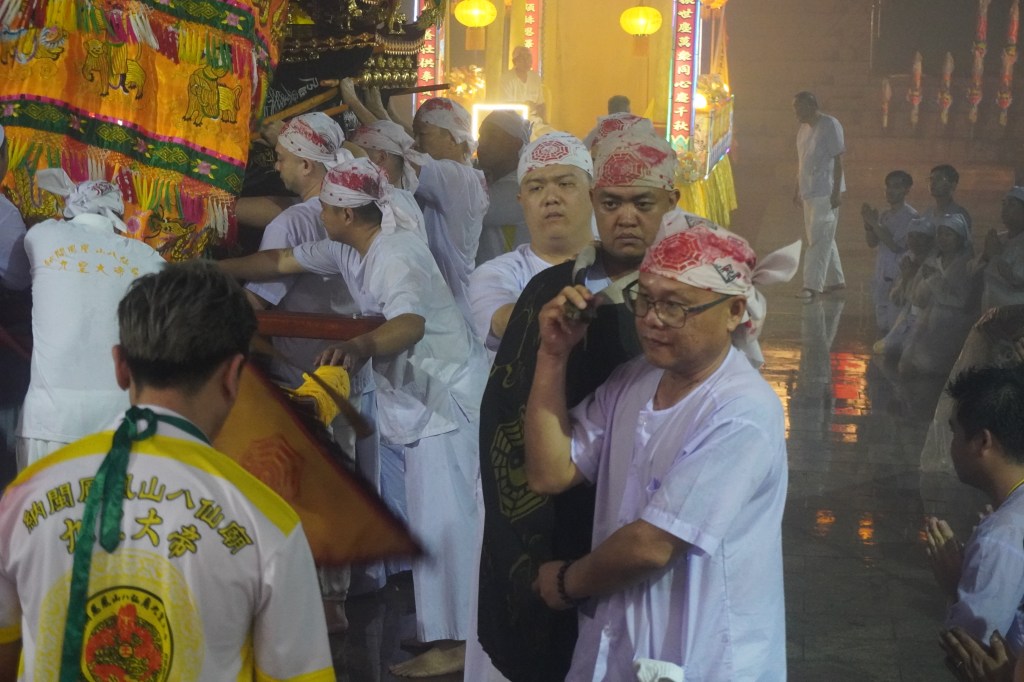
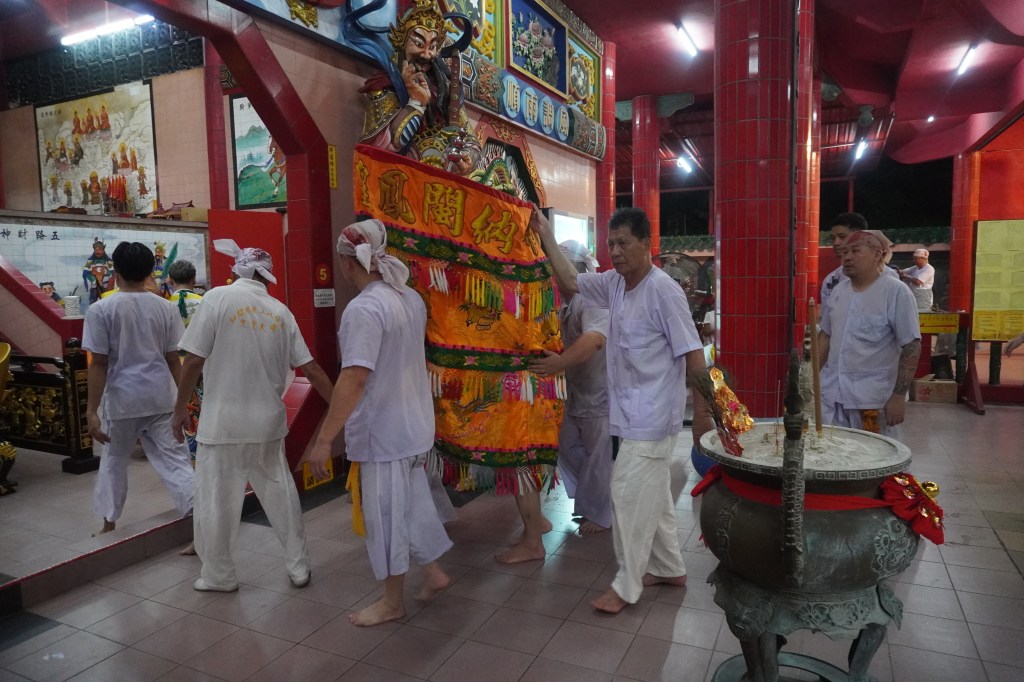
At the temple, the Nine Emperor Gods are concealed and escorted to the third-storey Sacred Virtue Palace under a parasol and black command flags, led by the temple’s senior leadership.
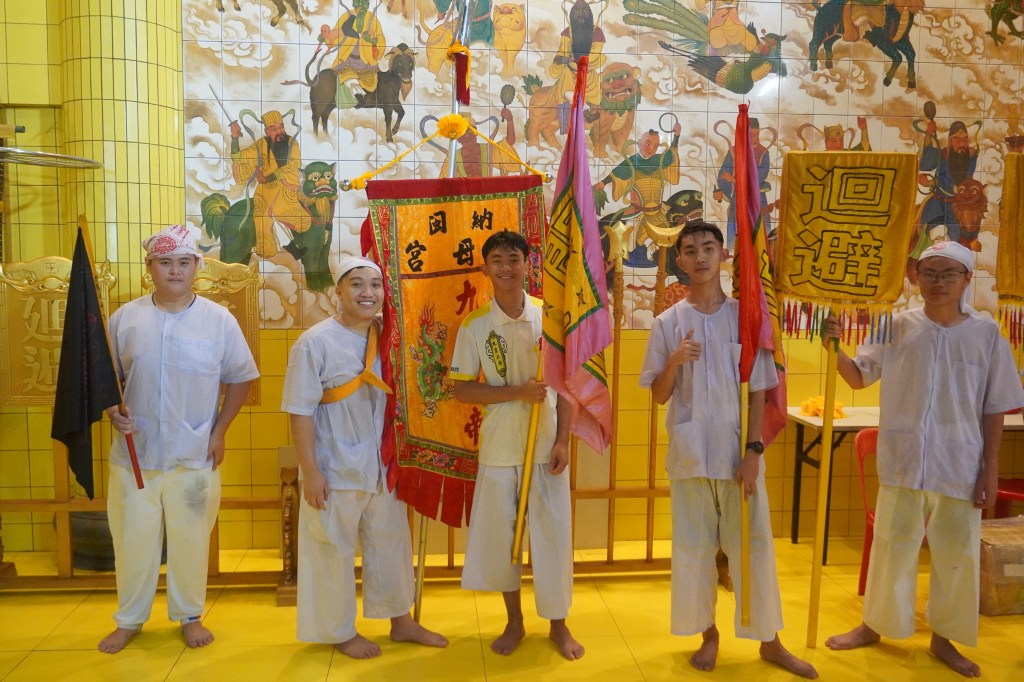
Younger volunteers and helpers gather outside the Sacred Virtue Palace following the successful enshrinement of the Nine Emperor Gods.
6. Ninefold Offering Ritual 九献礼 (Observed on the first, third, sixth, ninth, and final days of the festival)
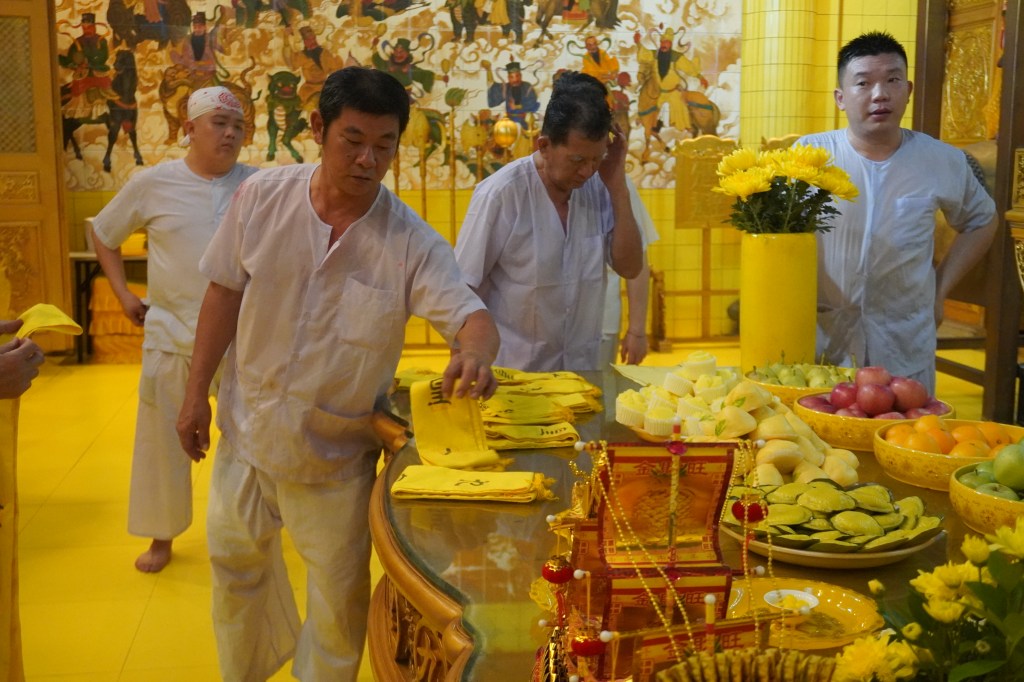
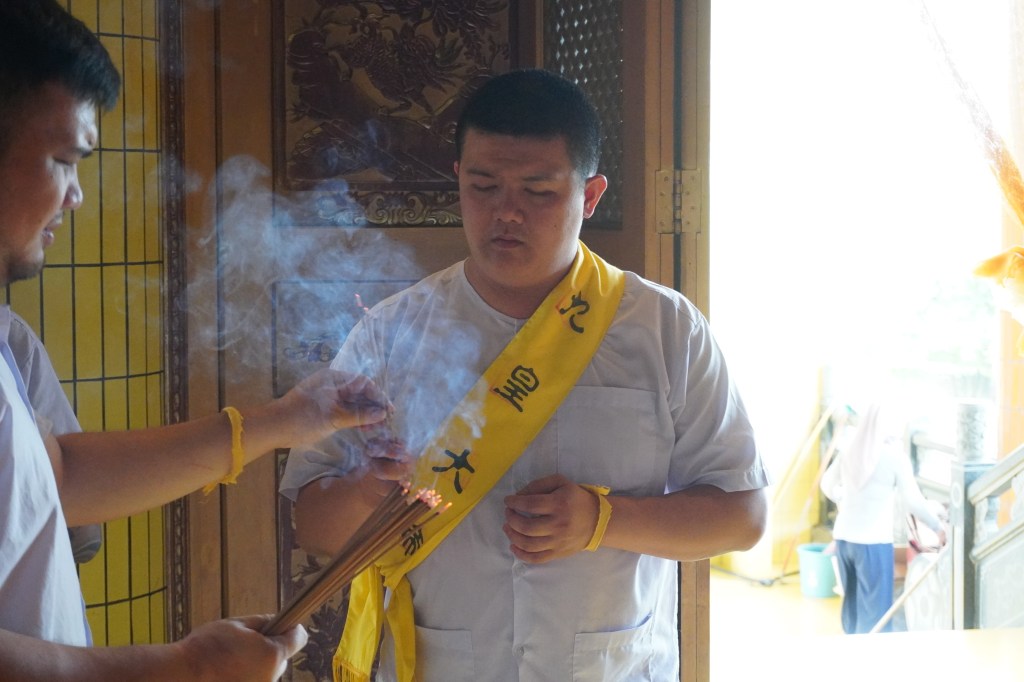
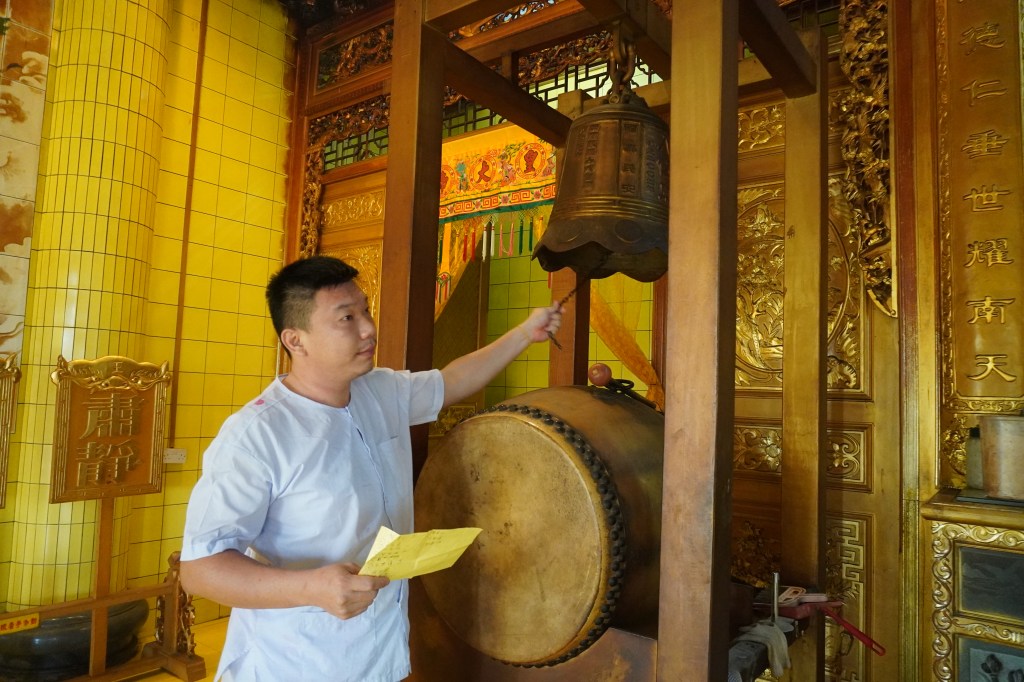
Temple leaders don ceremonial sashes, incense is distributed to participants, and a bell is rung to prepare the assembly for the rite.
The festival formally opens at the Nine Emperor Gods Palace 九皇殿 with the performance of the Ninefold Offering Ritual 九献礼 upon the Nine Emperor Gods enshrinement, accompanied by the ritual of Three Kneelings and Nine Prostrations 三跪九叩首礼. Conducted on the third storey of the temple, this rite marks the confirmed arrival of the Nine Emperor Gods and inaugurates the festival cycle in a solemn and highly formalised manner. At the Feng Huang Shan Ba Xian Miao, the Ninefold Offering Ritual is observed on the mornings of the first, third, sixth, and ninth days of the festival, as well as at other significant ritual junctures. For this temple, the ritual was formally systematised for the festival, with nine members of the temple leadership donning ceremonial sashes 绶带 and presenting offerings in strict sequence, followed by the reading and burning of a written petition. The atmosphere is deliberately restrained and dignified, underscoring the ritual authority of the deities.
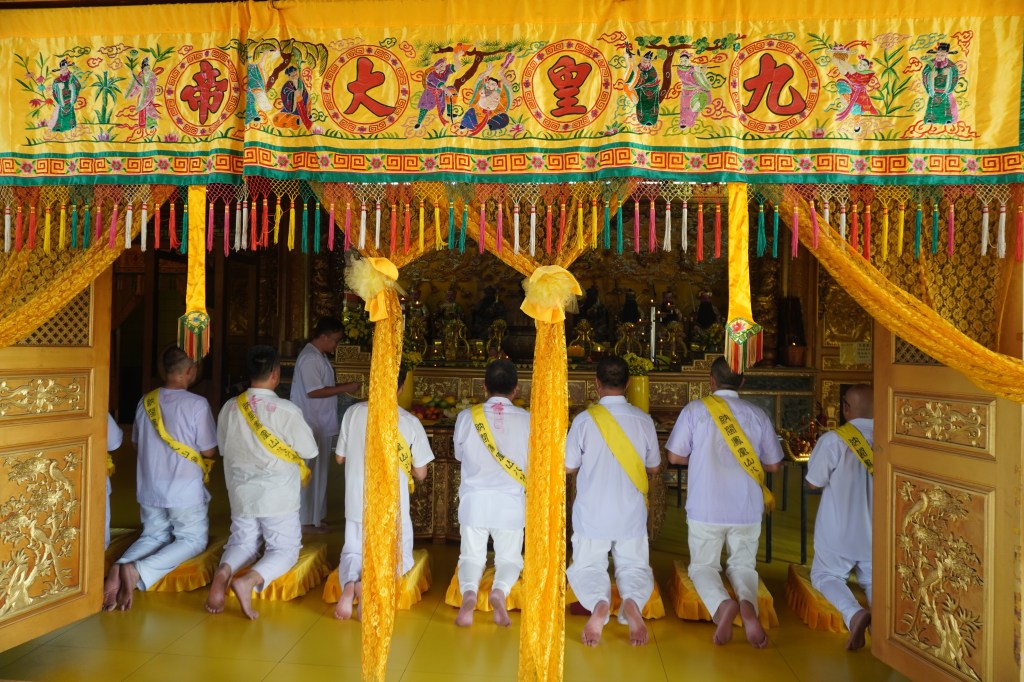
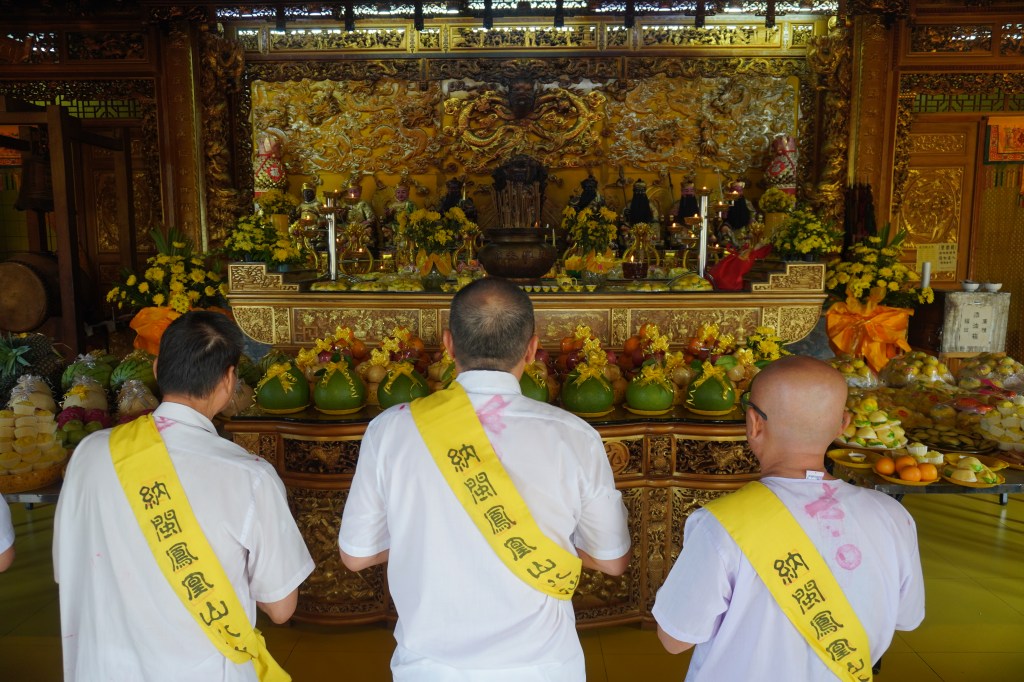
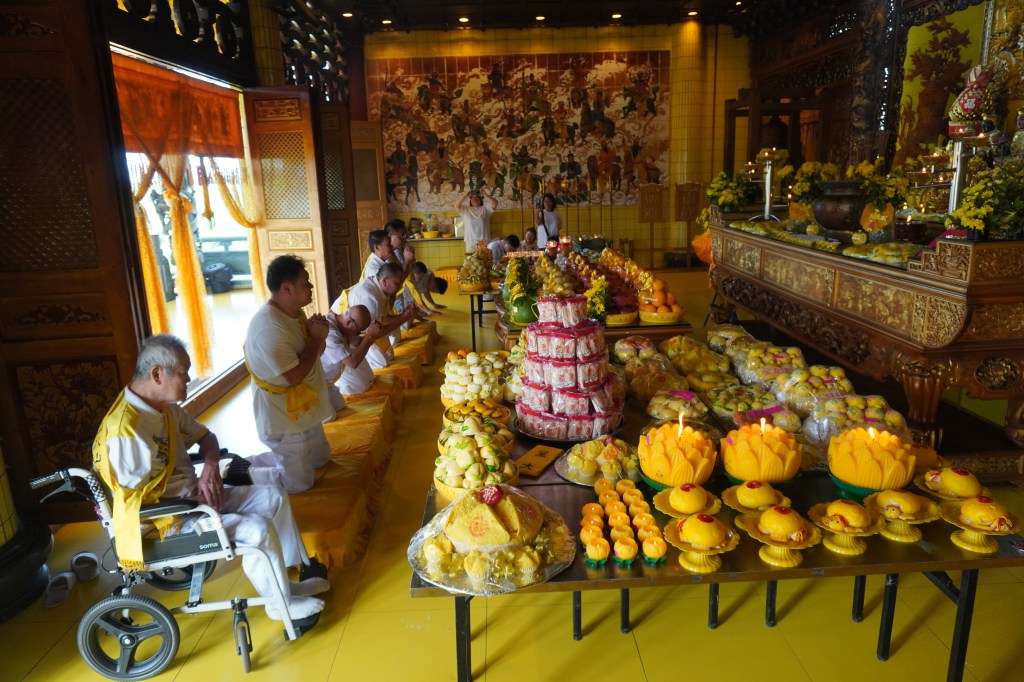
Participants take their positions and follow the master of ceremonies’ instructions and recitations.
In the context of the Nine Emperor Gods Festival at the Feng Huang Shan Ba Xian Miao, the Ninefold Offering Ritual refers to a structured presentation of nine distinct offerings to the Nine Emperor Gods. The number nine corresponds directly to the nine deities, and the repetition of the offering act establishes ritual completeness and symmetry. Through this ordered sequence, each deity is formally acknowledged, and the offering is rendered ritually whole and balanced. The rite affirms the presence and authority of the Nine Emperor Gods within the temple and signals the formal transition from preparation to full ritual engagement.
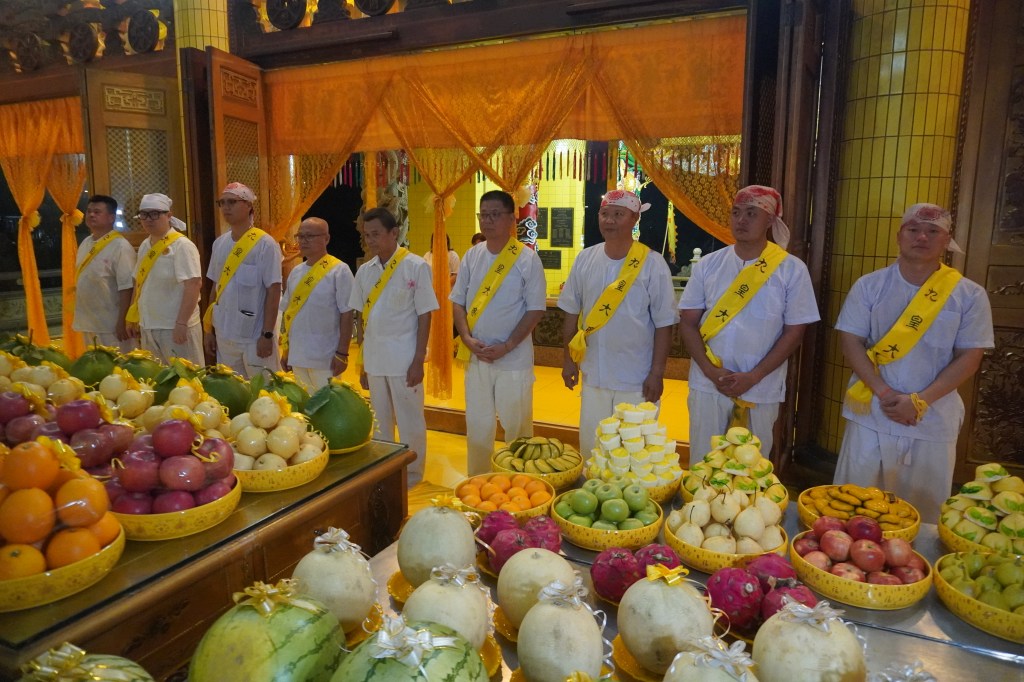
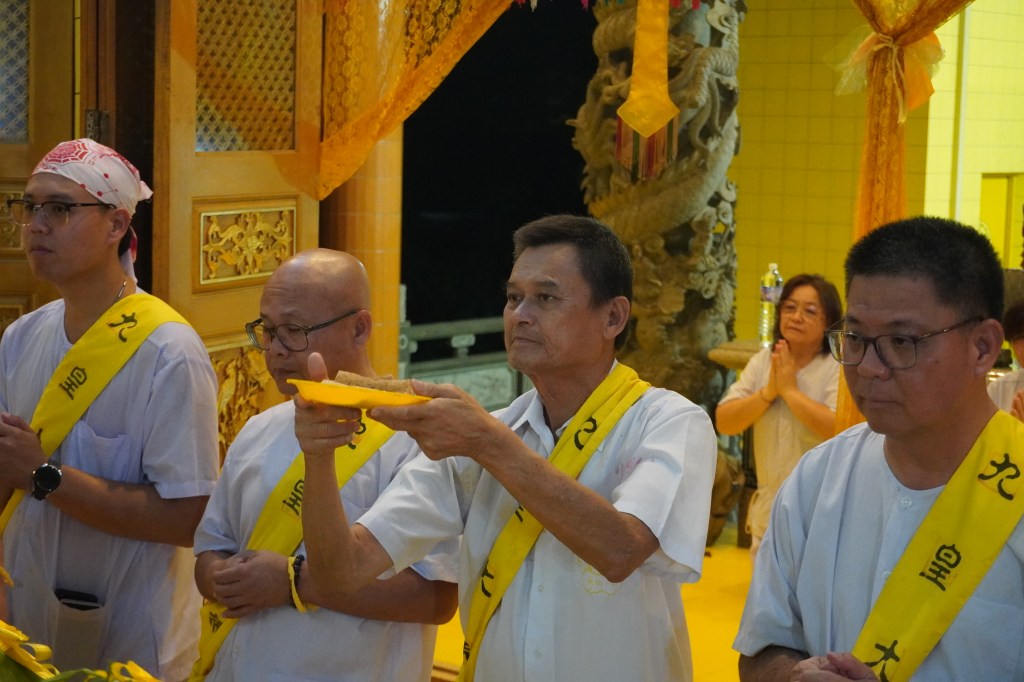
The temple chairman presents incense as part of the Ninefold Offering Ritual.
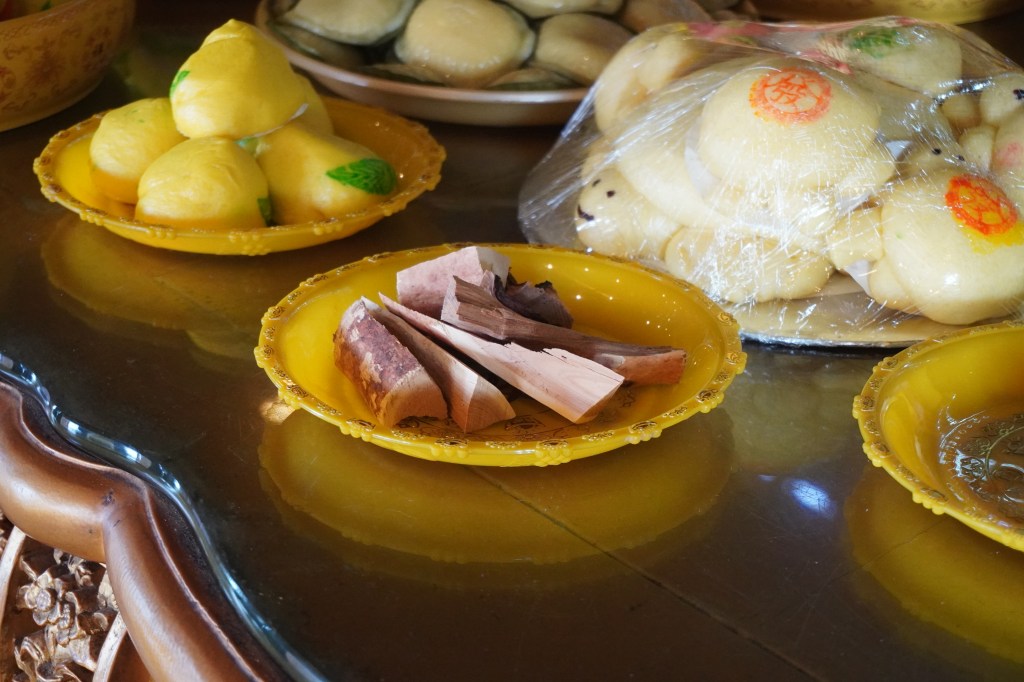
While the precise offerings may vary between temples, they are typically presented in a fixed and prescribed order. These commonly include incense, light in the form of lamps or candles, tea or water, flowers, fruits, ritual food, symbolic paper offerings, and prostrations, accompanied by spoken or chanted petitions. Each offering is made once within the sequence, producing nine consecutive acts of presentation.
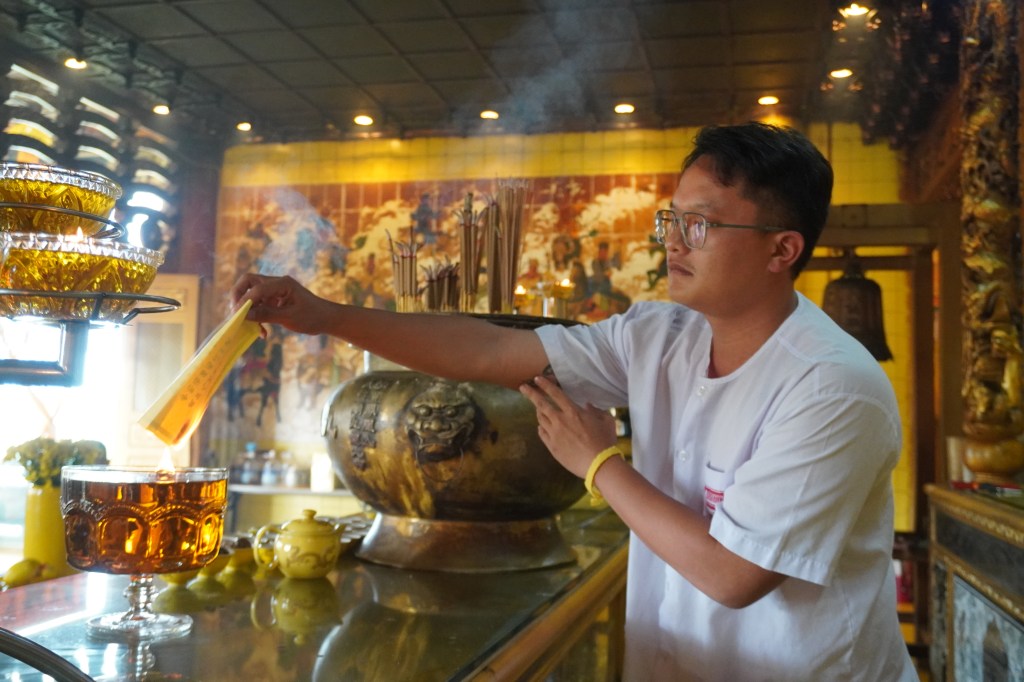
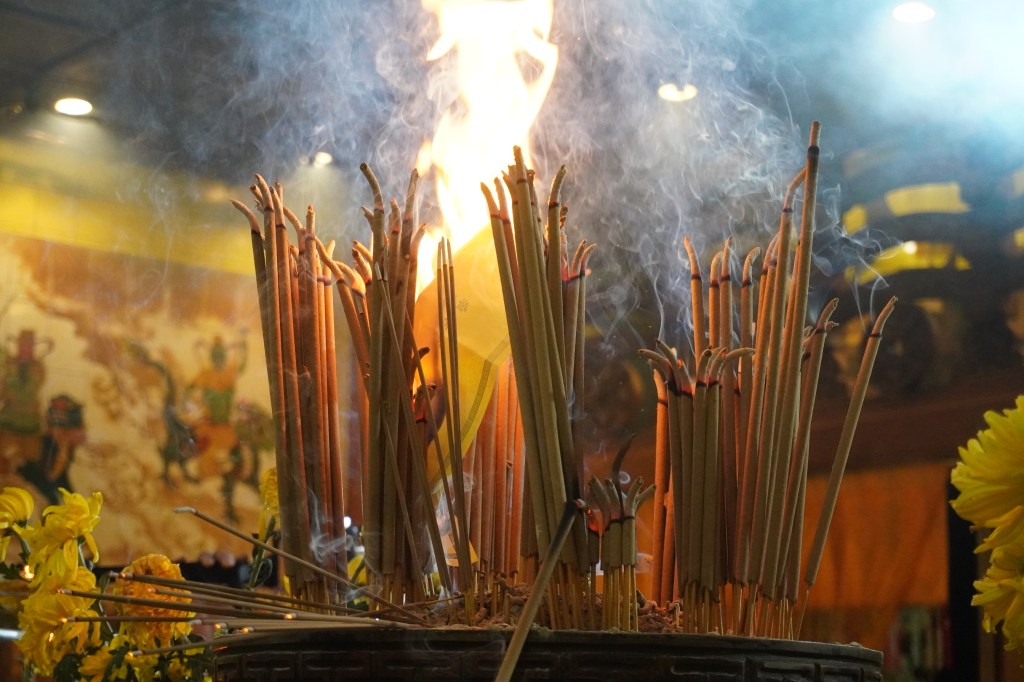
The written petition is incinerated in the incense censer dedicated to the Nine Emperor Gods at the conclusion of the ceremony.
7. Nine Lamps and Bamboo 高灯竹
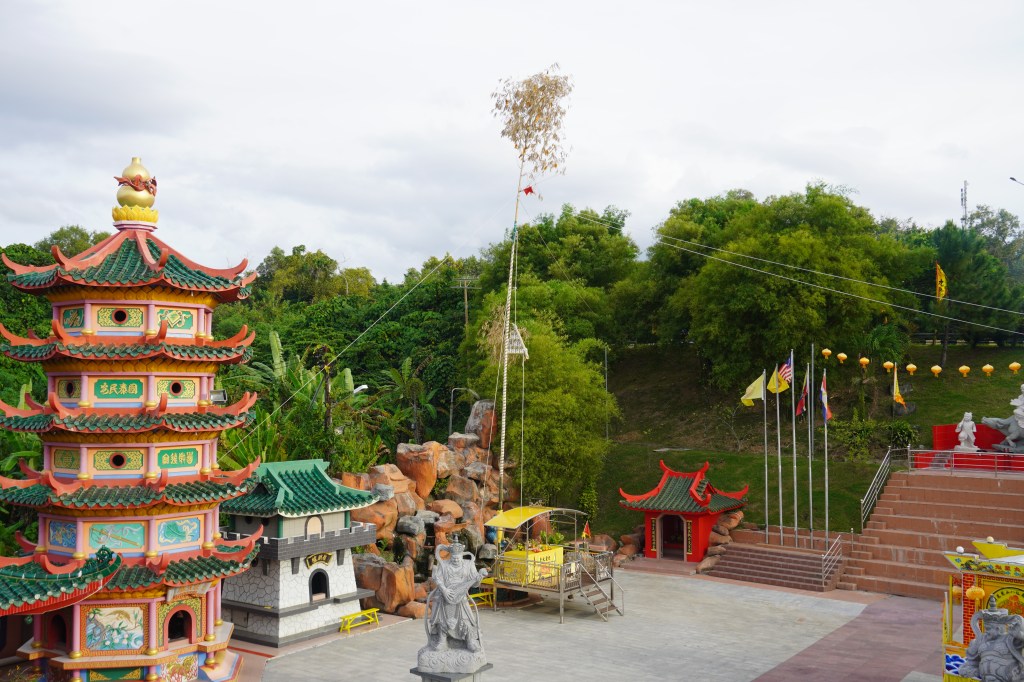
The nine lamps are raised into the sky on two prepared bamboo masts.
As with other Nine Emperor Gods temples, the commencement of the Festival at Feng Huang Shan Ba Xian Miao is marked by the establishment of a clearly defined ritual site through the raising of the Nine Lamps on a bamboo mast 高灯竹. At the temple, the nine lamps are lit and raised into the sky immediately after the Nine Emperor Gods are enshrined within the Sacred Virtue Palace on the third storey. For this purpose, bamboo stalks are specially sourced from a forest and ritually prepared. Two stalks are required: a slender bamboo mast bearing a red pennant inscribed with Heavenly Officer Bestowing Blessings 天官赐福, and a thicker bamboo shaft that forms the main structural support for the lamp installation.
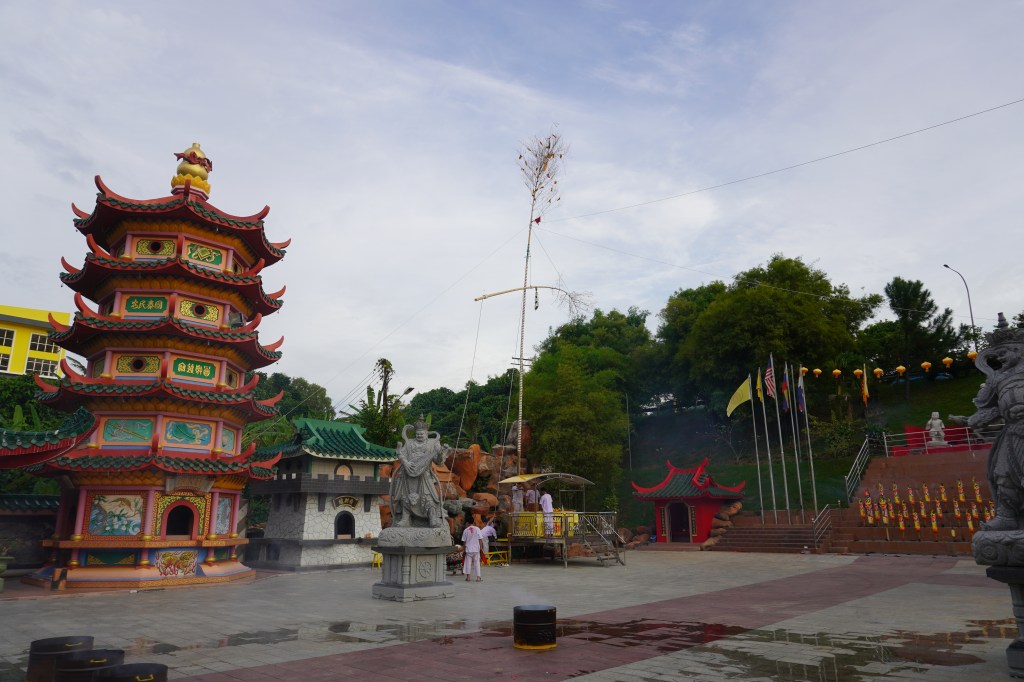
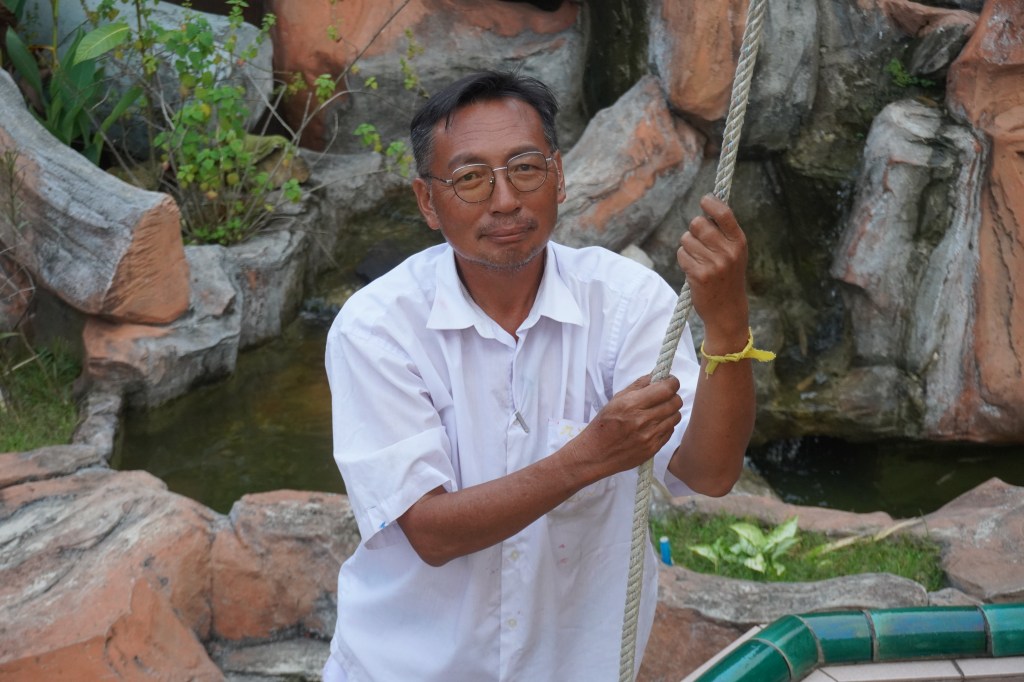
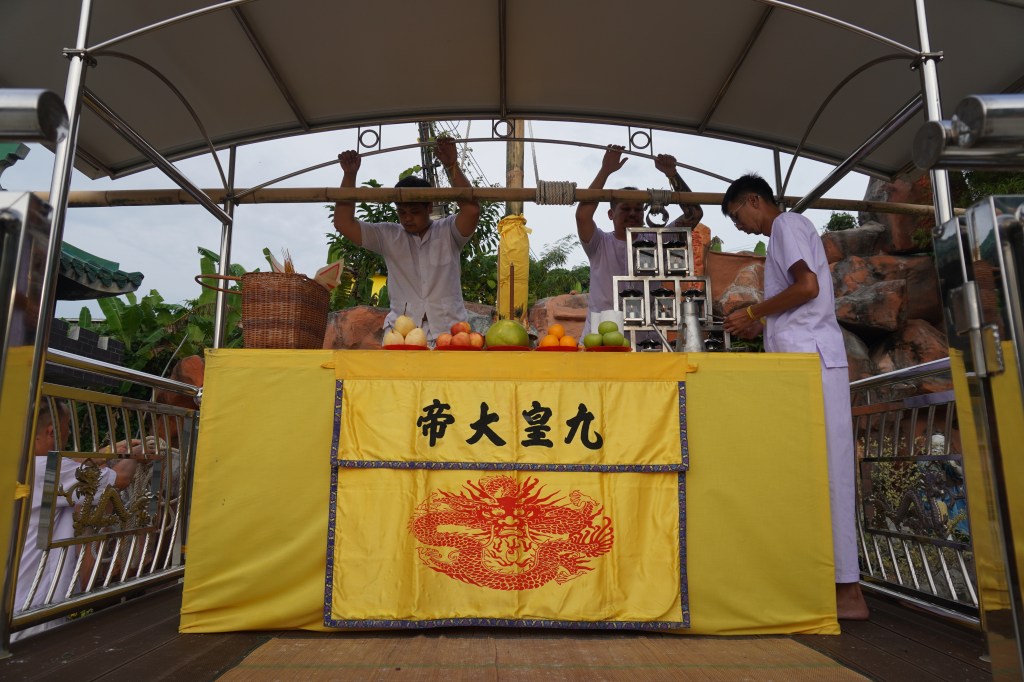
Senior volunteers carefully lower the nine lamps using a rope-and-pulley system, stabilising the structure to prevent excessive sway.
Once raised, the nine lamps are kept continuously lit for the entire duration of the festival. They are lowered only twice daily, at five in the morning and five in the evening, for cleaning and refuelling. These procedures are treated with solemnity. Only designated personnel are permitted to ascend the platform where the lamp altar is located, and they must be dressed entirely in white and remove their footwear before doing so. Senior volunteers are responsible for hoisting the mast, removing soot from the wicks, and replenishing the oil, while younger volunteers provide rhythmic accompaniment with drums and cymbals, marking the ritual maintenance of the lamps as a collective and disciplined undertaking.
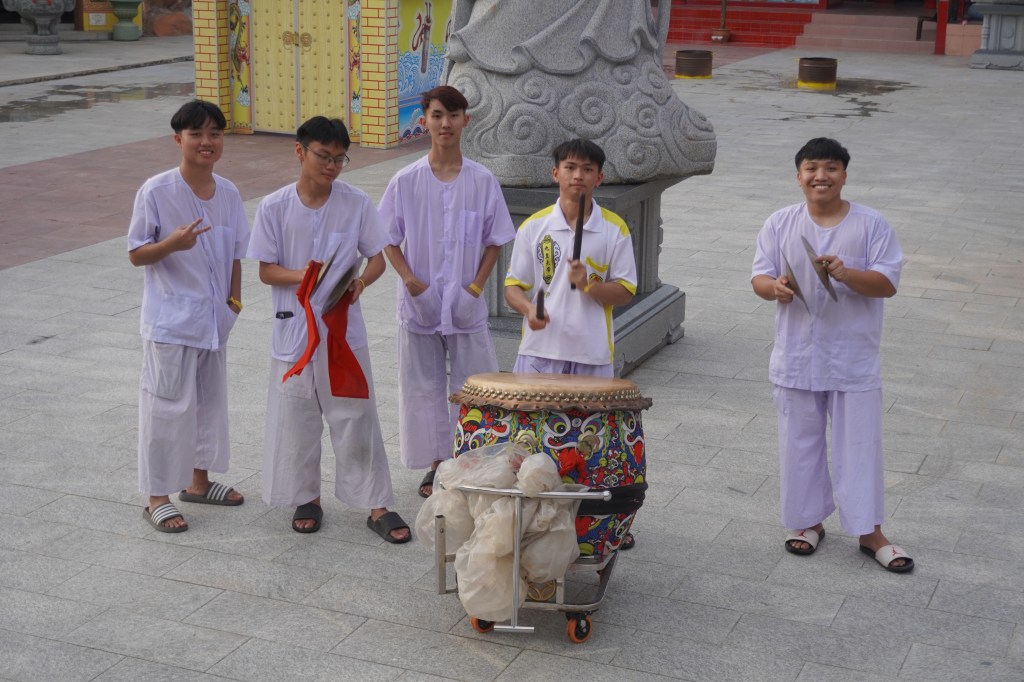
Drums and cymbals sound continuously while the lamps are lowered and cleaned.
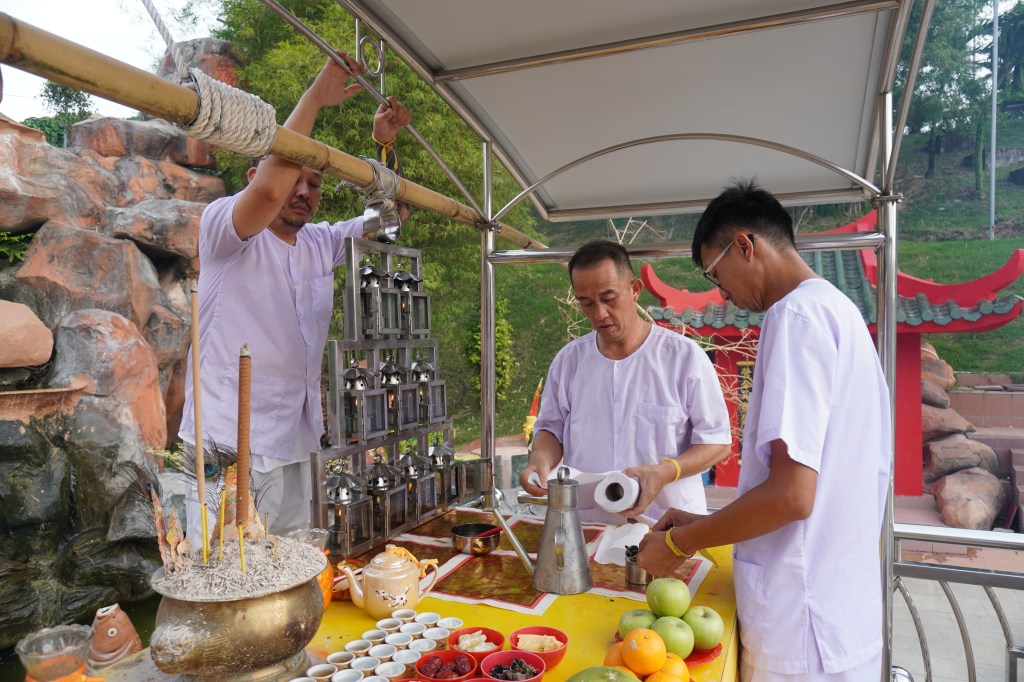
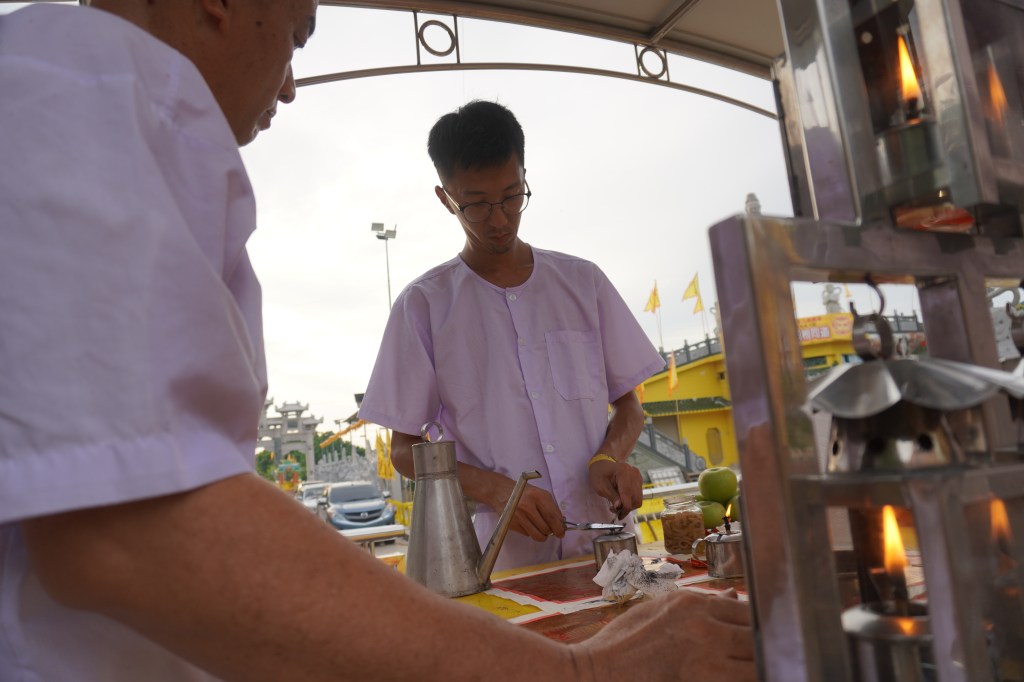
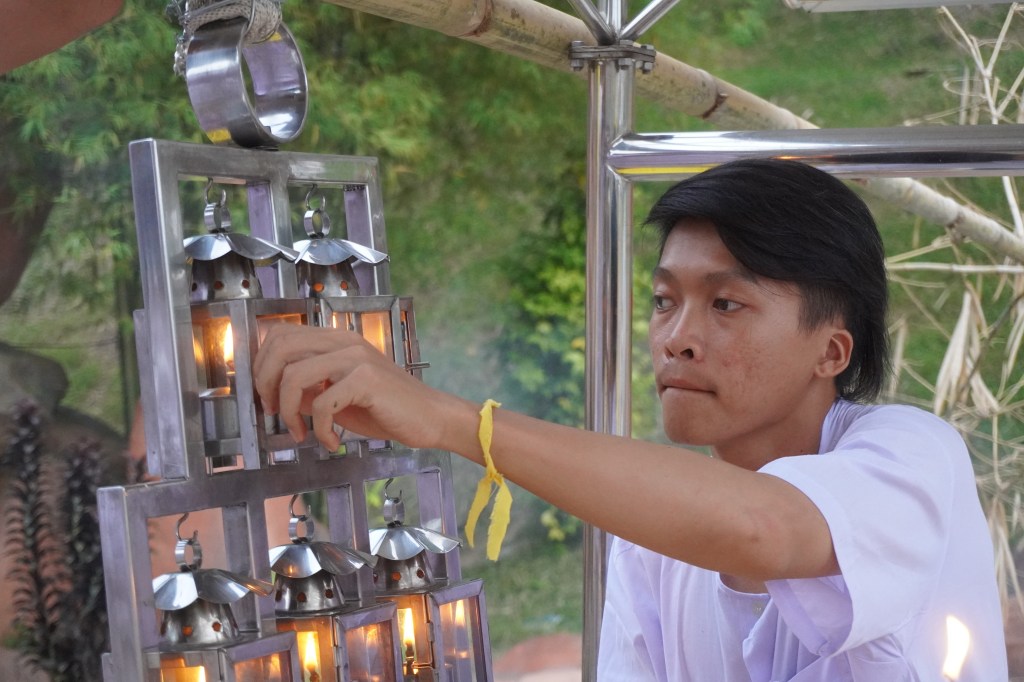
Each lamp is cleaned, its wick trimmed, kerosene replenished, and fittings checked for security.
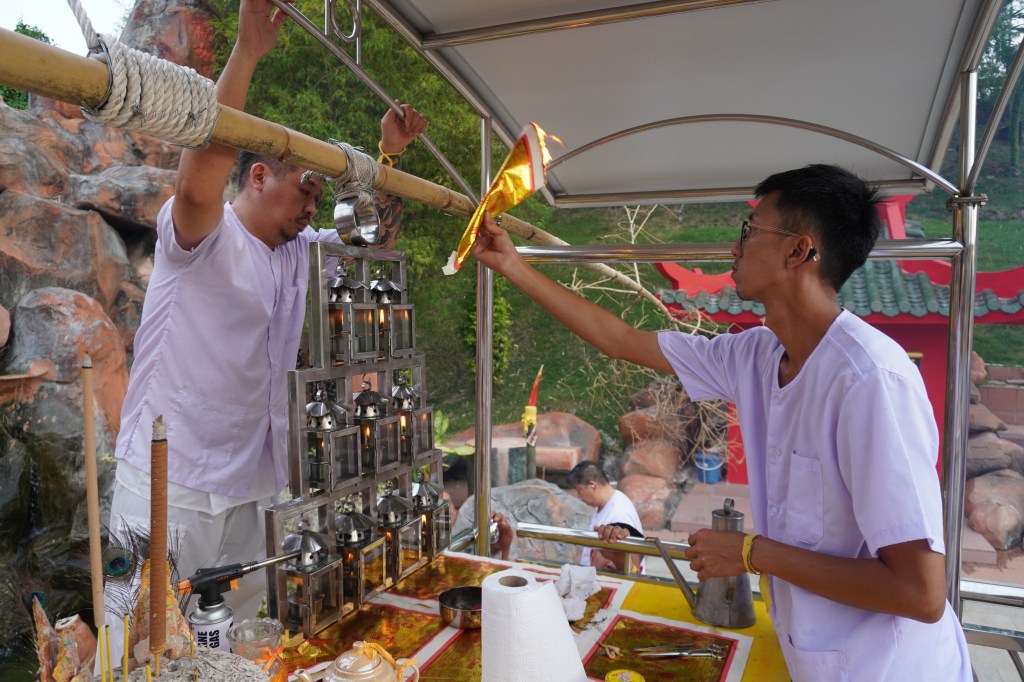
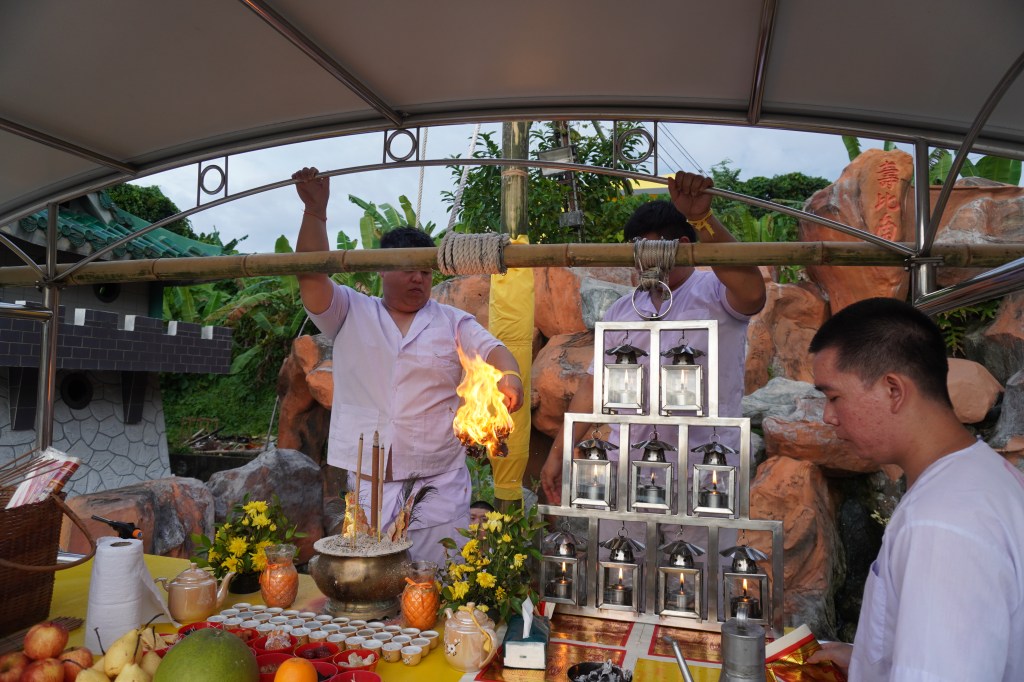
A sheaf of burning incense paper is passed along the lamps and bamboo mast to ritually purify the installation.
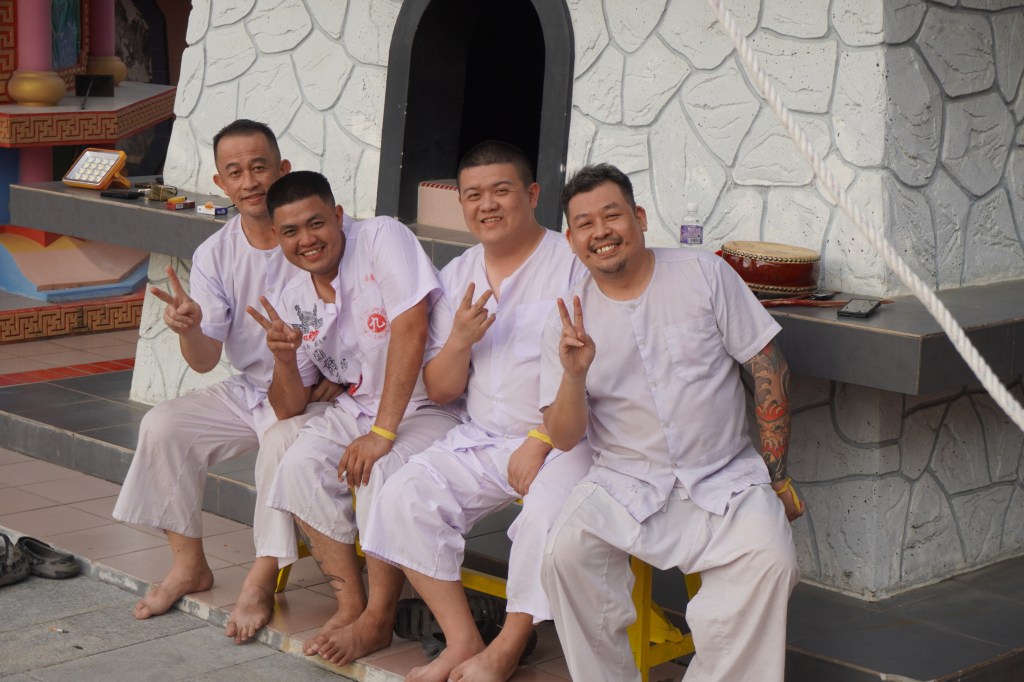
Ritual specialists and volunteers rest briefly after the nine lamps are successfully raised.
At the Feng Huang Shan Ba Xian Miao, the Nine Lamps are not fixed at a single height but are raised progressively over the course of the festival. Each day, the lamps are hoisted slightly higher, reaching their maximum height on the morning of the ninth day. This gradual elevation is understood to signal spirit soldiers 神军神兵 associated with the Nine Emperor Gods, who are believed to follow the deities from afar, to descend upon the temple. After the Nine Emperor Gods depart on the ninth day of the ninth lunar month, the lamps are lowered to half-mast height. This change in position marks the conclusion of the deities’ presence and signals that the festival is ending, after which the bamboo structure will be dismantled.
8. Inviting the Deities to Respond to Devotees’ Questions, 21 October 2025 (First day of the ninth lunar month)
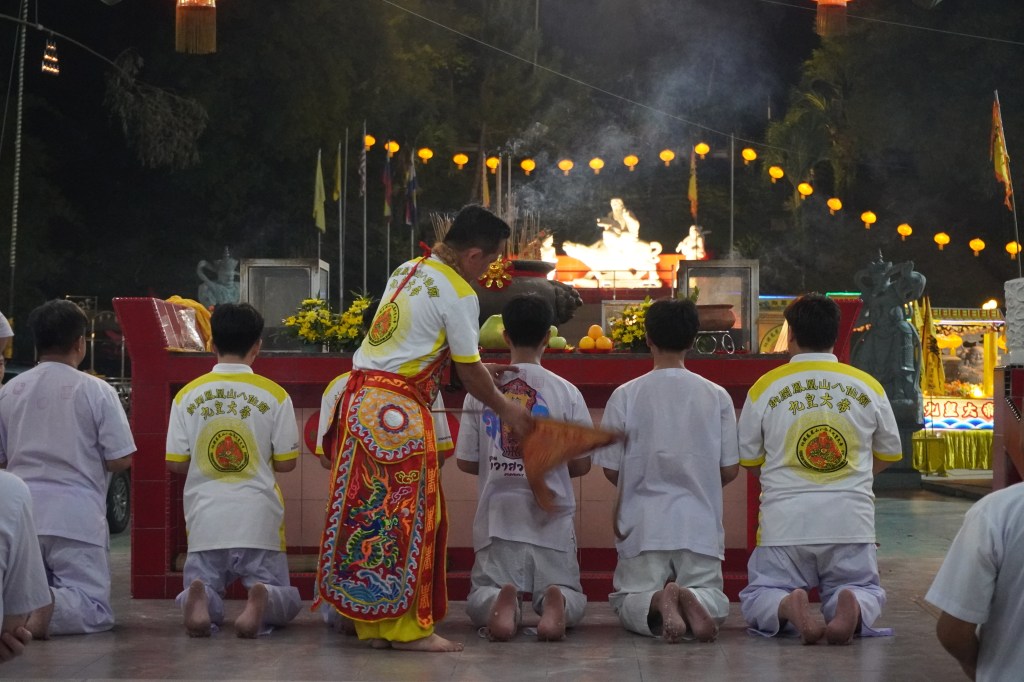
Devotees gather in batches before the Jade Emperor altar for the ceremony to be performed.
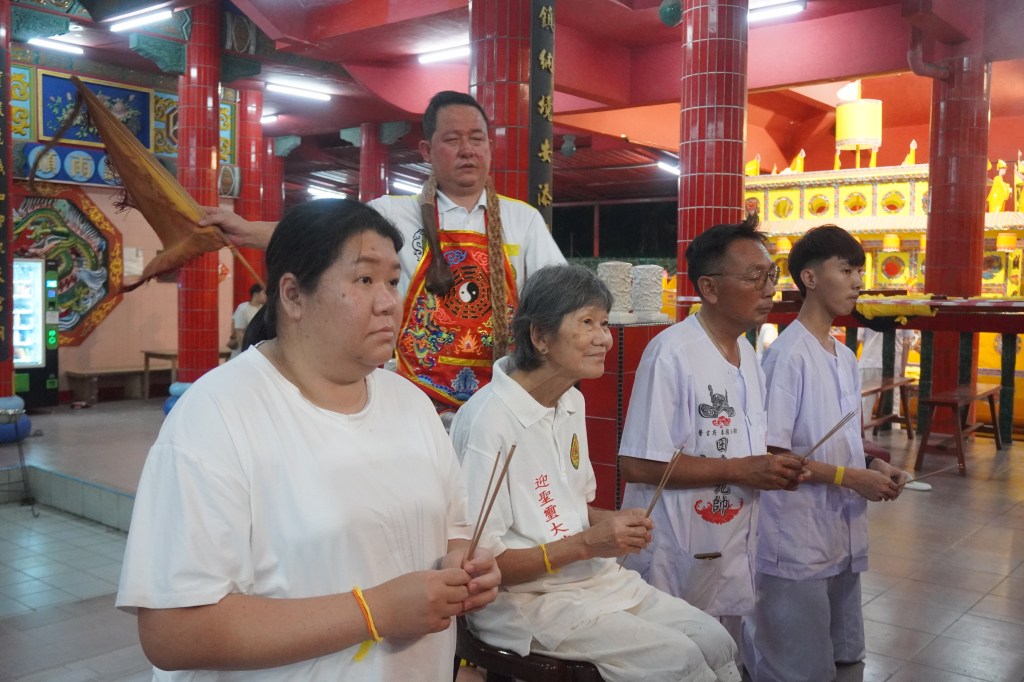
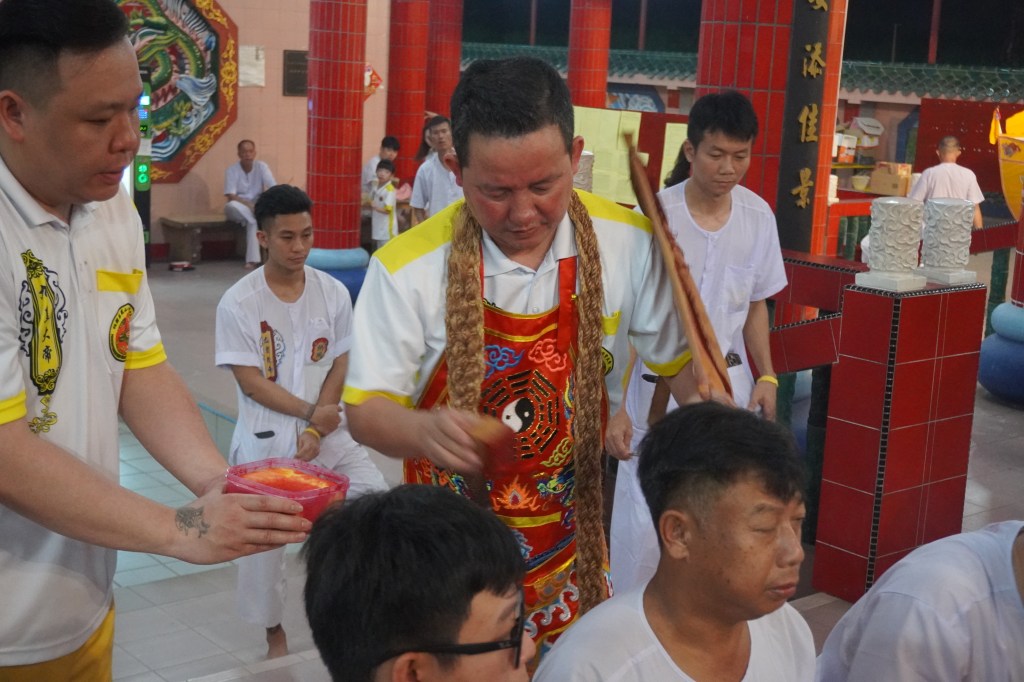
A spirit medium waves a command flag behind devotees to confer blessings and dispel misfortune, then stamps a seal on the back of their clothing to signify protection.
In the evening of the first day of the ninth lunar month, deities are invited to descend to the altar to respond to devotees’ questions and dispense blessings. On this occasion, a spirit medium takes position at the temple’s main altar to receive the deities. Upon their descent, ritual whips are employed before and after each devotee, and command flags 令旗 are used to stamp and ritually cleanse participants as they pass before the altar. The ceremony is conducted in successive batches, allowing for orderly movement and broad participation. Devotees of all ages, young and old alike, may take part, reflecting the inclusive character of this first evening of direct deity–devotee interaction during the festival.
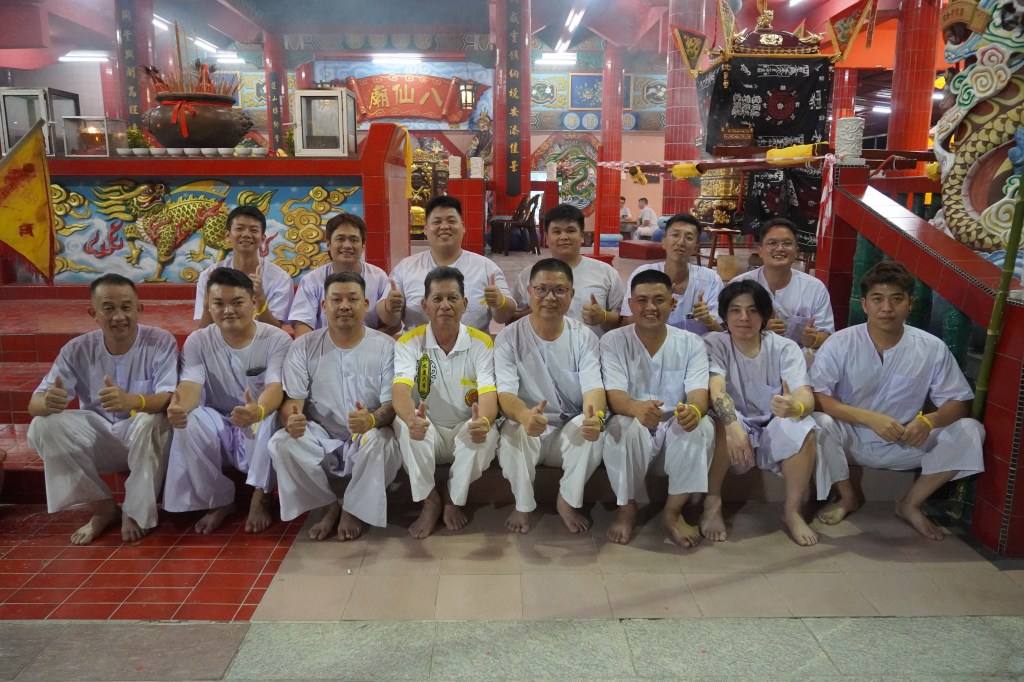
Senior devotees and volunteers gather at the temple entrance after completing the evening blessing rite.
9. Preparation for the Crossing of the Pass and Commemoration of the Dipper Star Lords, 22 October 2025 (Second day of the ninth lunar month)
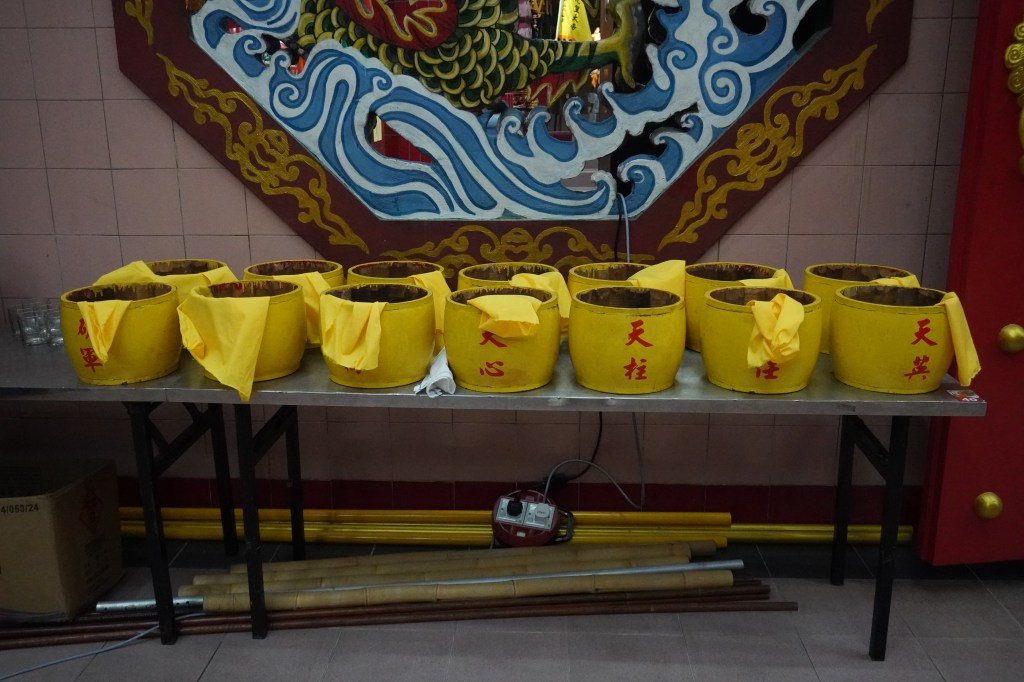
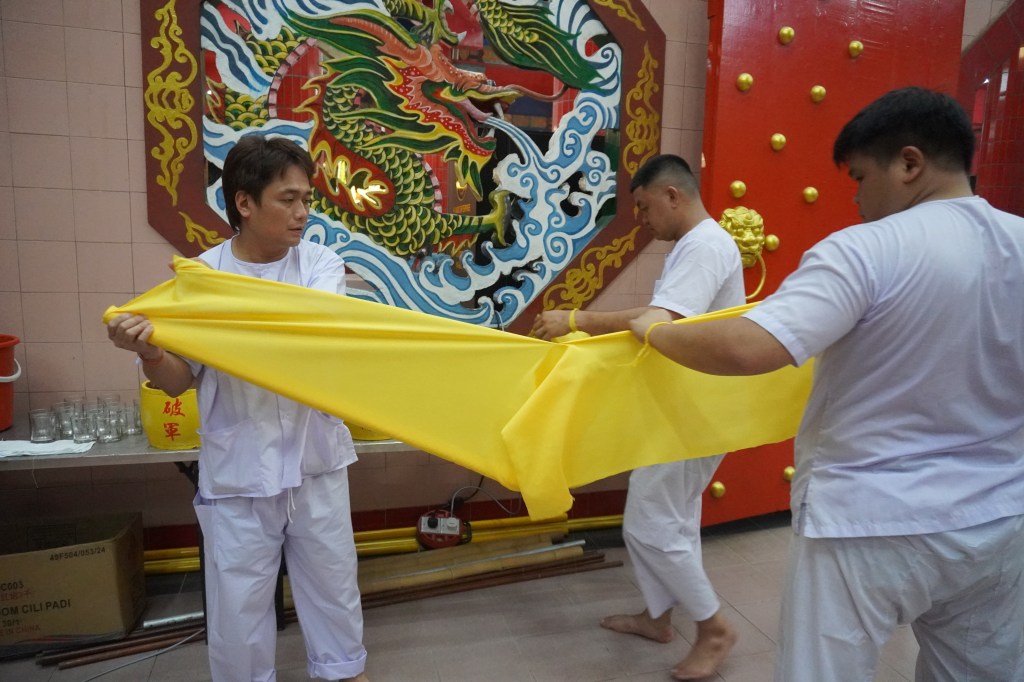
Yellow cloth is prepared to fill the interior of the Dipper Lamps painted with the names of the Northern Dipper stars for later use in the Festival.
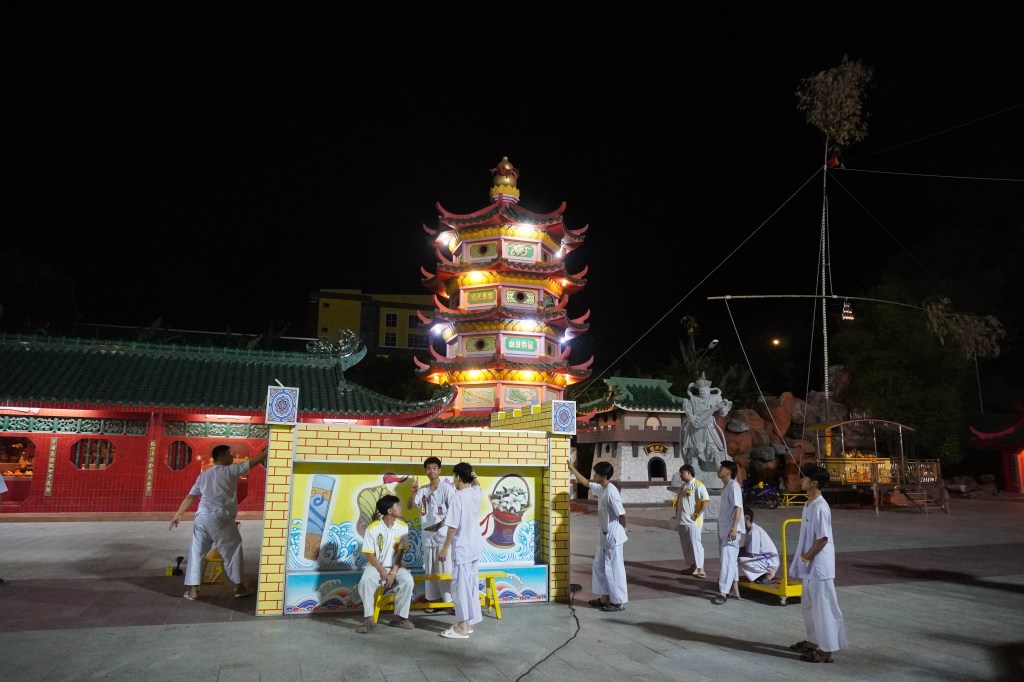
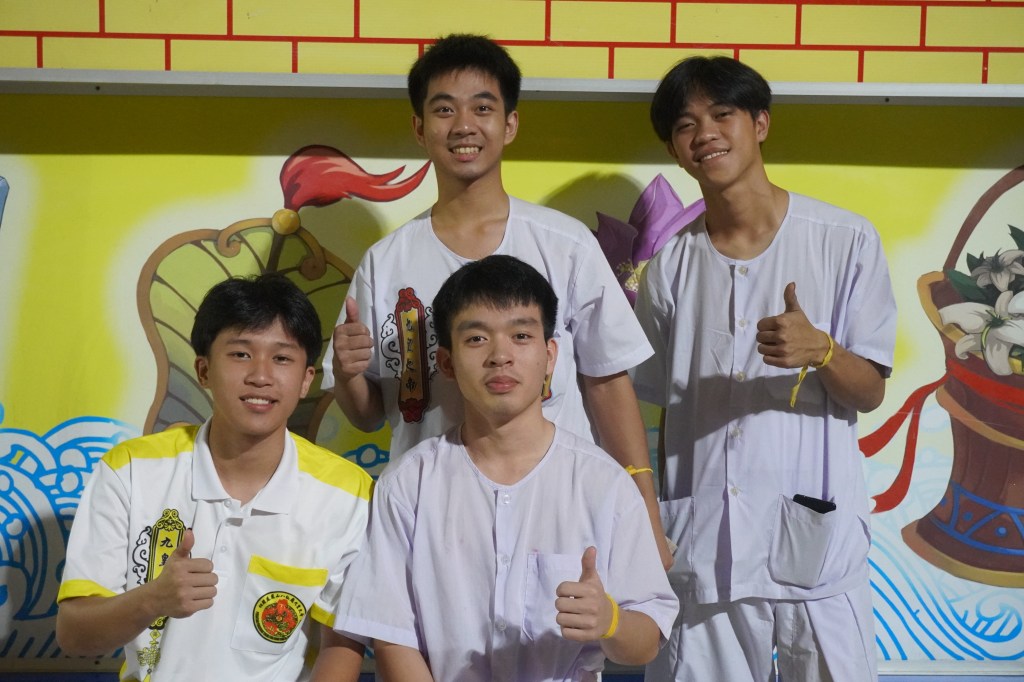
Younger devotees and volunteers clean the Crossing of the Pass structure after it has been erected by senior devotees.
The second evening is largely devoted to preparation for the Crossing of the Pass and Safety ritual 过平安关, scheduled for the fourth night of the festival and regarded as one of its most anticipated events. Dipper Lamps 斗灯 bearing the names of the seven stars of the Northern Dipper 北斗七星 are carefully cleaned, refilled with oil, and draped in yellow cloth. At the same time, temple volunteers assemble the temporary ritual structure for the crossing ceremony, a purpose-built installation with a clearly defined entrance and exit. Once the framework is secured and reinforced, younger volunteers take over to clean the structure and check its stability, ensuring that it is ready for use in the days ahead.
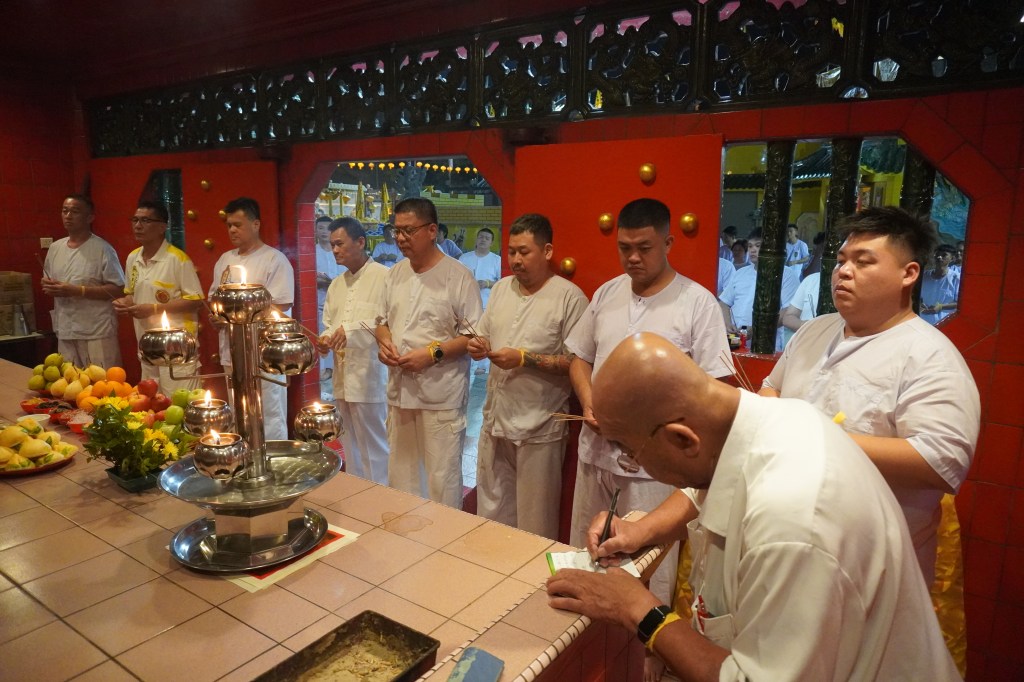
Temple leaders gather at the Dipper Mother altar to perform prayers to the Southern and Northern Dipper Star Lords.
Later that night, the temple committee and leaders commemorate the anniversary of the Southern and Northern Dipper Star Lords 南辰北斗星君 by performing the Three Kneelings and Nine Prostrations ritual 三跪九叩首礼 at the altar of the Dipper Mother Dou Mu 斗母殿, located on the first floor of the temple.
10. Collective Offering at the Gate of the Netherworld for Deceased Senior Vegetarian Members and Selection of Censer Masters for the Coming Year, 23 October 2025 (Third day of the ninth lunar month)
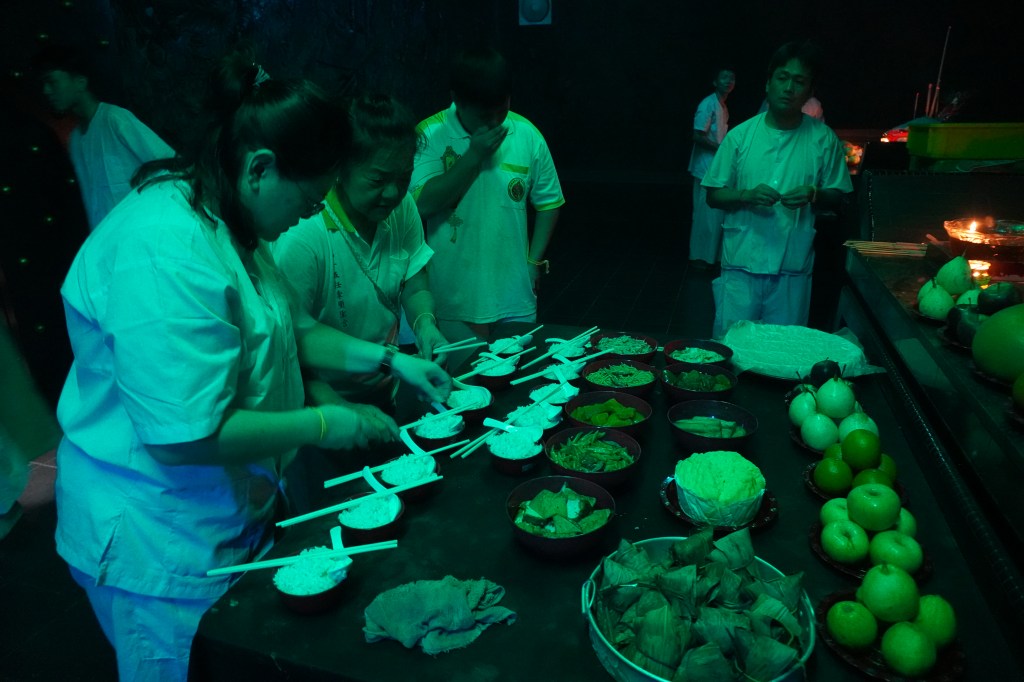
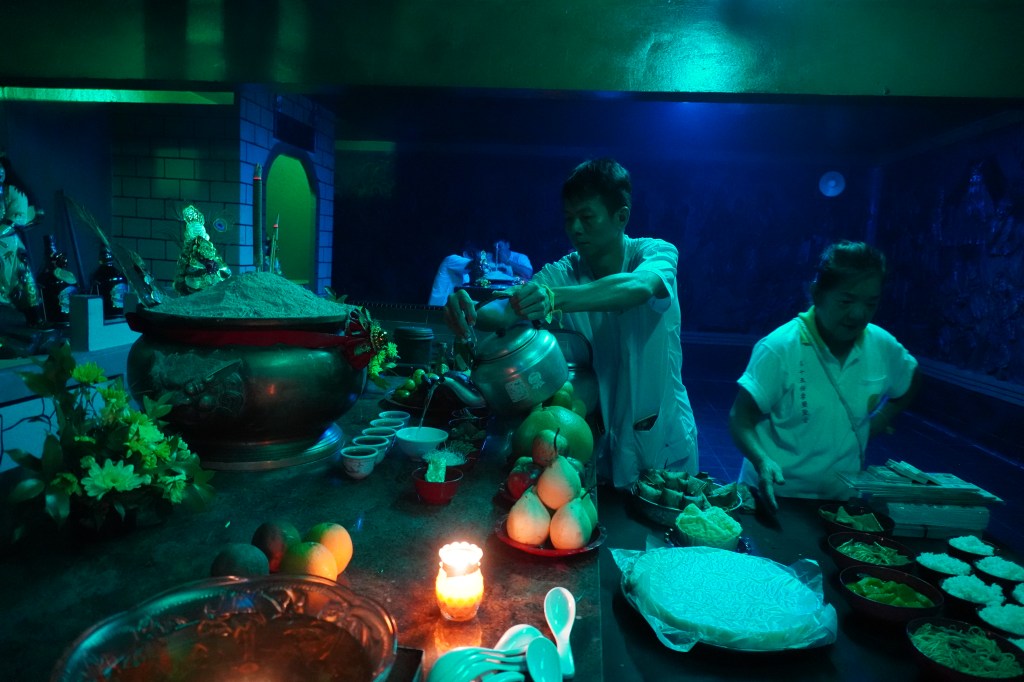
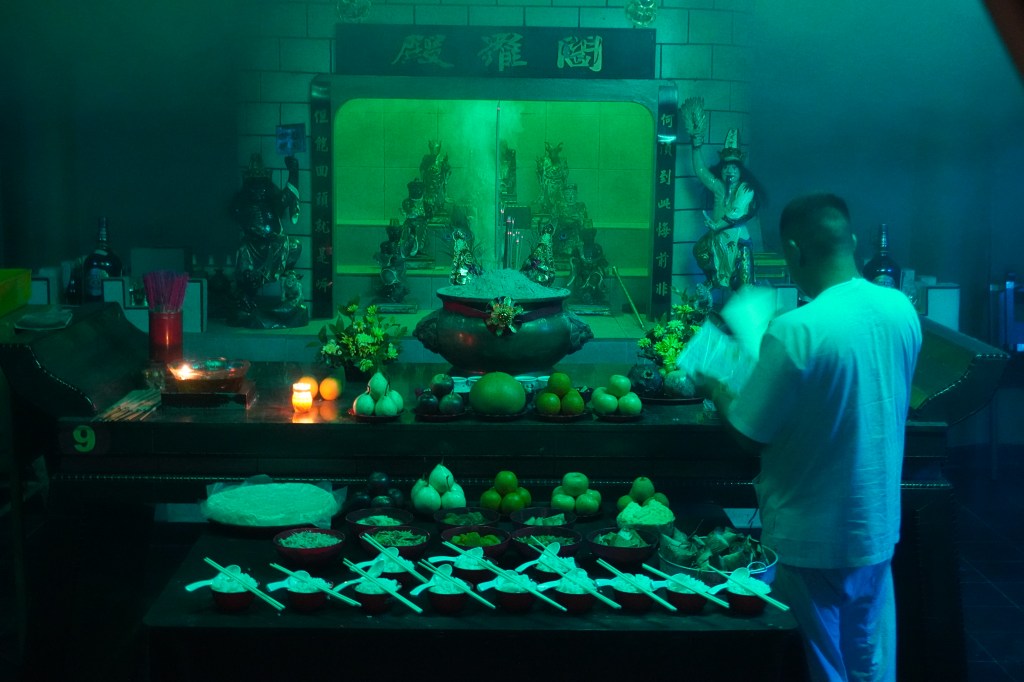
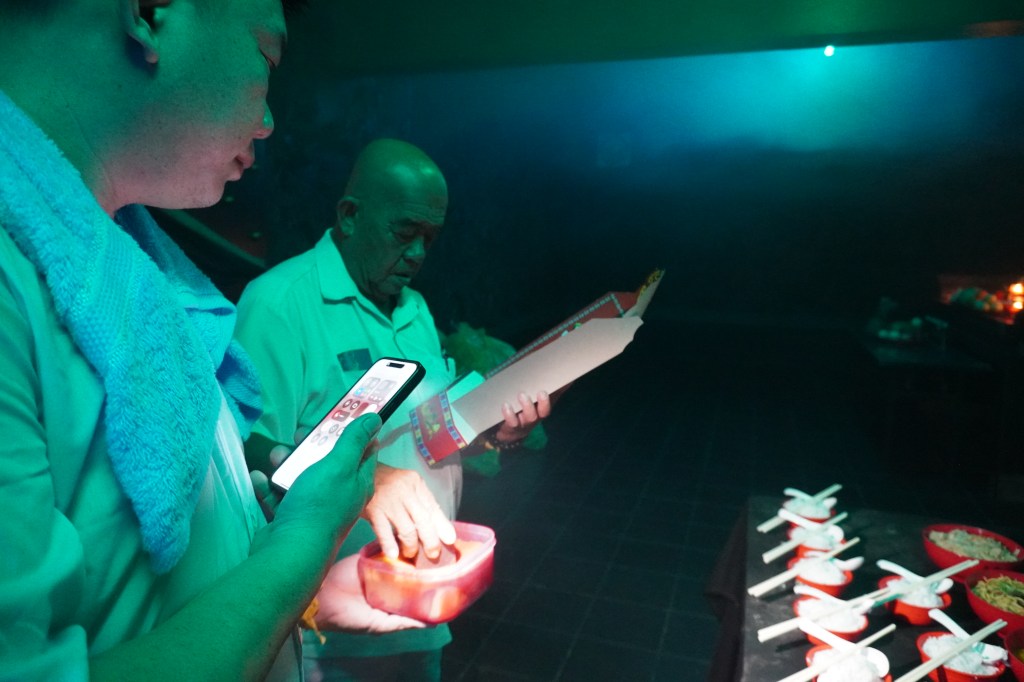
Volunteers prepare vegetarian food, incense paper, beverages, and pastries, laying out dishes and table settings for the Old Vegetarian Friends.
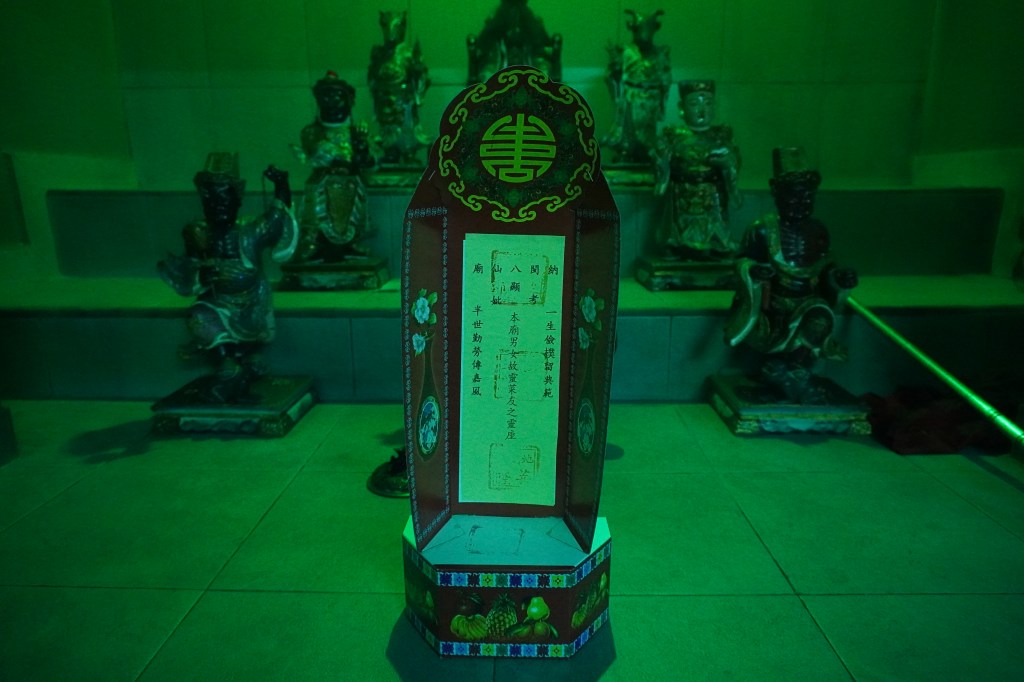
A spirit tablet is prepared and sealed with the temple’s seal to consecrate it for the occasion.
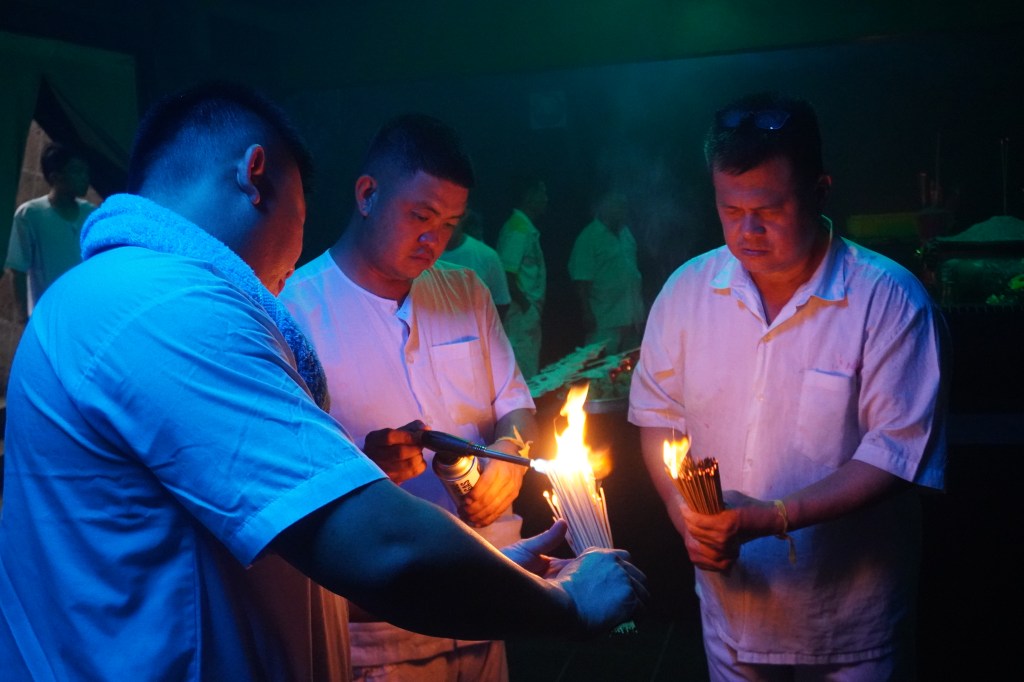
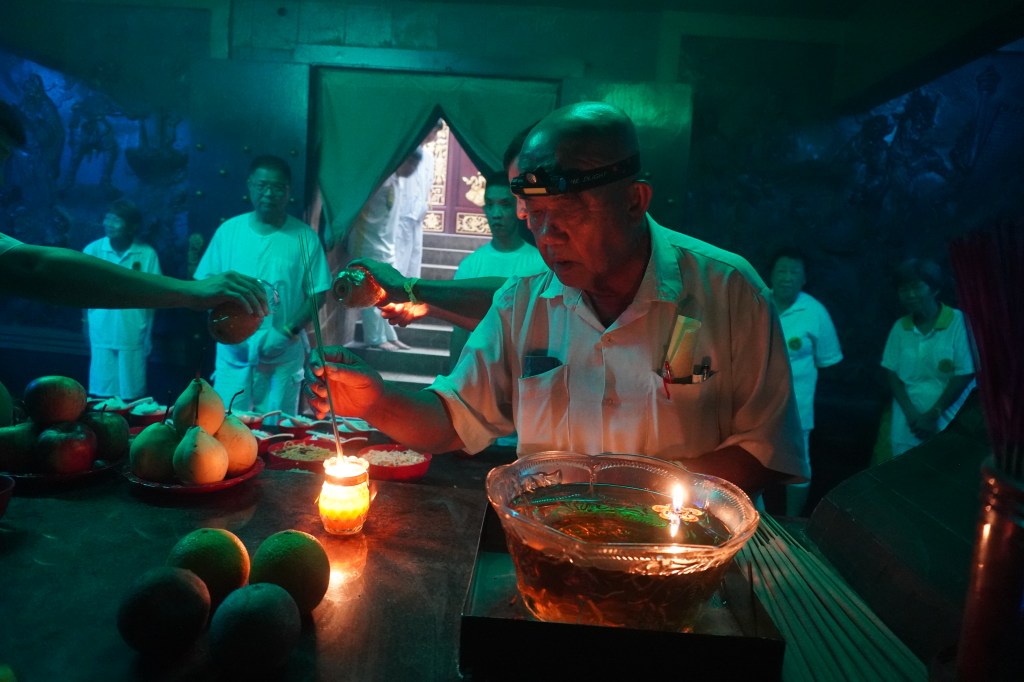
Devotees and volunteers present incense in remembrance of the Old Vegetarian Friends.
In the evening, a collective offering is held at the Gate of the Netherworld 地狱门 in the temple’s basement, dedicated to deceased senior members of the community who had long observed the festival, known as Old Vegetarian Friends 老菜友. Vegetarian observance and dress discipline form a central component of the Nine Emperor Gods Festival, and many of these individuals—both during their lifetimes and through extended periods of residence at the temple—had adhered strictly to vegetarian diets, all-white attire, and the ritual conventions of the festival. Although they are no longer present, they continue to be remembered as part of the temple community. For this occasion, a spirit tablet is erected in their honour, and elaborate vegetarian offerings are laid out with full table settings. Living devotees present their respects by offering incense, affirming continuity between past and present members of the ritual community.
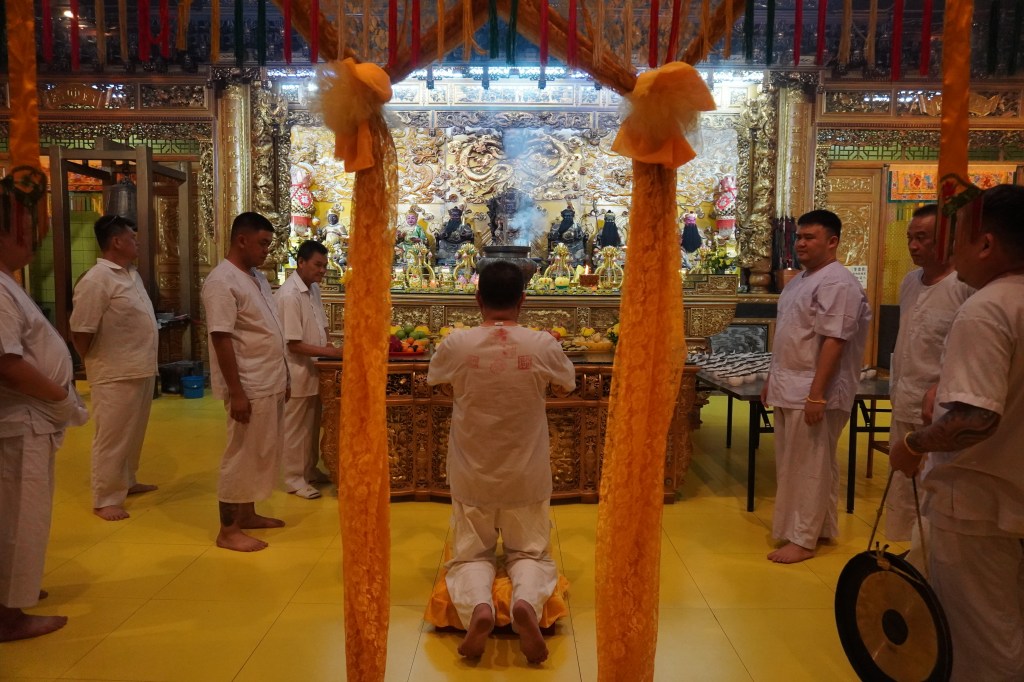
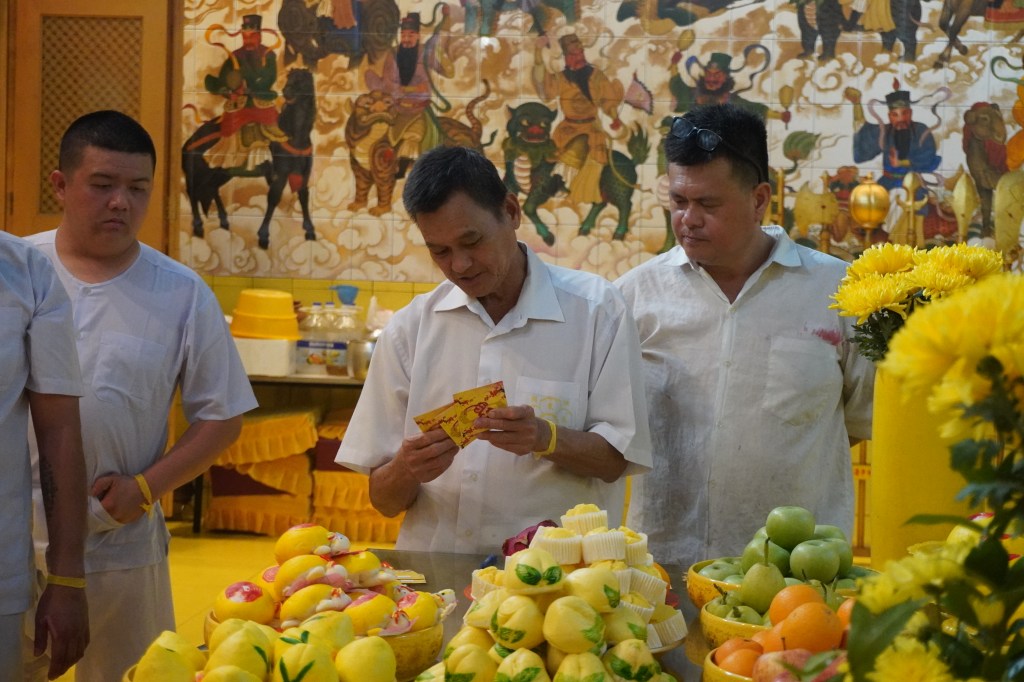
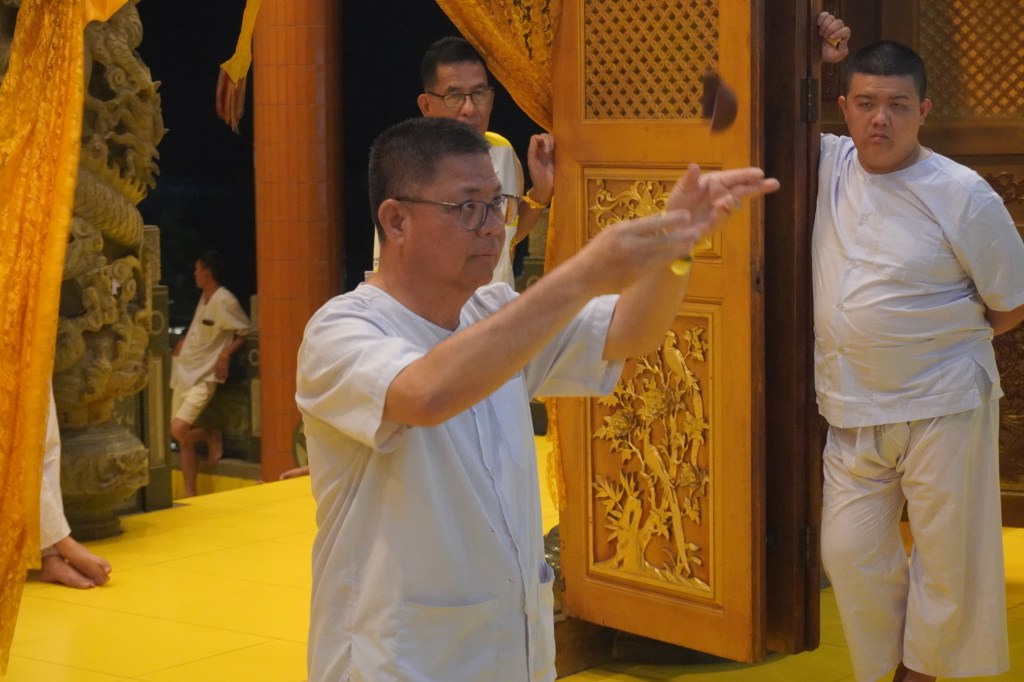
Temple leaders witness and tally the divination results as the incumbent censer master casts divination blocks, with each anonymised name read aloud and the blocks passed over incense before being tossed.
Later that night, divination using divination blocks 筊杯 is conducted to select the principal and deputy sponsors of the following year’s Universe Dipper Bucket 乾坤斗. As is common in many Nine Emperor Gods temples, nominees are anonymised and selected through consecutive divination throws before the Nine Emperor Gods. Those who receive the highest number of consecutive affirmative responses are appointed to the roles. In 2025, the individual selected as the principal censer master 正乾坤斗福主 was the wife of the temple’s vice chairperson, having obtained five consecutive affirmative throws. As service in the Sacred Virtue Palace is restricted to men, the ritual and practical responsibilities associated with this appointment were undertaken by her husband, who himself received three consecutive affirmative responses.
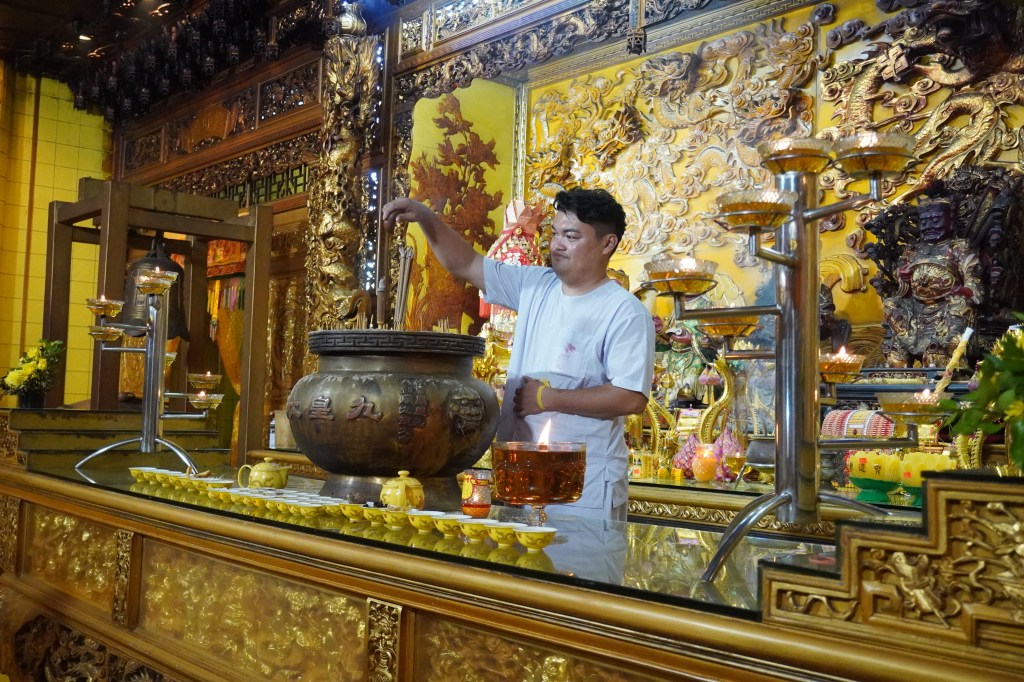
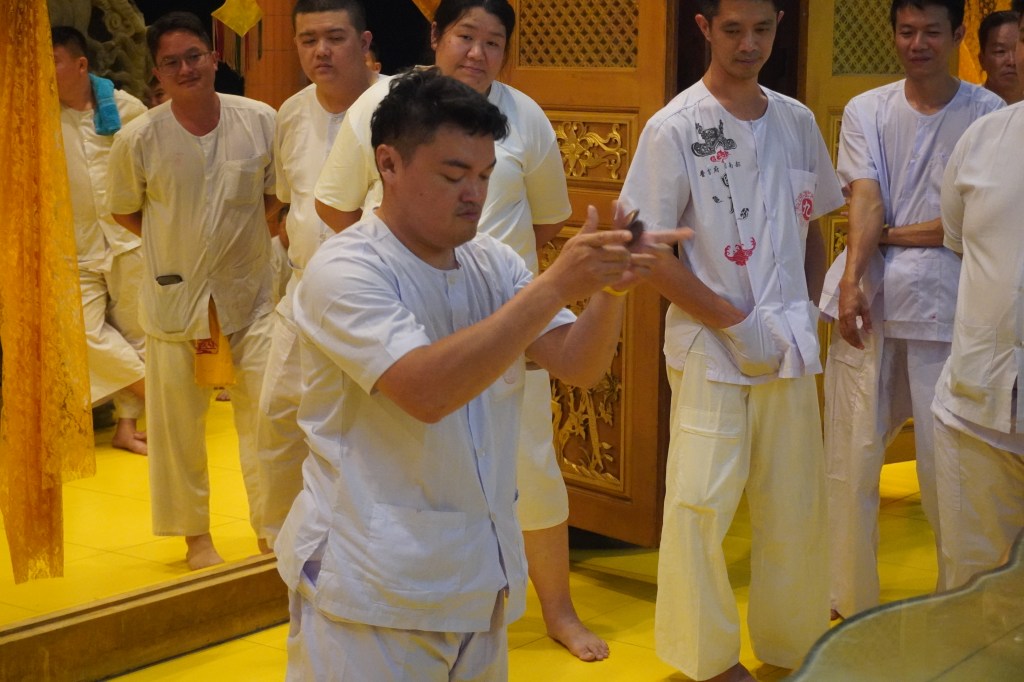
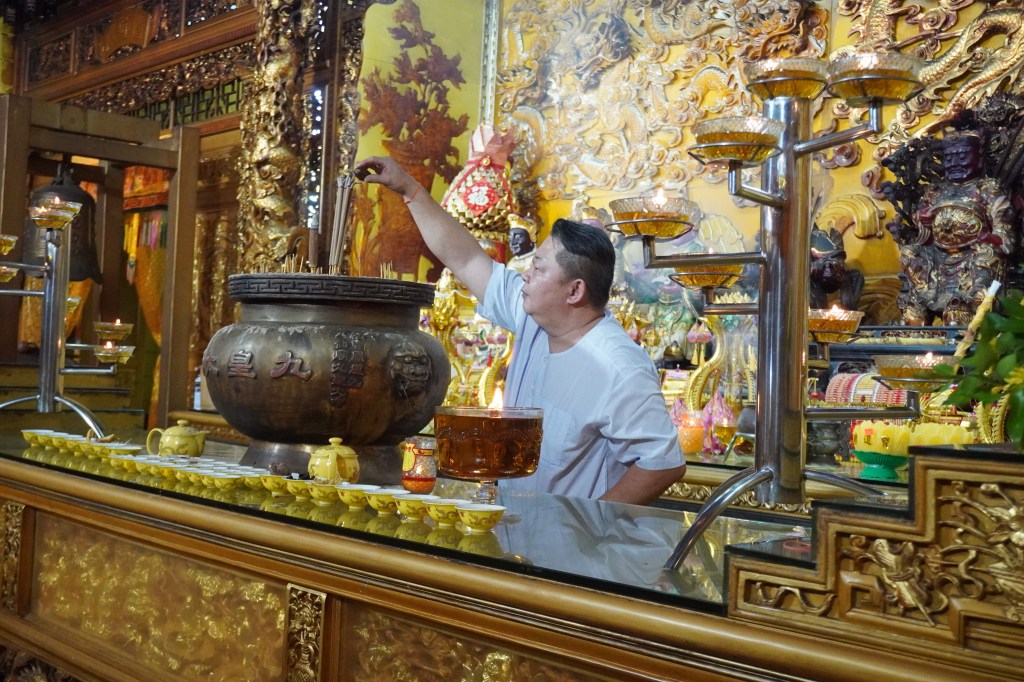
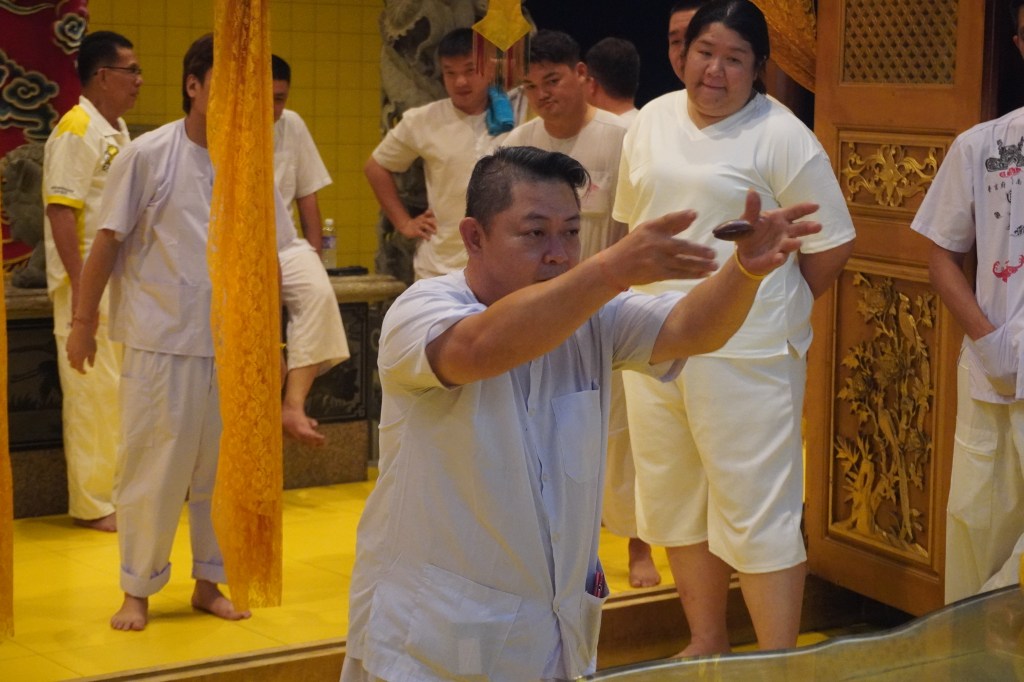
Devotees aspiring to serve the Nine Emperor Gods in the Sacred Virtue Palace pass the divination blocks over incense and cast them for approval.
Devotees were also permitted to submit their own names for nomination, determined through the tossing of divination blocks, to serve in the Sacred Virtue Palace for the coming year. Entry is structured around a regularised regime of participation, with members attending on four fixed days each lunar month (first, third, fifteenth, and seventeenth). Vegetarian observance begins after midnight, followed by early morning ritual duties at approximately four-thirty, after which participants return to their ordinary routines. Continued eligibility depends on meeting a minimum of twenty-one attendances within the year. This role entails adherence to vegetarian observance and disciplined conduct while attending to the deities. In 2025, only one individual successfully secured this appointment.
11. Crossing the Pass of Peace and Longevity, 24 October 2025 (Fourth day of the ninth lunar month)
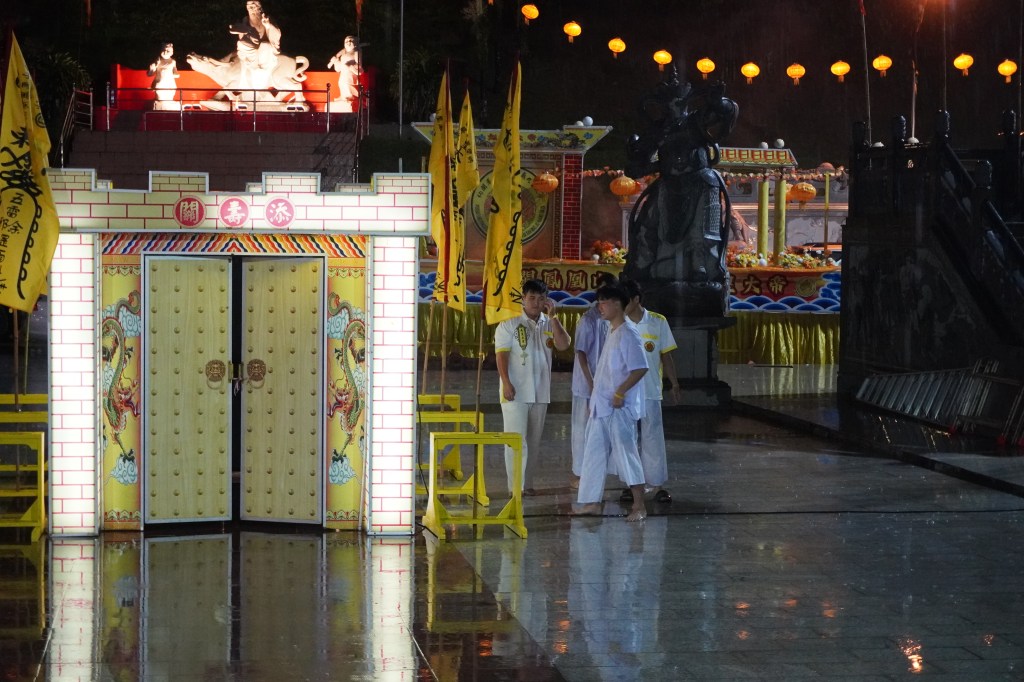
Volunteers conduct a final inspection of the Pass structure and switch on the lights in anticipation of the ceremony.
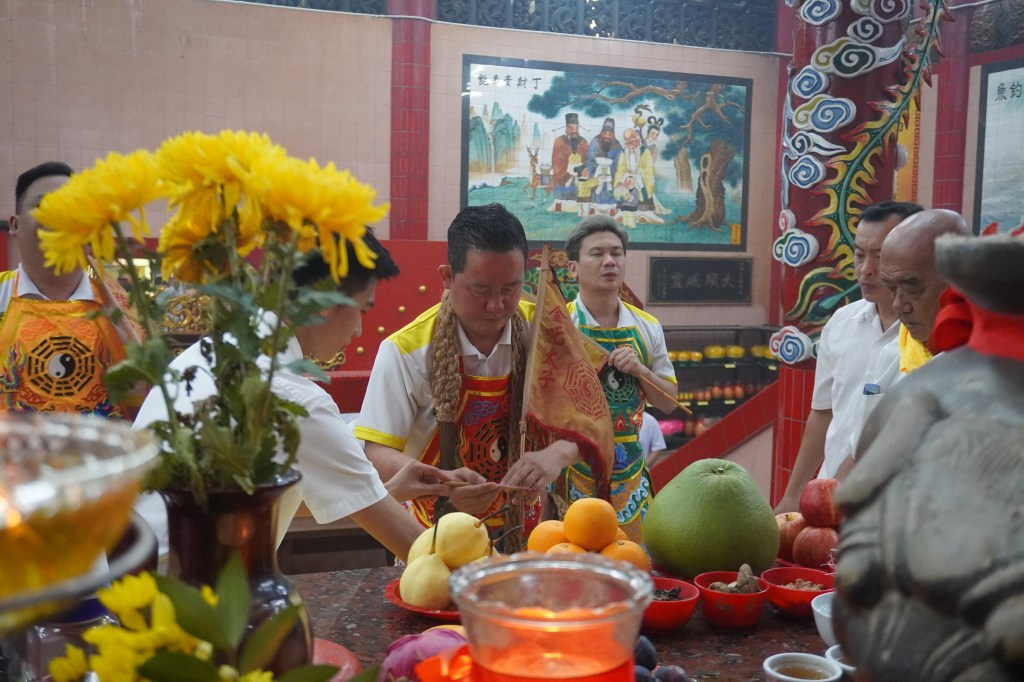
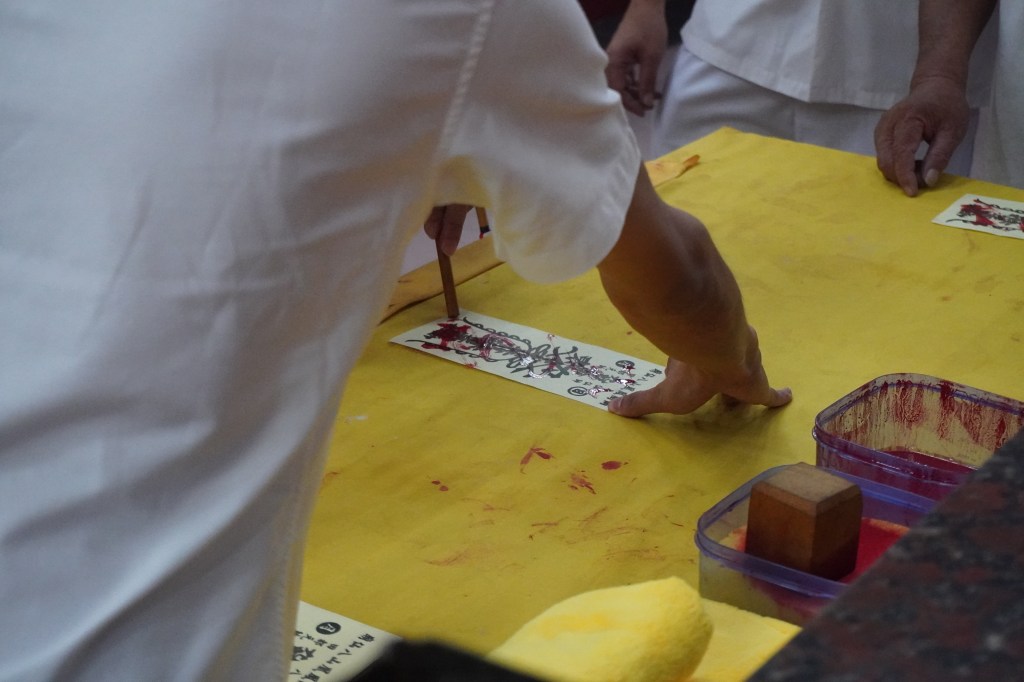
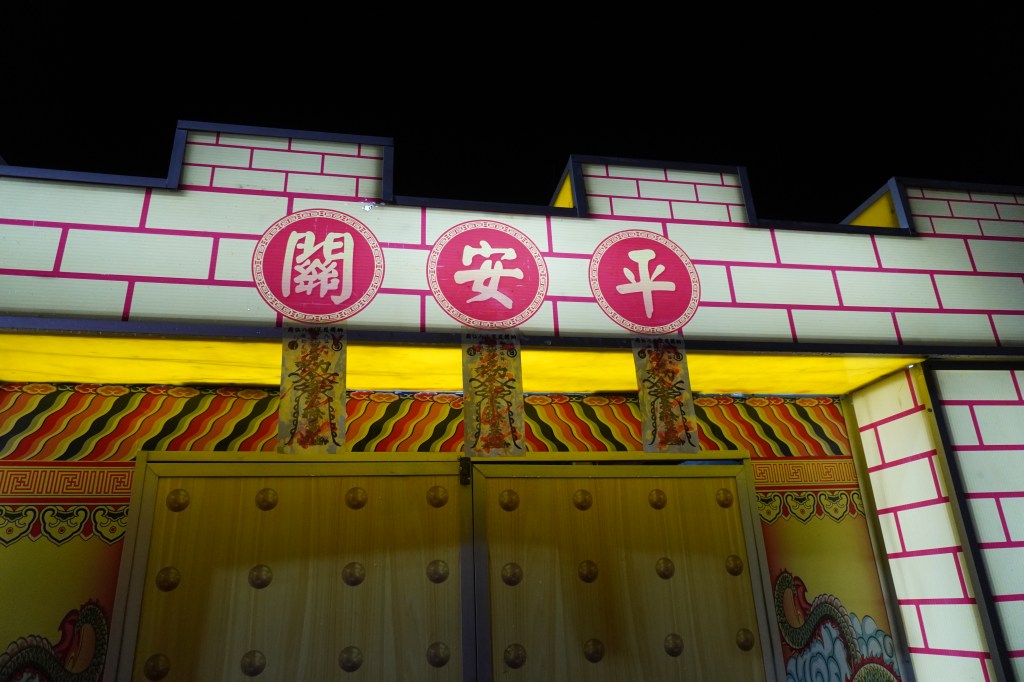
Through the spirit mediums, talismans are issued and affixed to the entrance and exit to consecrate the Pass.
In the evening of the fourth day of the ninth lunar month, devotees are led through the Pass of Peace and Longevity Crossing ritual 过平安添寿关, one of the Festival’s most widely anticipated rites. This ceremony focuses on personal well-being, protection, and the extension of longevity, and is officiated by three spirit mediums. The ritual begins in the main hall with the consecration of talismans—yellow paper strips marked with the temple’s name and principal deities—performed by the spirit mediums. At their instruction, the temple’s portable altar dedicated to the Five Encampments of Spirit Soldiers 五营将军 is moved into position. On this occasion, the rite is further overseen by three martial deities—Jin Zha 金吒, Mu Zha 木吒, and Nezha 哪吒—whose images are ceremonially brought from the main altar to the temple courtyard to preside over the proceedings.
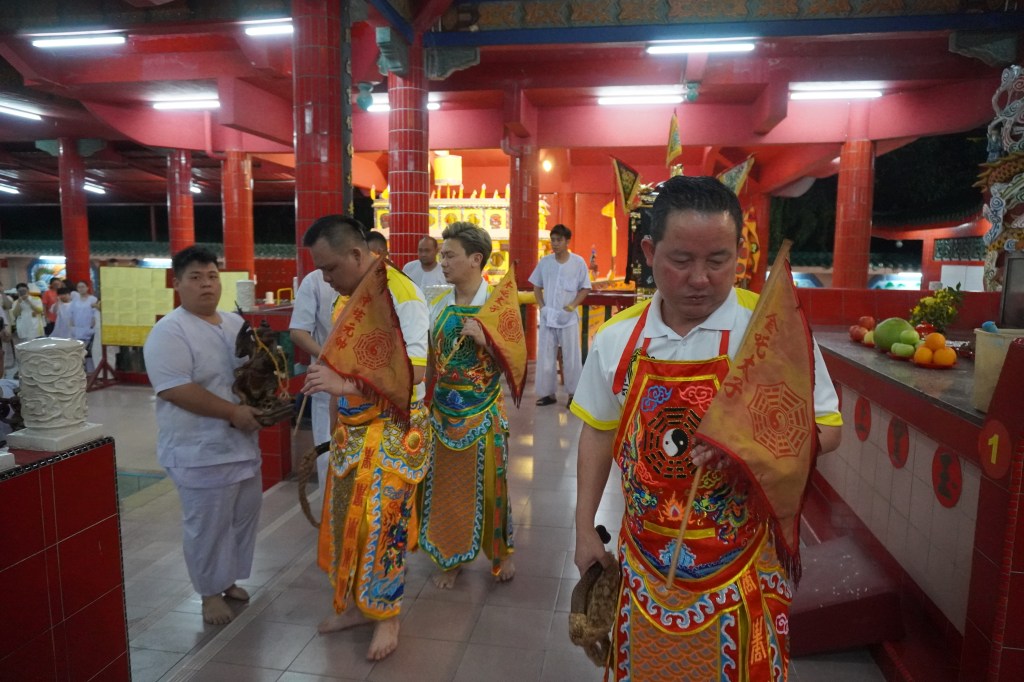
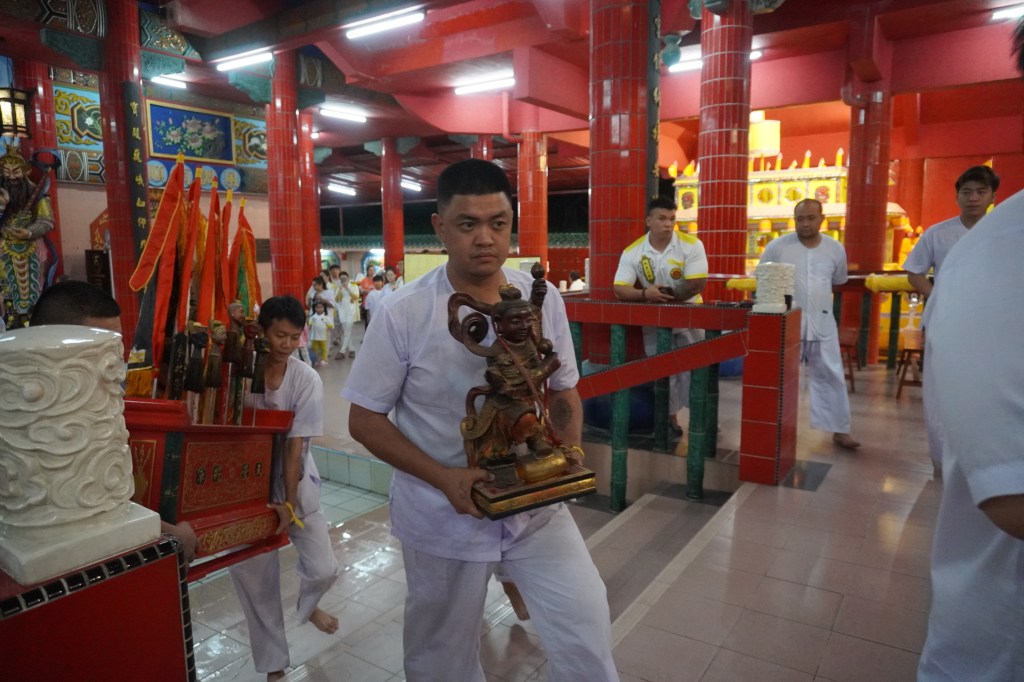
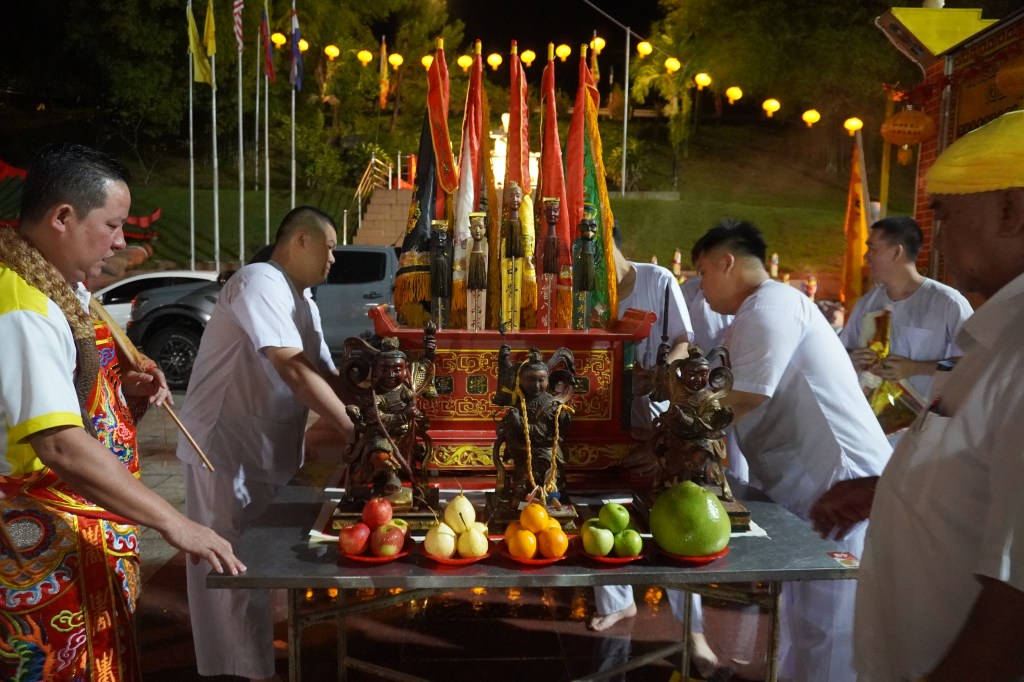
Images of the three martial deities and the Five Generals are installed on a temporary altar overlooking the courtyard.
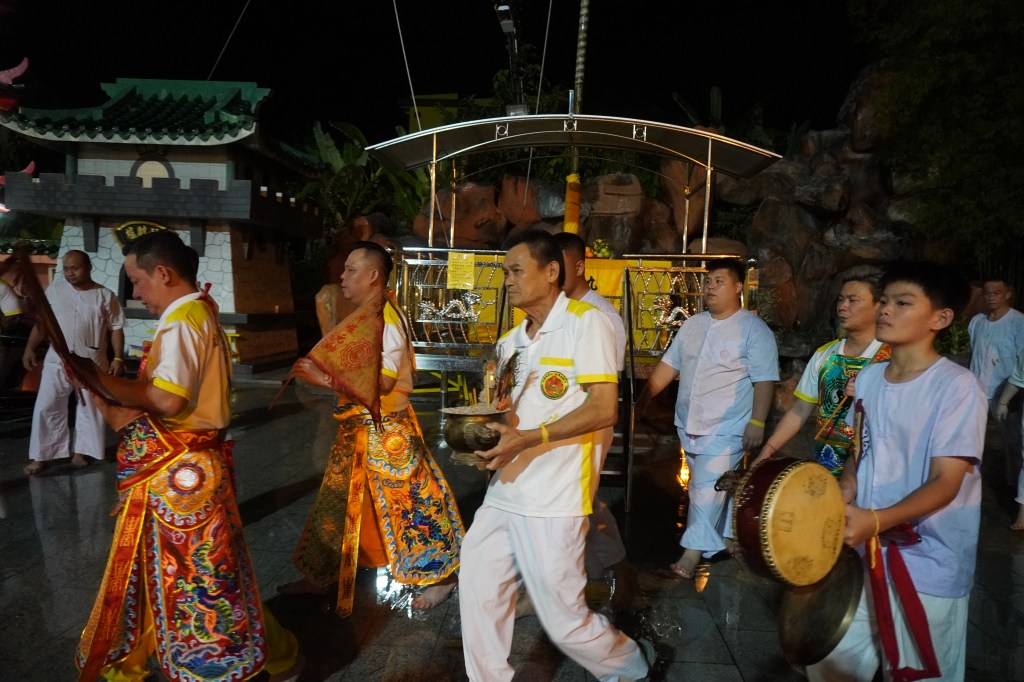
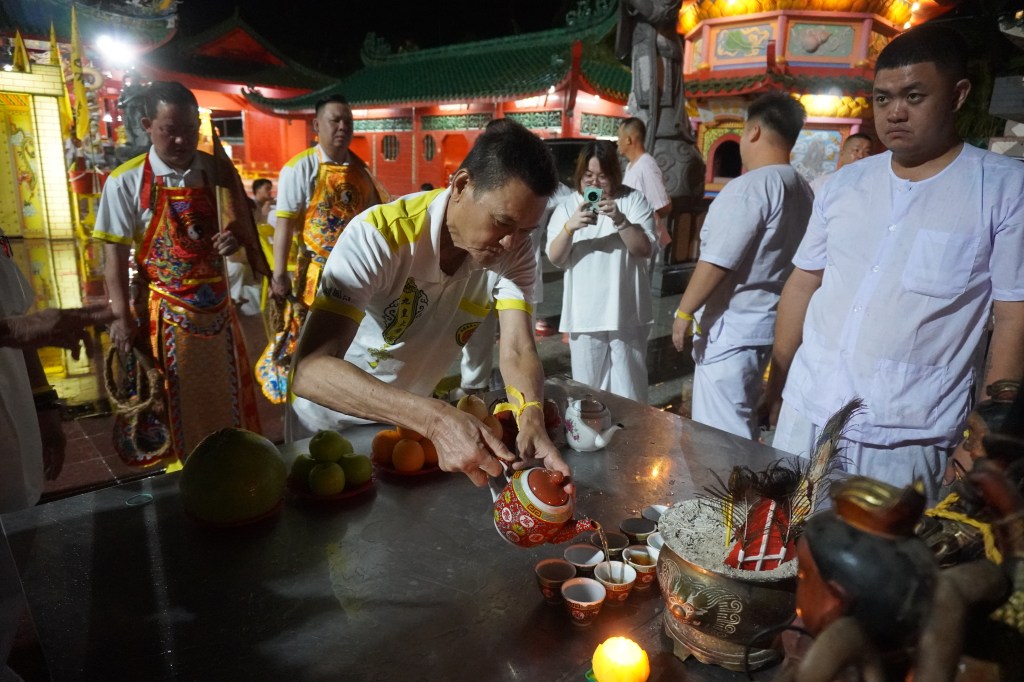
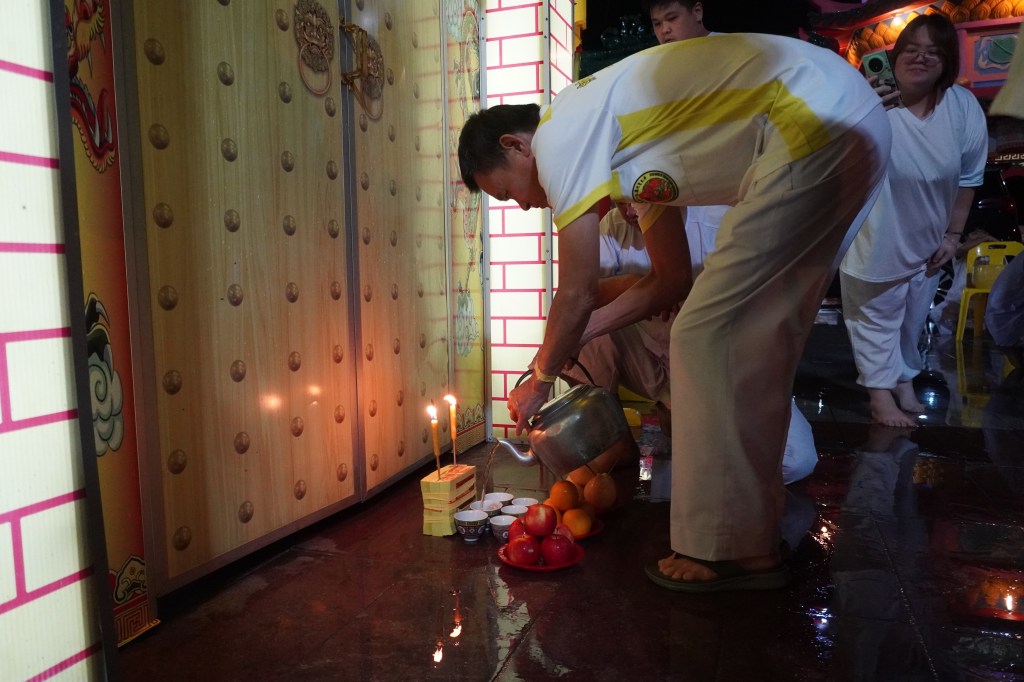
The incense censer from the Hall of Martial Commemoration is installed before the altar, with offerings, incense, and candles presented.
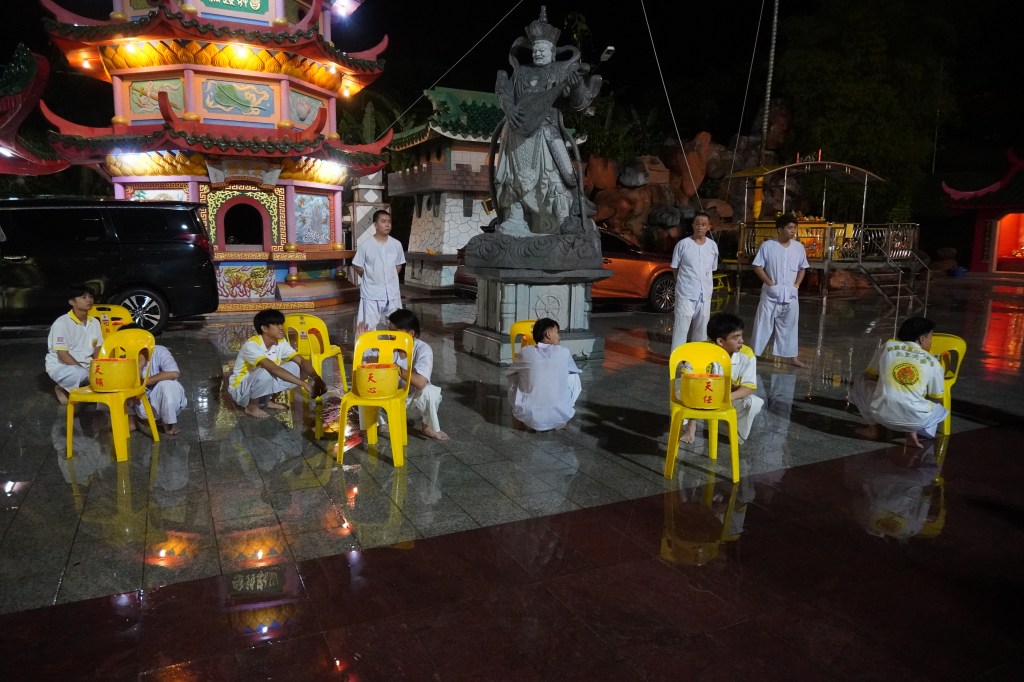
As in the Rewarding the Spirit Soldiers ritual, the incense censer associated with the spirit soldiers is invited before the shrine, positioned directly in front of the Pass of Peace and Longevity structure. Command flags bearing the temple’s name are relocated to the courtyard, framing a group of fourteen male volunteers arranged symmetrically on either side. Each volunteer is responsible for a single oil lamp housed within a Dipper Lamp bucket, together forming a constellation-like arrangement that guides the ritual flow. Devotees are organised into a long queue and proceed through the rite in stages. Each spirit medium performs a distinct role: one clears and marks the ritual path with measured cracks of a ritual whip at key junctions, another leads the procession through the structure, while the third guides devotees from the rear, ensuring orderly movement. Temple leaders and senior members at the head of the queue hold the deity’s ritual whip as they are led through the temple compound in a slow, snaking motion that traces the pattern of the lamps. As devotees pass each lamp, they deposit coins into the buckets, symbolising the offering of burdens and the accrual of renewed fortune. Upon exiting the pass, a seal bearing the imprint of the Nine Emperor Gods is pressed onto their clothing, signifying divine protection.

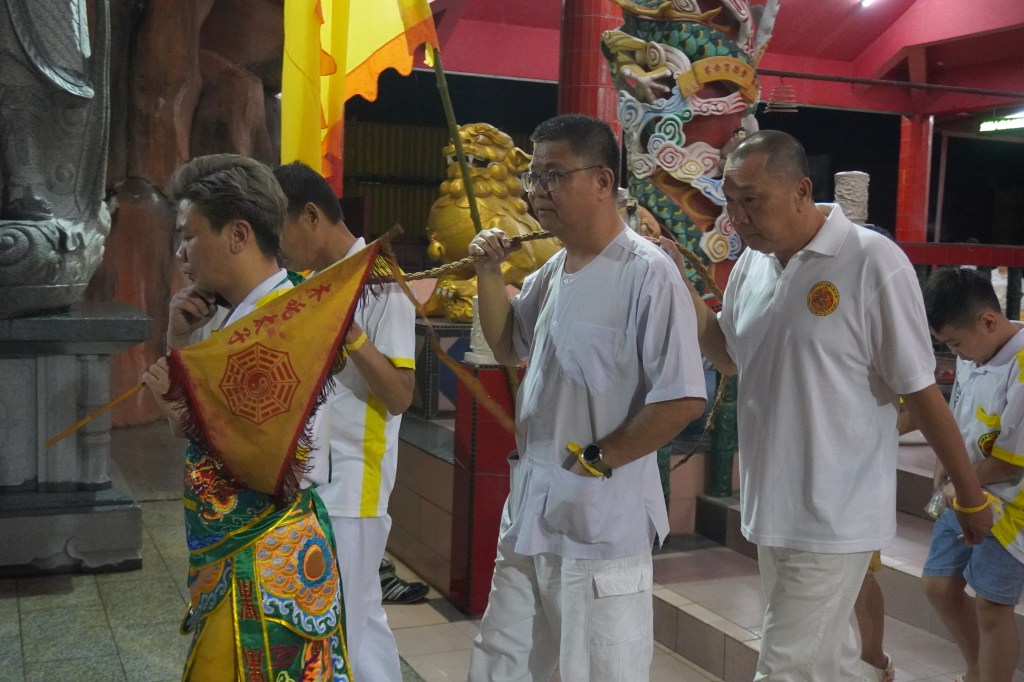
Participants move through the Pass in a slow, winding line, guided by holding the spirit medium’s ritual whip.
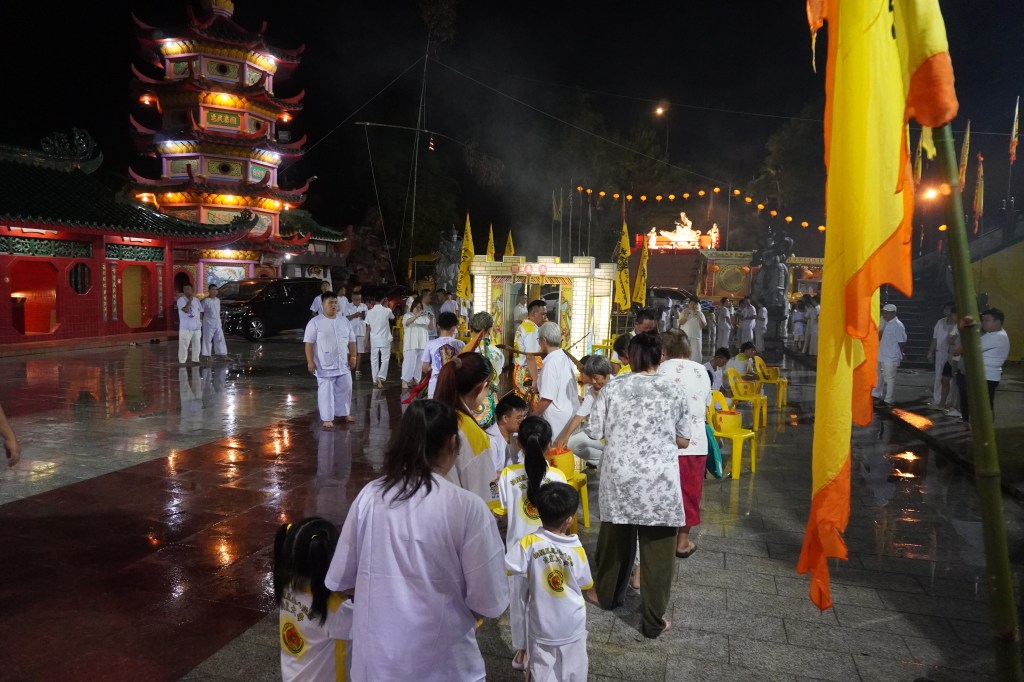
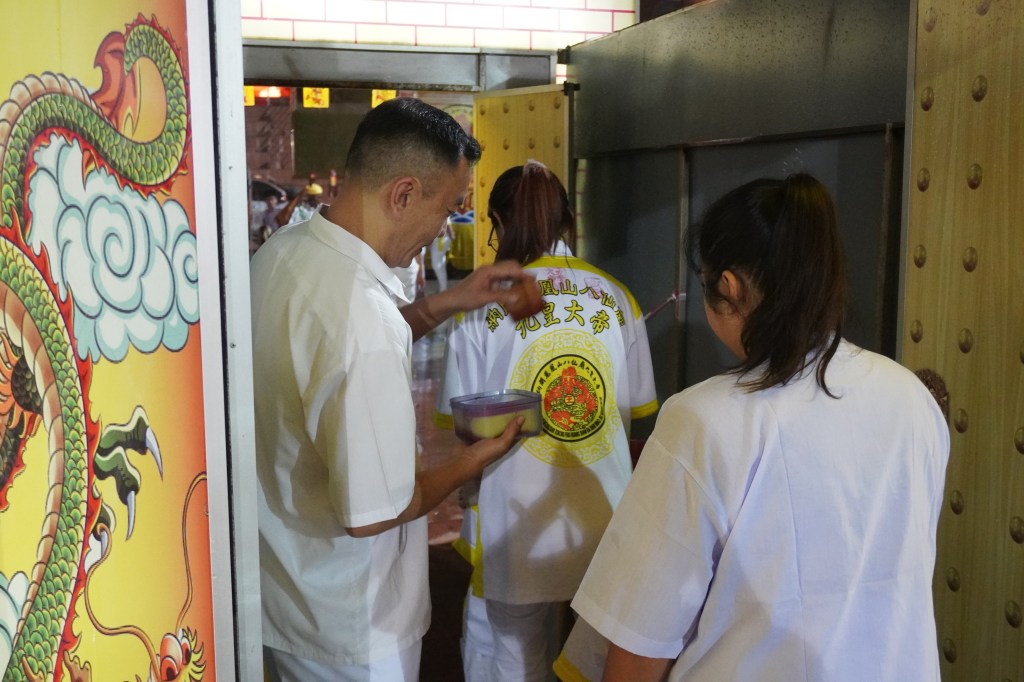
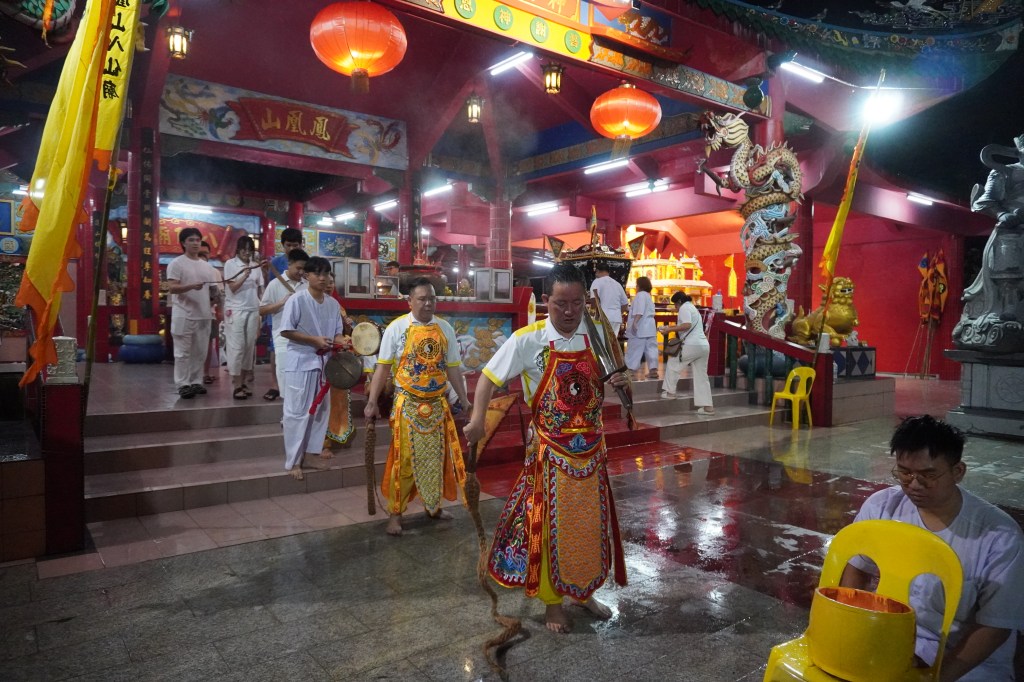
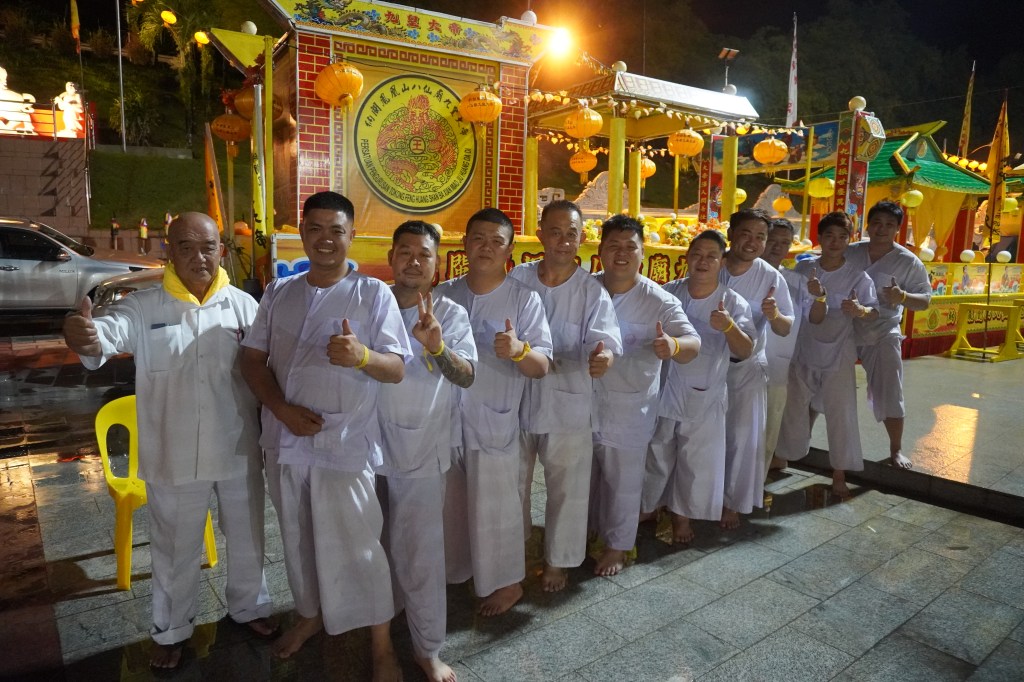
Due to the large crowd, the rite continues in many batches, with temple volunteers passing through last.
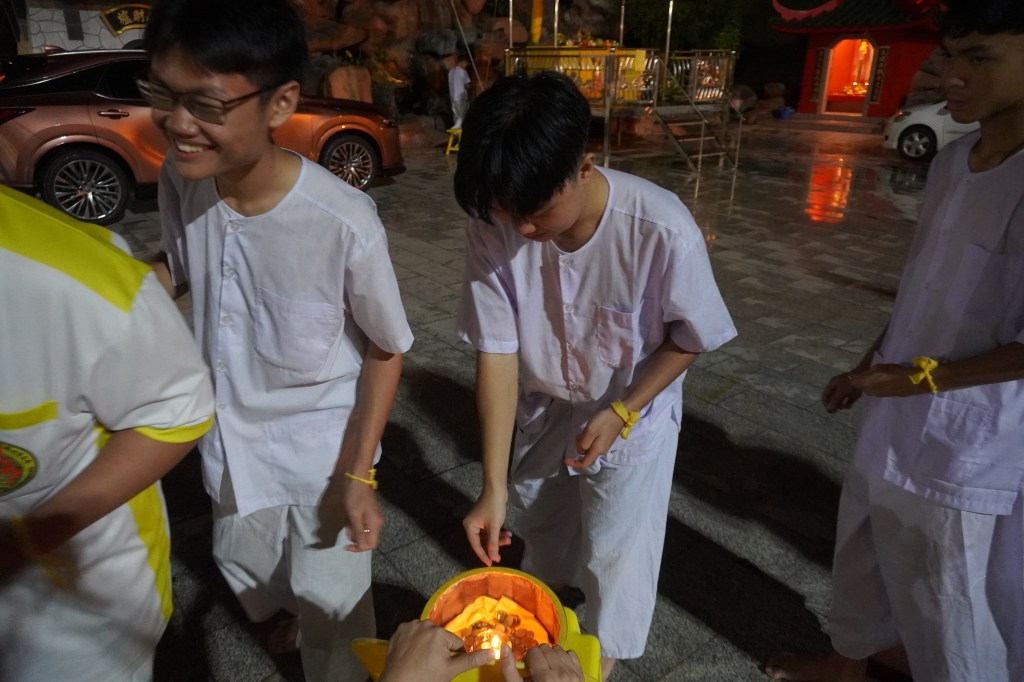
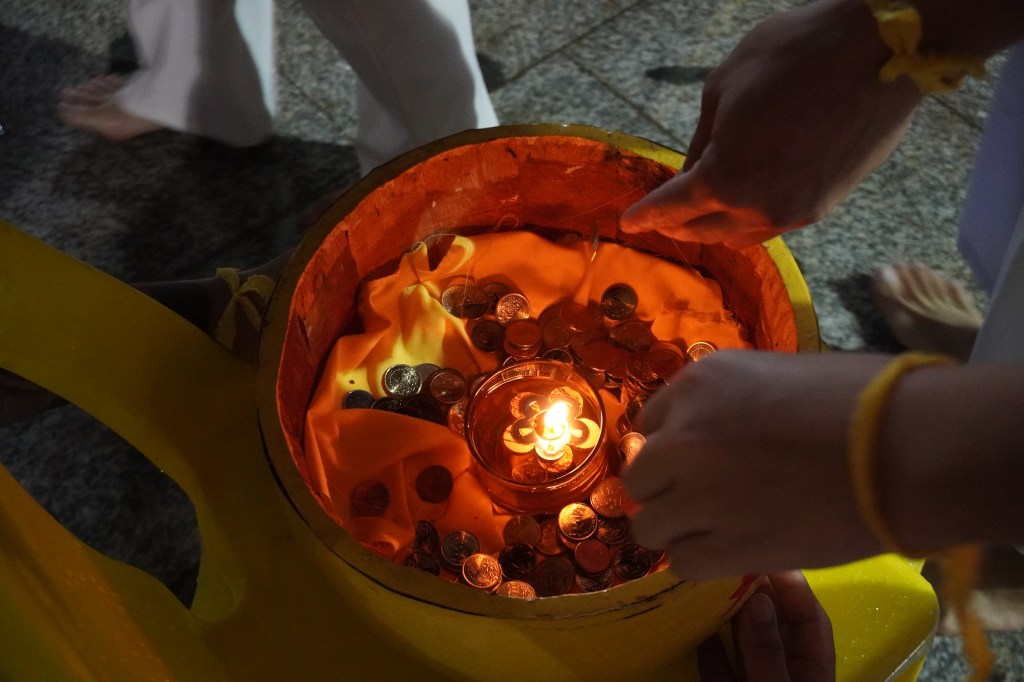
Devotees deposit coins at each lamp as they pass.
The ritual continues until all participants—young and old, volunteers and visitors alike—have passed through, often in multiple batches that stretch late into the night. Once the final group has completed the crossing, the pass is formally sealed and deconsecrated. This is marked by the closing of the structure’s doors, the removal and tearing of talismans affixed to the entrance and exit, and the transfer of the still-burning fourteen lamps back into the main altar. The temporary structure is then dismantled. As the courtyard returns to an open space, preparations quietly begin for the next stages of the festival, with volunteers already turning their attention to upcoming events in the days ahead.
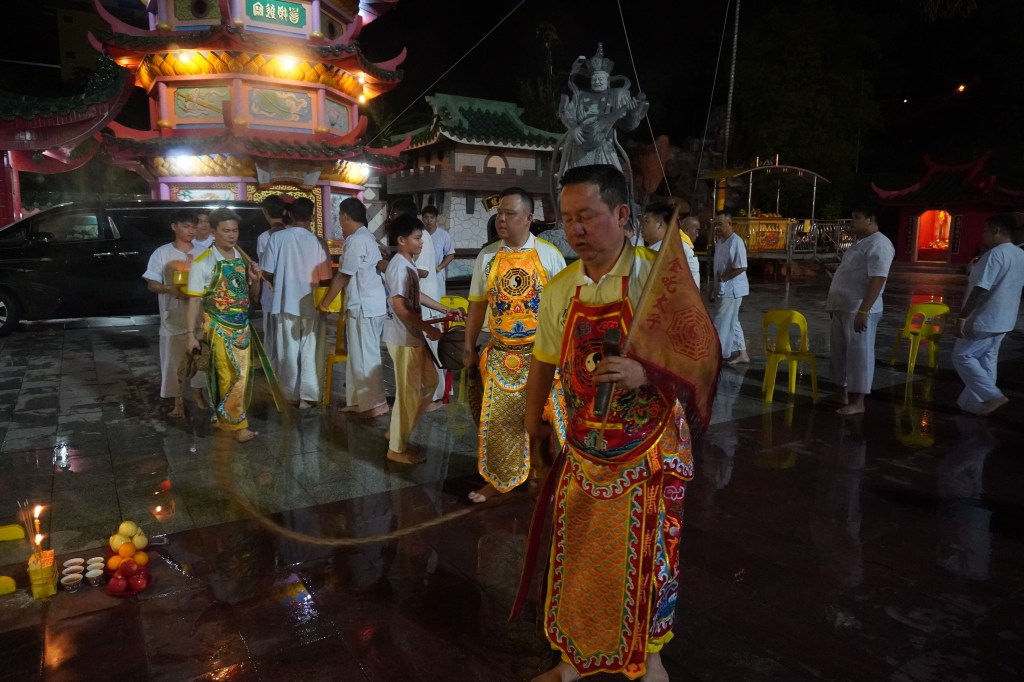
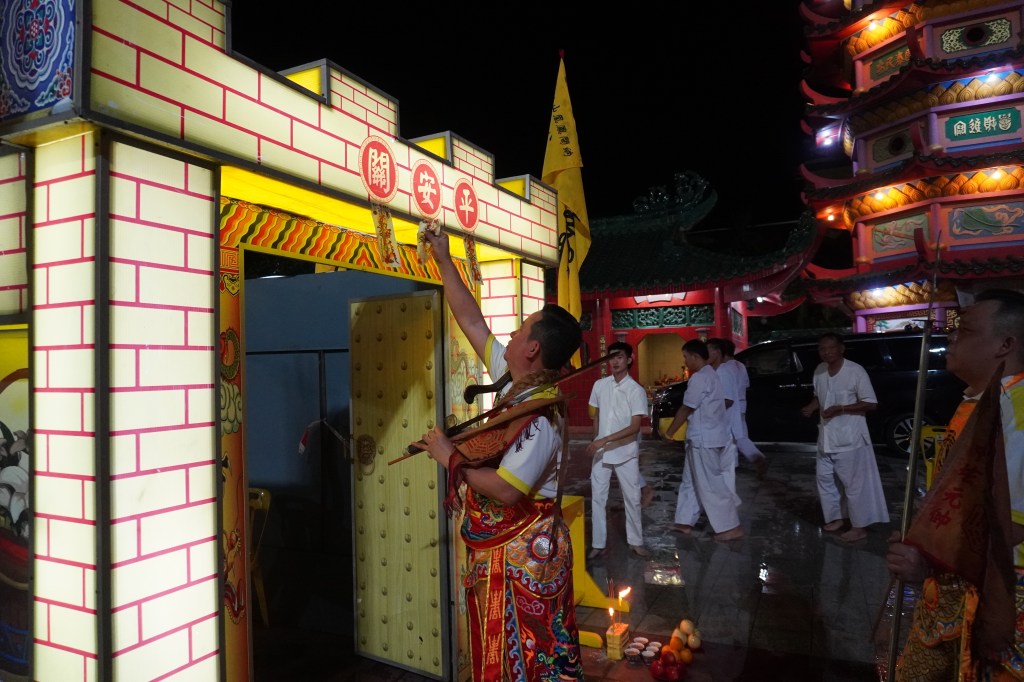
The deities lead the return of the lamps, remove the affixed talismans, and formally close the Pass.
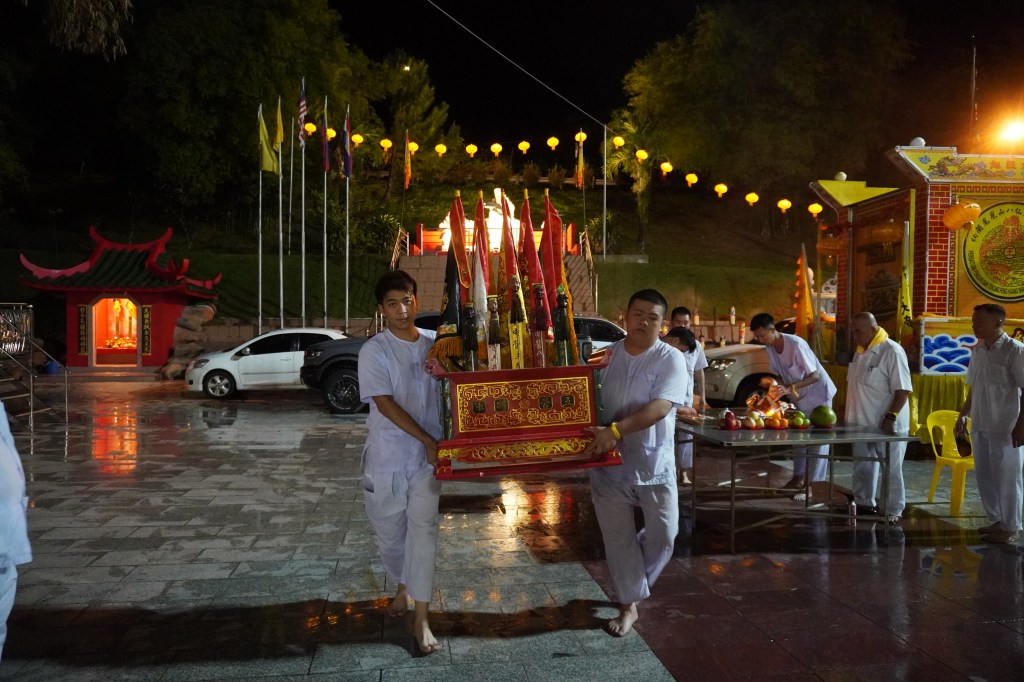
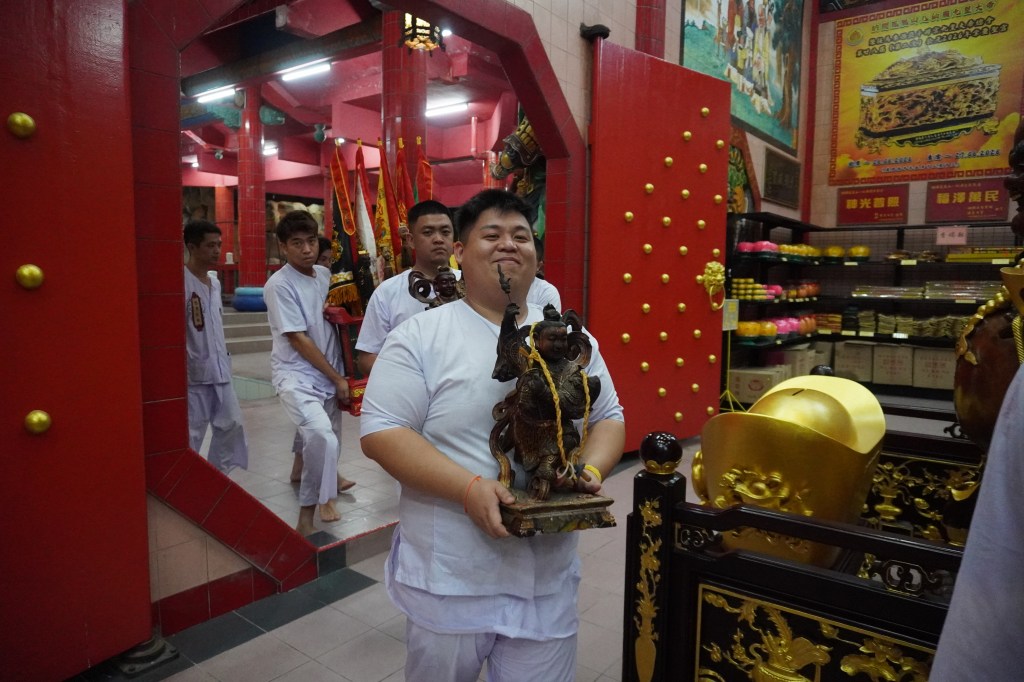
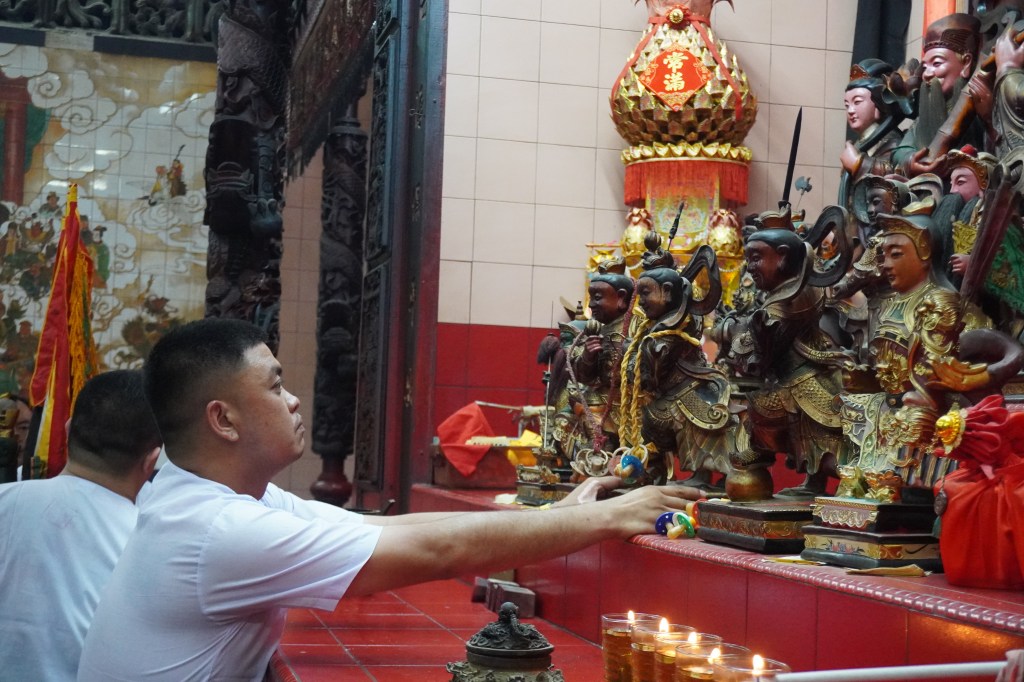
Volunteers assist in returning the Five Generals altar and deity images to their original locations.
[Continued on page 2, please click the hyperlink below]
 Nine Emperor Gods Project 九皇文化计划